Verification Codes
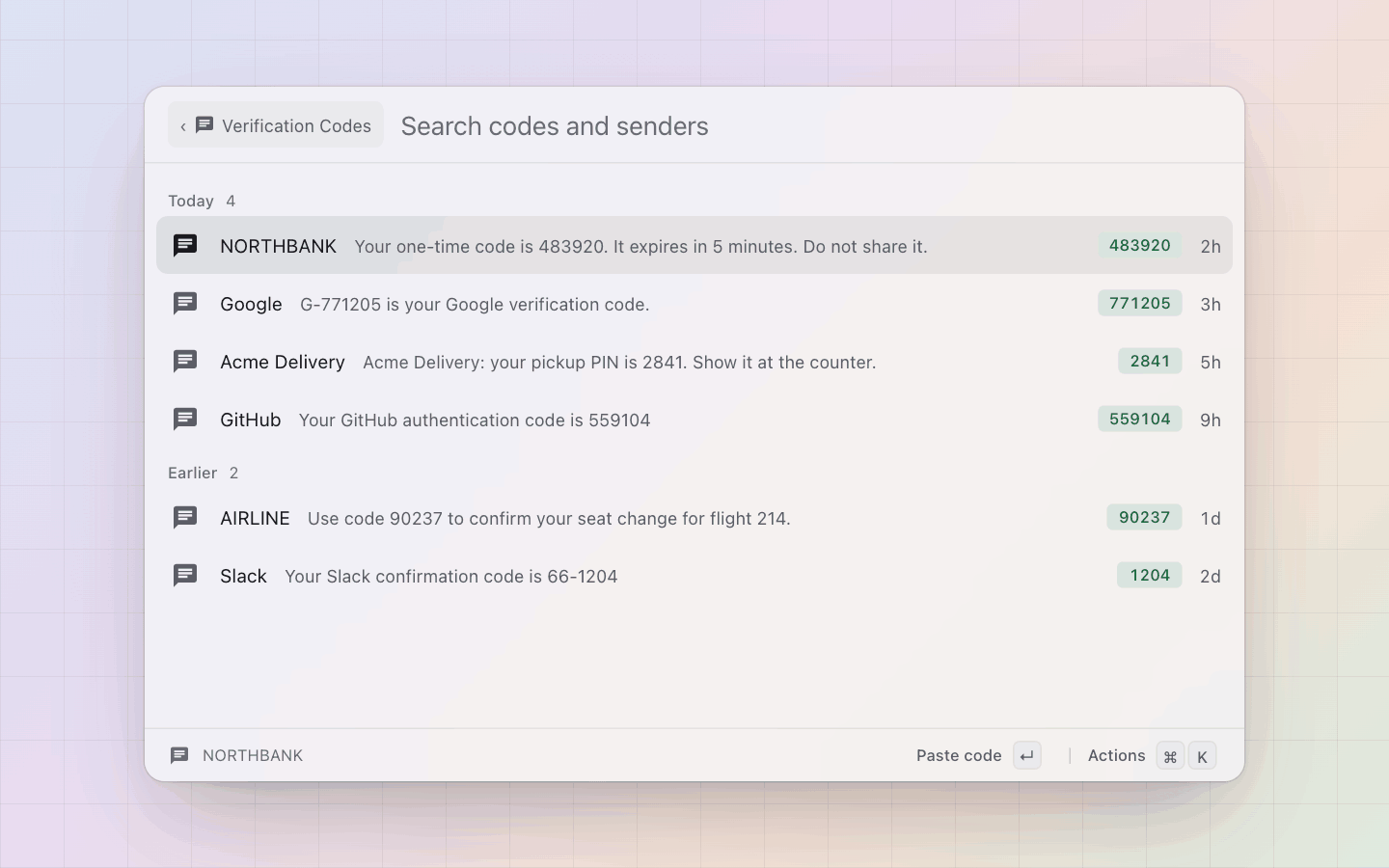
The one-time codes in your recent text messages, newest first; enter pastes the code where you were.
 palv0.1.0IntegrationbundledMenu bar: Latest code
Ships inside pal. Installing puts an editable copy ahead of the bundled one.
Menu bar 1




What it does
Verification Codes
One-time codes out of your recent text messages, read straight from
Messages' database (~/Library/Messages/chat.db, read-only, one SQLite
query per listing). The last hours of incoming messages are scanned; a
message counts when it talks about a code (code, kod, şifre, OTP, PIN,
parola, passcode, verification, doğrulama, código, token and so on) and
carries a run of 4 to 8 digits that is not part of an amount, a date, a
time or a phone number; Google's G-123456 is taken by its digits.
The row is the sender as Messages knows it (a shortcode like NORTHBANK,
an alphanumeric originator, a number or an email; a number or an email
that is in Contacts shows the contact's name, read from the AddressBook
database the same permission covers), the message text is the subtitle,
the code is a green tag on the right with how long ago it arrived.
Sections are Today and Earlier, newest first. A live palette: listed
again on every show, so the code that just arrived is at the top, and the
codes are root results while they are in the window (type the sender or
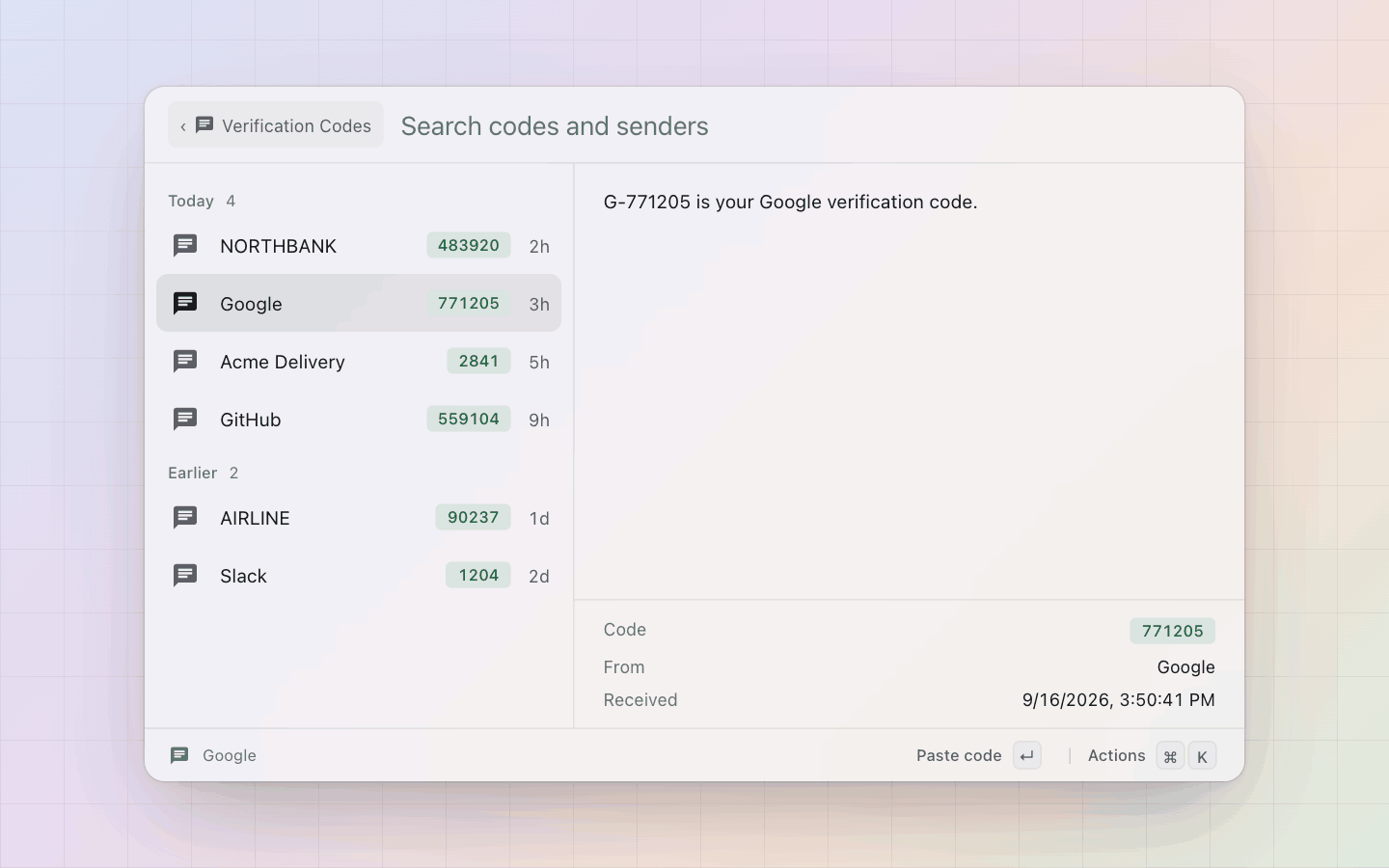
the code itself). The detail pane (cmd+i) has the whole message, the
code, the sender and when it was received.
Keyboard
| keys | action | what |
|---|---|---|
enter |
Paste code | hides, then pastes the code into the app that was in front |
cmd+c |
Copy code | copies the code |
cmd+shift+c |
Copy sender | copies the sender as Messages stores it (+1 555 0142, not the contact's name) |
Setup
Full Disk Access. Messages keeps the database behind it, and without it SQLite answers "authorization denied": the palette then has one row, "Full Disk Access needed", whose action opens System Settings, Privacy & Security, Full Disk Access. Add pal there and open the palette again. There is no other way to read Messages.
Paste is a synthesised Cmd+V, which macOS only delivers from a process on the Accessibility list; without it pal shows the system prompt once and a toast saying what to grant. Copying needs nothing.
A database SQLite reports locked (Messages writing at that moment) is
copied aside with its -wal and -shm and the copy is read, then
removed. A database that is not there ("No Messages database"), or any
other read error, is one inert row with the reason. Messages on Ventura
and later keeps many texts in attributedBody rather than text; both
are read.
Settings, [extensions.otp]:
| key | type | default | what |
|---|---|---|---|
hours |
number, 1 to 720 | 24 |
How far back to scan. |
senders |
list | [] |
Senders never listed, as Messages shows them (AKBANK, a number, an email); case does not matter. |
db |
path | ~/Library/Messages/chat.db |
The database to read. ~ is expanded. |
contacts |
path | empty | An AddressBook-v22.abcddb for names; empty reads every source under ~/Library/Application Support/AddressBook. |
The bar item Latest code puts the newest code on the strip for a minute after it arrives (green, the sender and the message as its tooltip); a click copies it. Hidden the rest of the time.
What it does not do
- Codes from email, authenticator apps or the browser: only Messages (SMS and iMessage) is read.
- Codes without a keyword near them: a bare six-digit text is not listed, since it could be anything.
- Codes longer than 8 digits or shorter than 4, or spaced ones (
123 456is read as two numbers). - Delete or mark messages; the database is opened read-only.
Platforms
macOS only: the palette reads Messages, which Linux does not have (there the palette is one "Unavailable" row and the bar item is hidden). Needs Full Disk Access to read, and Accessibility to paste.
Palettes 1
-
Otp
otpliveCodes from the last day of messages, Today and Earlier.
- ↵Paste the code
- ⌘CCopy the code
- ⌘⇧CCopy the sender
Actions
- Paste codeHides, then pastes into the app that was in front.↵
- Copy code⌘C
- Copy senderAs Messages stores it.⌘⇧C
Settings
Extension, [extensions.otp]
hoursHow many hours of messages to scan for codes.
sendersSenders whose messages are never listed, as Messages shows them (a shortcode like AKBANK, a number, an email). Case does not matter.
dbThe chat.db to read. ~ is expanded.
contactsAn AddressBook-v22.abcddb whose names replace phone numbers; empty means every source under ~/Library/Application Support/AddressBook.
Defaults shown. Change them in pal's settings window or in the config file.