1Password
Your 1Password items through the op CLI: a password, username or one-time code onto the clipboard.
 palv0.1.0Integrationbundled
Ships inside pal. Installing puts an editable copy ahead of the bundled one.
What it does
1Password
Your 1Password items through the op CLI. One op item list --format json per listing, kept for ttl seconds so the vault filters and a
Refresh inside the ttl do not run the CLI (and its unlock prompt) again;
cmd+r past the ttl asks it again. No secret is ever in a row, the index
or a log: a pick runs op item get for that one field and puts the value
on the clipboard.
One palette, 1Password (items).
Rows
| part | what |
|---|---|
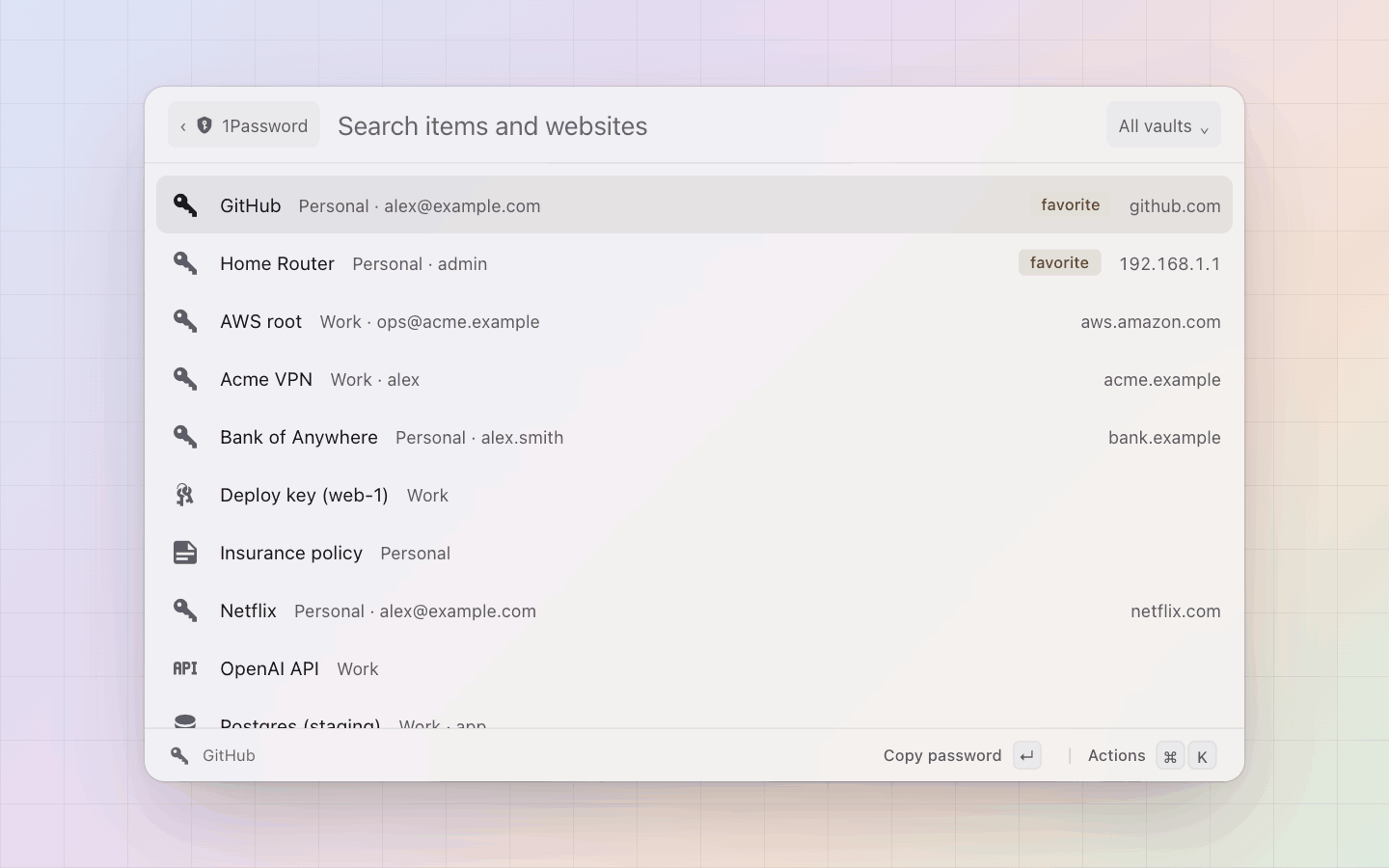
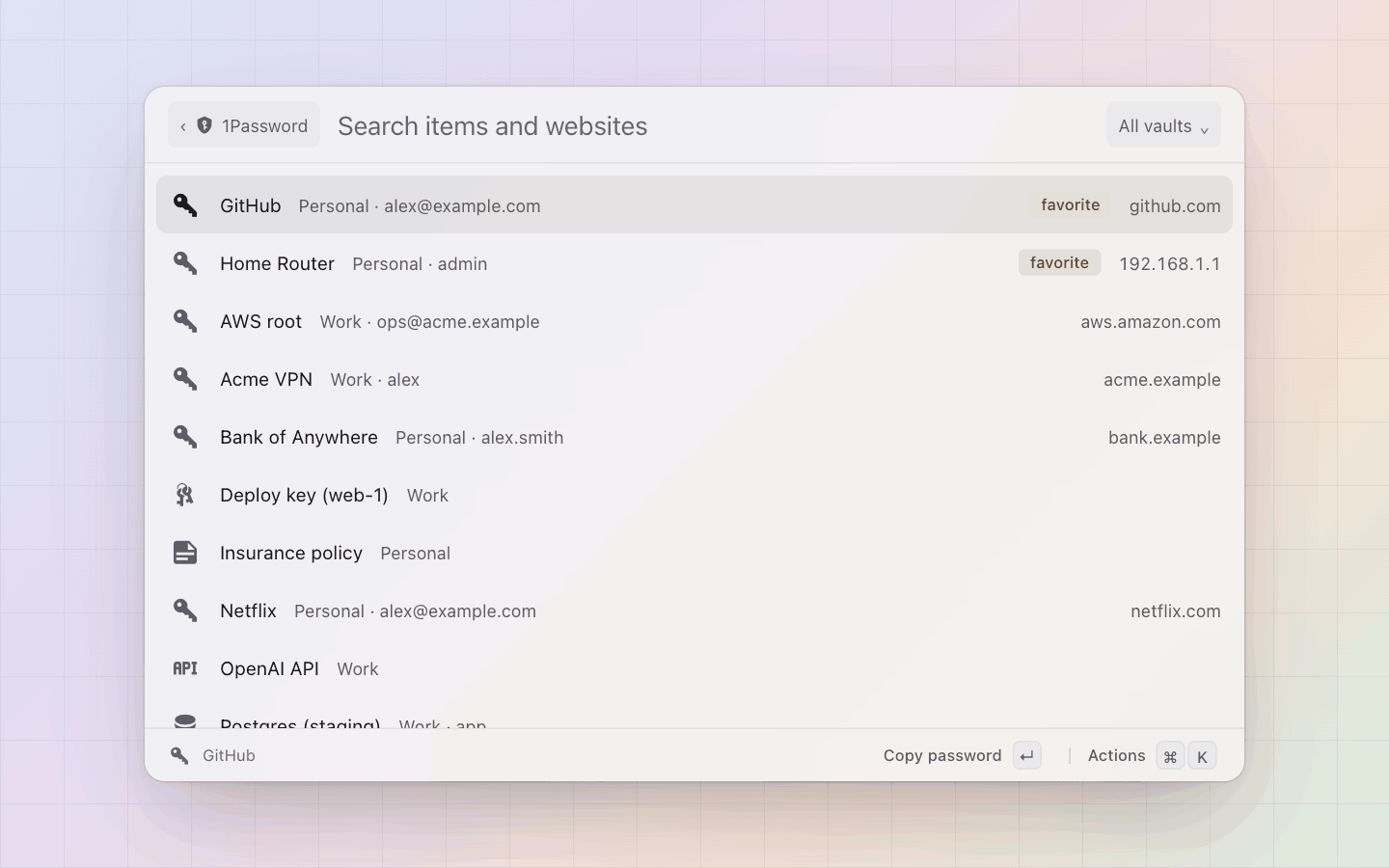
| icon | a glyph by category: login and password, secure note, card and bank account, identity, SSH key, API credential, server and database, and so on |
| title | the item's title |
| subtitle | the vault, then the username (Personal · alex@example.com) |
| accessories | favorite (amber) for a favourite, then the primary website's host |
| keywords | the website hosts, the username, the category, the vault and the tags, so github.com finds the login |
| detail pane | vault, category, username, the website as a link, tags and the update time (cmd+i) |
Favourites come first with their tag, then the rest by title. With
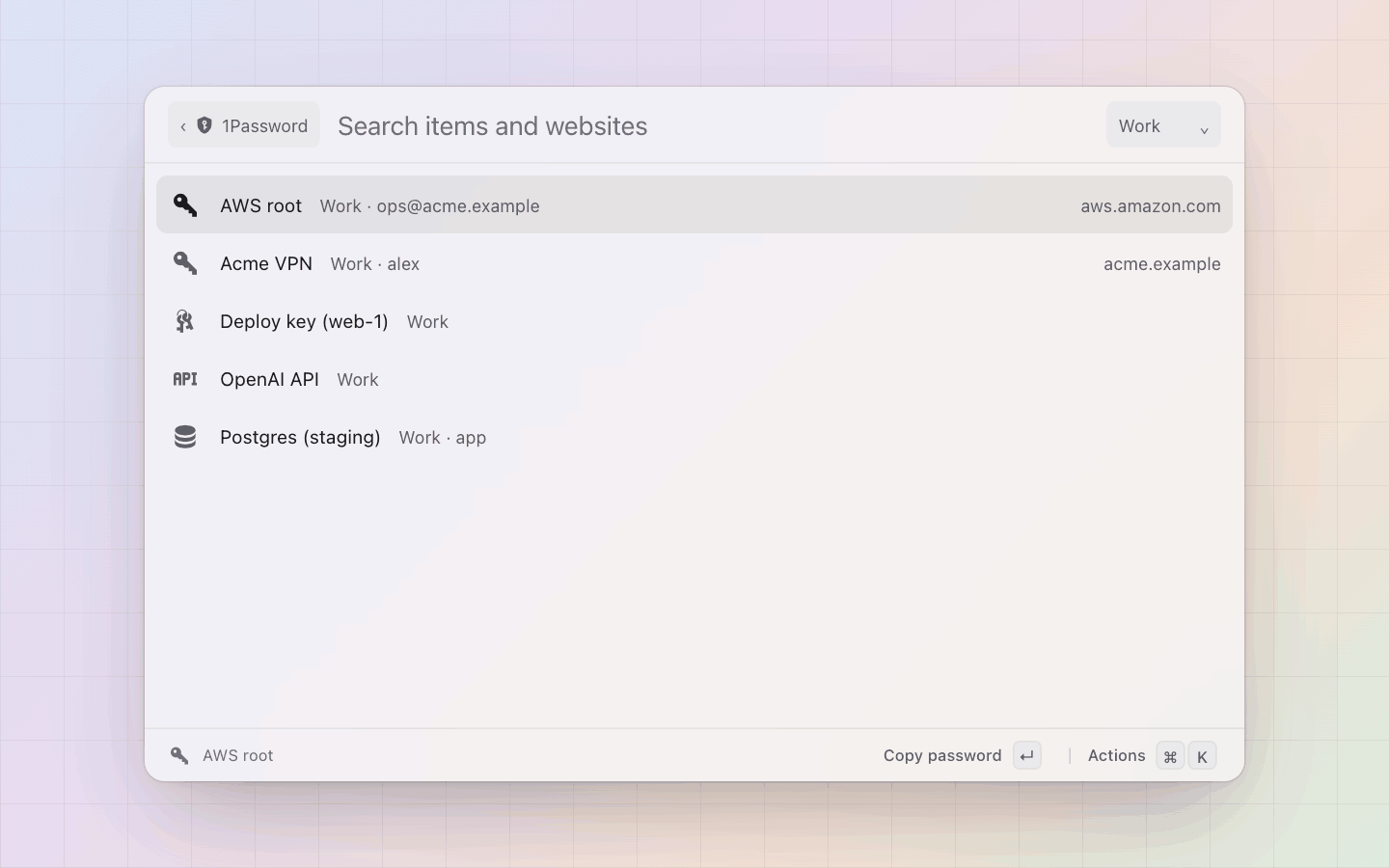
vaults set, the palette has a filter per vault (All vaults first) and
lists only those.
Keyboard
| keys | action |
|---|---|
enter |
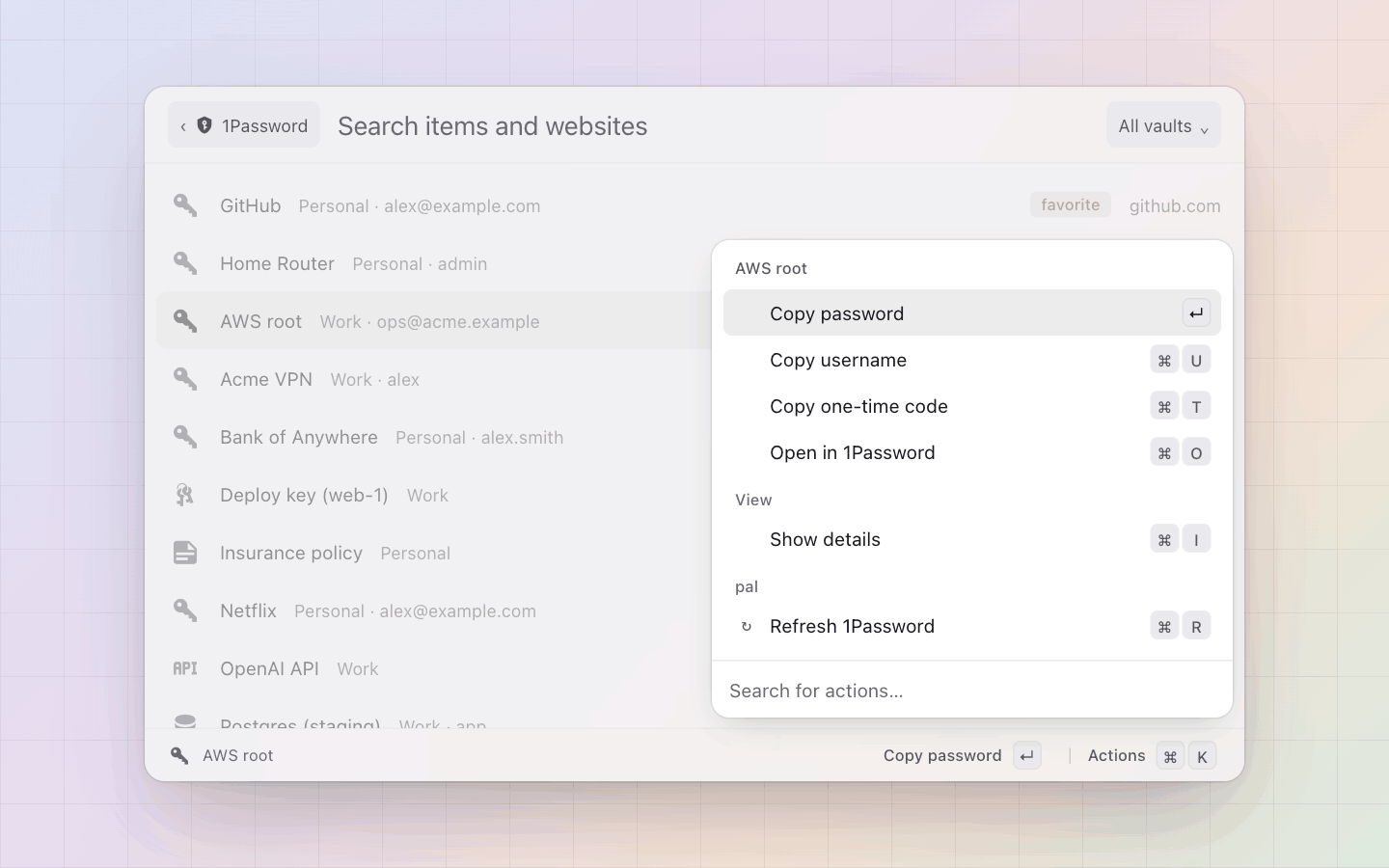
Copy password: op item get <id> --fields label=password --reveal; "Copied password" in the HUD |
cmd+u |
Copy username: the username field |
cmd+t |
Copy one-time code: op item get <id> --otp, the current TOTP |
cmd+o |
Open in 1Password: onepassword://view-item?i=<item>&v=<vault>&a=<account>, the app's own link (the account from op account list, when there is one or account names it) |
An item without the field (a secure note has no password, a login without TOTP has no one-time code) keeps the panel open with a toast carrying the CLI's message.
Setup
Install the 1Password CLI
(brew install 1password-cli on macOS) and sign in, either with
eval $(op signin) in a terminal or by turning on the desktop app
integration (1Password, Settings, Developer), which makes every CLI
call that needs the vault show 1Password's own unlock prompt (Touch ID
on a Mac); pal waits up to a minute for it. op is looked up on PATH,
then in /opt/homebrew/bin, /usr/local/bin and /usr/bin, since the
app under launchd has a bare PATH.
Signed in or not:
- Nothing signed in (or no account set up for the CLI at all) is one row,
"Sign in to 1Password", whose action opens the CLI's sign-in page. Sign
in, then
cmd+r. opnot installed is one row whose action opens the install page.- A vault filter with nothing in it, or an account with no visible items, is one "No items" row.
Settings, [extensions.onepassword]:
| key | type | default | what |
|---|---|---|---|
account |
text | empty | Passed as --account to every call: a shorthand, sign-in address, account id or user id. Empty uses the CLI's default account. |
vaults |
list | [] |
Only these vaults are listed, and each is a filter in the palette (All vaults first). Empty lists every vault with no filter. Read when the extension loads, so a change shows after the host restarts. |
ttl |
number (seconds) | 300 |
How long the item list is kept before op is asked again. |
Nothing beyond the panel: the CLI does its own unlocking, and the clipboard is the core's.
What it does not do
- No autofill and no typing into a field: the value goes to the clipboard, you paste it. The copy is a plain one, not marked concealed the way the 1Password app marks its own, so pal's Clipboard History records it like any copy; delete the entry there when that matters.
- No item creation or editing, no vault management: the app does those.
- No other fields than password, username and one-time code: a custom field or a note's body is not offered.
- No SSH agent, no
op run: this is the item list and three fields.
Platforms
macOS and Linux, wherever the op CLI runs. The desktop app integration
(the biometric prompt) is the app's feature on both; without the app,
op signin in a terminal signs the CLI in.
Palettes 1
-
Items
itemslistEvery item you can see, favourites first.
- ↵Copy the password
- ⌘UCopy the username
- ⌘TCopy the one-time code
- ⌘OOpen in 1Password
Actions
- Copy password`op item get --fields label=password --reveal`; "Copied password" in the HUD.↵
- Copy username⌘U
- Copy one-time codeThe current TOTP.⌘T
- Open in 1PasswordThe app's own view-item link.⌘O
Settings
Extension, [extensions.onepassword]
accountPassed as --account to every op call: a shorthand, sign-in address, account id or user id. Empty uses the CLI's default.
vaultsOnly these vaults are listed, and each becomes a filter in the palette. Empty lists every vault. A change takes effect when the extension host restarts.
ttlSeconds the item list is kept before op is asked again. Refresh in the panel asks at once.
Defaults shown. Change them in pal's settings window or in the config file.