Home Assistant
Your Home Assistant entities, services and areas in the panel, over the REST API.
 palv0.1.0Integrationbundled
Ships inside pal. Installing puts an editable copy ahead of the bundled one.
What it does
Home Assistant
Home Assistant over its REST API (/api/states, /api/services, one
/api/template render for areas), with a long-lived access token. Three
palettes: the entities, the services, the areas.
Palettes
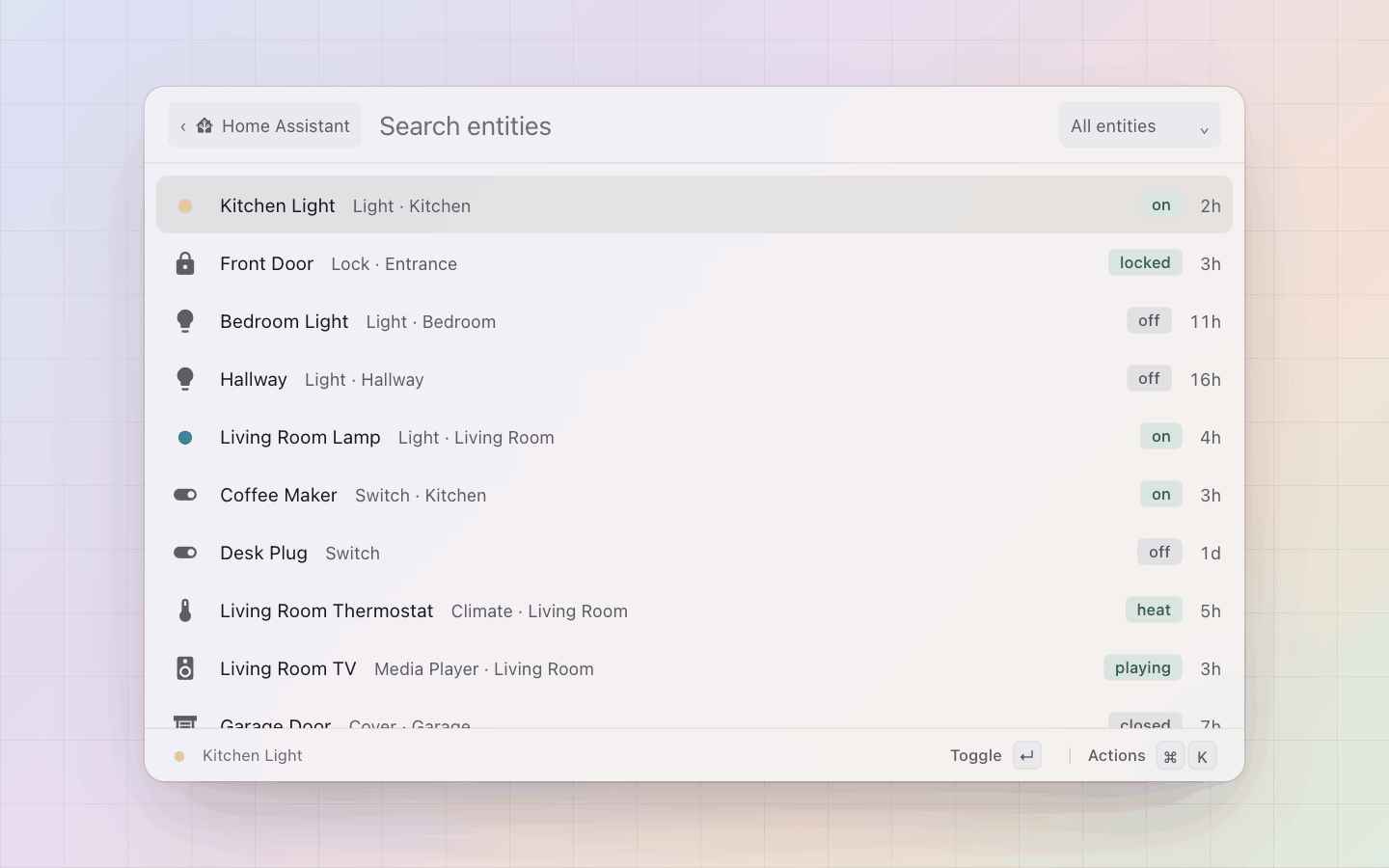
Home Assistant (entities) is live: every entity of the domains
setting, listed again whenever the panel shows, so a light's state at
the root is the current one and kitchen light finds it from the root.
Favourites come first in their order, then the domains in the setting's
order, names sorted within. A row is the friendly name; the subtitle is
the domain and the area (when the entity has one); the entity id, domain
and area are keywords; the accessories are the state (a coloured tag for
on, off, open, locked, playing and the other known states, the
value with its unit otherwise) and when it last changed. The icon is the
domain's glyph; a light that is on is a dot in its colour (rgb_color,
else warm white). The filter dropdown scopes it: All entities (the
domains setting), Every domain, then Lights, Switches, Sensors, Binary
sensors, Climate, Media players, People, Scripts, Automations, Scenes.
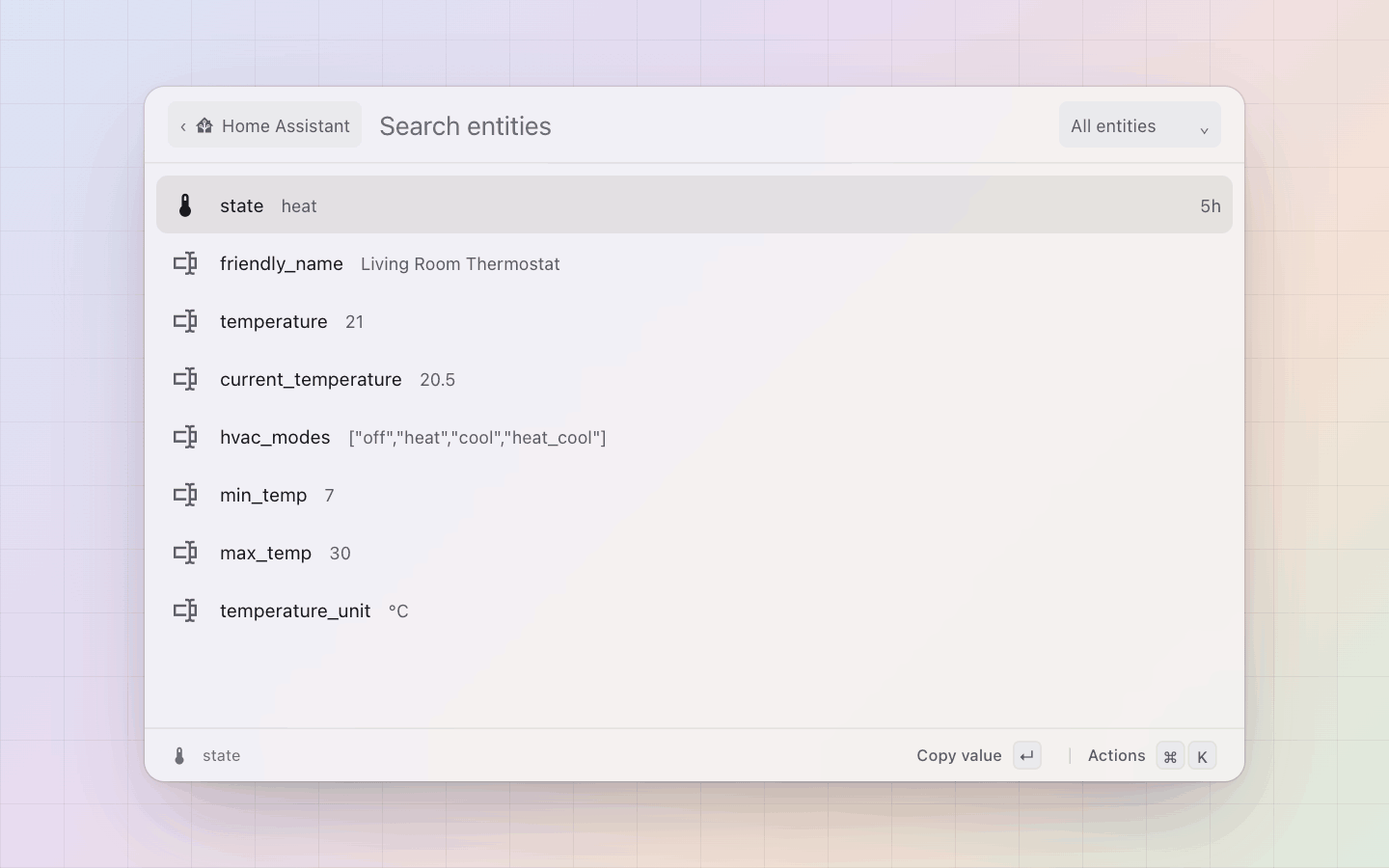
The detail pane (lazy, asked when the cursor rests) shows the entity,
its state, when it changed and its first attributes.
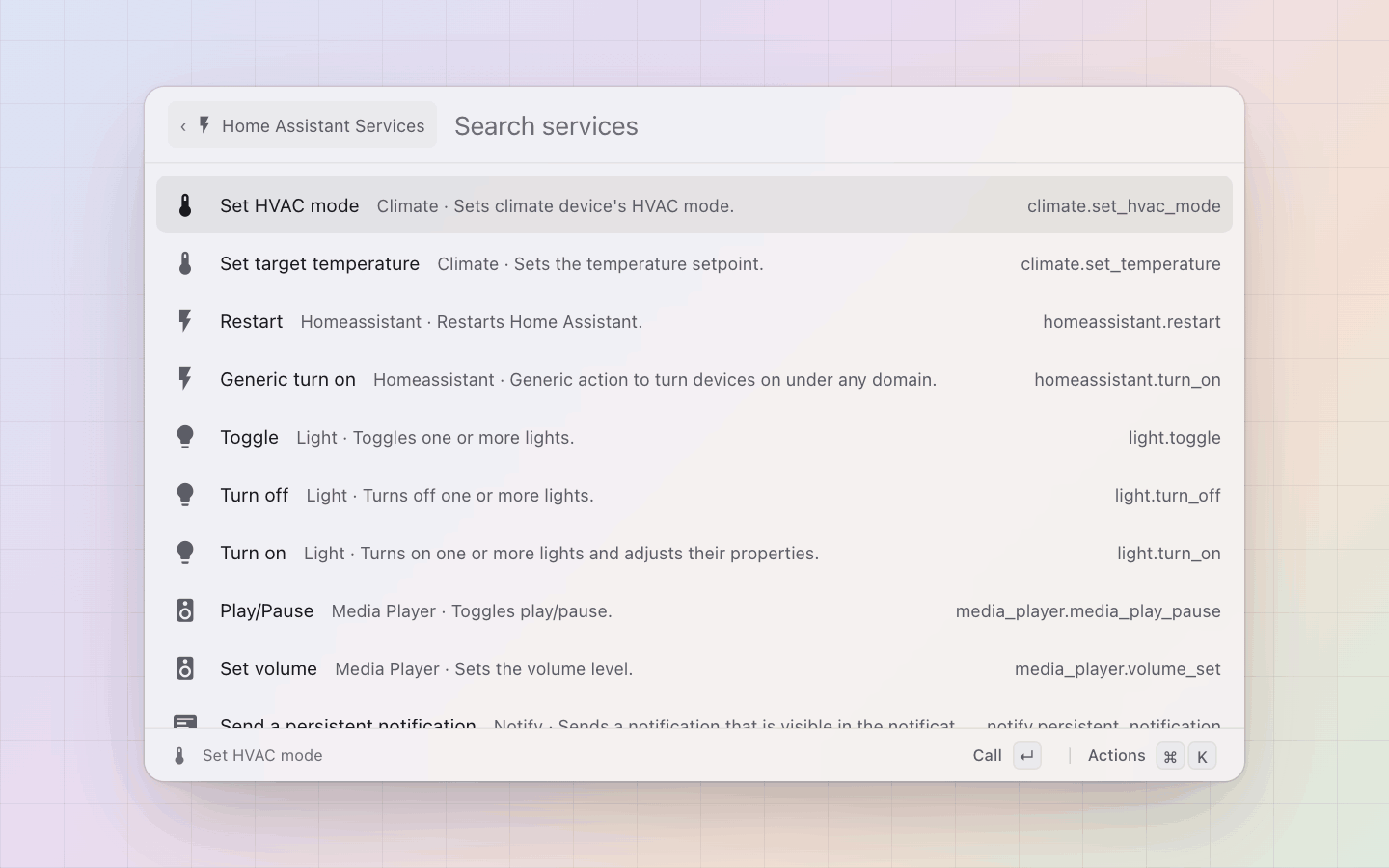
Home Assistant Services (services) is every service from
/api/services, by domain then name, the id (light.turn_on) as an
accessory and a keyword, HA's name and description when it gives them.
enter opens a form: the target as a select of the entities the service
takes (no field for a service without a target), then the service's
fields from its description (a select selector is a select, a
boolean one a checkbox, the rest text with the example as placeholder
and a number's range in the help line). The submit calls the service
with the values coerced by selector and toasts what changed; a number
field that is not one comes back on the form. Listed once an hour.
Home Assistant Areas (areas) is every area that has an entity,
with the count; enter lists those entities. Listed once an hour.
Keyboard
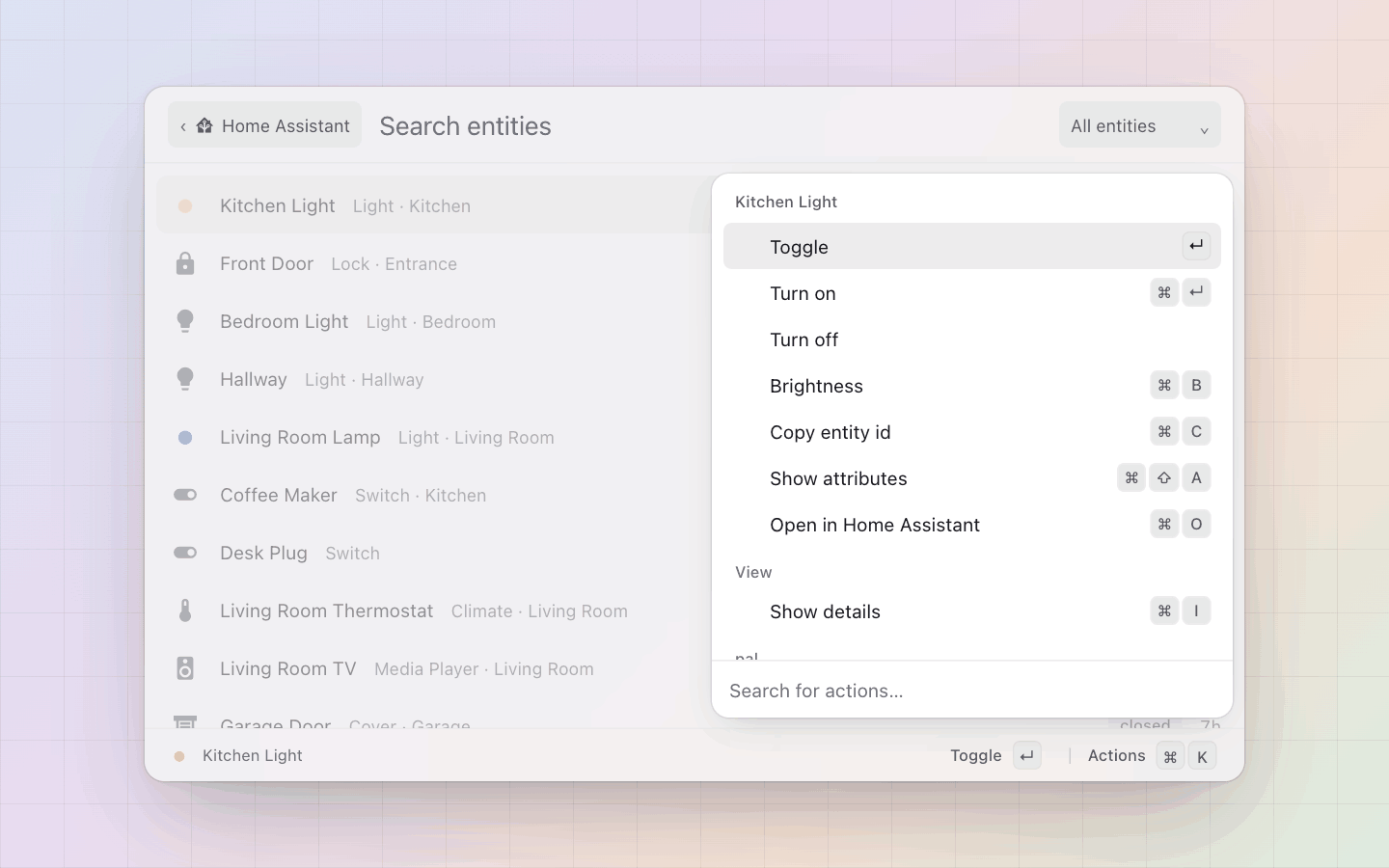
The first action of a row is enter, the second cmd+enter; cmd+k
has them all. By domain on an entity row:
| domain | actions |
|---|---|
| light | Toggle, Turn on, Turn off, Brightness (cmd+b: presets of 10 / 25 / 50 / 75 / 100 %, the current one tagged) |
| switch, fan, input_boolean, humidifier | Toggle, Turn on, Turn off |
| climate | Set temperature (a form: the temperature with the entity's range, the mode from its hvac_modes), Turn on, Turn off |
| cover | Open, Close, Stop (Close first while open) |
| lock | Lock, Unlock (both ask first; the one that changes the state comes first) |
| media_player | Play or Pause, Next track, Previous track, Volume (cmd+u: presets), Turn off |
| scene | Activate |
| script | Run |
| automation | Trigger, Enable or Disable |
| button, input_button | Press |
| vacuum | Start, Return to dock |
| anything else (sensor, binary_sensor, person, ...) | Copy value |
On every entity row:
| keys | action |
|---|---|
cmd+c |
Copy entity id |
cmd+i |
Show attributes: a level with the state and every attribute as rows, each copying its value (cmd+c its name) |
cmd+o |
Open in Home Assistant: the automation or script editor, the history page for the rest |
On a service row: enter Call (the form, then the call), cmd+c Copy
service id. On an area row: enter Show entities.
A service call keeps the panel open and lists again, so the row shows the new state, with a toast naming it; a call that fails is a failure toast with HA's answer. Entity ids are the row ids, so an item hotkey toggles one entity without showing pal:
[palettes.home-assistant-entities.item_hotkeys]
"light.kitchen" = "ctrl+alt+k"
Setup
In Home Assistant, your profile, Security, create a long-lived access
token. In pal, Settings, Extensions, Home Assistant: the URL with its
scheme (http://homeassistant.local:8123) and the token, which the
config file keeps as a keychain: or env: reference, never the value.
Settings, [extensions.home-assistant]:
| key | type | default | what |
|---|---|---|---|
url |
text | unset | Where Home Assistant answers, scheme included. |
token |
secret | unset | A long-lived access token. A keychain: or env: reference in the file. |
domains |
list | light, switch, climate, media_player, cover, lock, fan, scene, script, automation, sensor, binary_sensor, person, input_boolean |
The domains listed at the root, in this order. |
favorites |
list | [] |
Entity ids pinned to the top, in this order, whatever their domain. |
timeout |
number (s) | 5 |
How long one request may take. |
When something is wrong every palette is one inert hint row that says
what and where to fix it: no URL, a URL without a scheme, no token, a
keychain: or env: token that did not resolve, a rejected token (401),
a host that did not answer within the timeout, or one that could not be
reached. A URL that redirects (an http:// one behind a proxy answering
301 to https://) is followed with the token kept, and the log says
which URL to set. An HA that refuses the template API leaves the rows
without areas and the Areas palette with a hint row.
Needs the network: every request goes to the URL you set, nothing else.
What it does not do
- No WebSocket: states are read on each show, not pushed, so a change
made elsewhere shows on the next show or
cmd+r. - No entity editing, no dashboards, no history graphs:
cmd+oopens the right page in Home Assistant for those. - No arbitrary brightness or volume: the presets are the five steps; the
service form (
light.turn_onwithbrightness_pct) takes any value. - A collapsed group in a service's description (HA's "advanced" section) is left out of the form.
Platforms
macOS and Linux, the same on both: everything is HTTP.
Palettes 3
-
Entities
entitiesliveEvery entity of the chosen domains with its state, favourites first; the domain filters scope it. Actions per domain: toggle, on, off, brightness, temperature, open, close, lock, play, activate, run, trigger, copy value; every row copies its id, shows its attributes, opens in HA.
- ↵The domain's first action: toggle, activate, run, copy value
- ⌘CCopy the entity id
- ⌘IShow the attributes
- ⌘OOpen in Home Assistant
-
Services
serviceslistEvery service Home Assistant offers, by domain; Enter opens a form with the target entity and the service's fields, submit calls it.
- ↵Open the form, then call
- ⌘CCopy the service id
-
Areas
areaslistEvery area with an entity in it; Enter lists those entities.
- ↵List the area's entities
Actions
- ToggleLights, switches, fans, input booleans.↵
- Turn on / Turn off⌘↵
- BrightnessPresets of 10, 25, 50, 75 and 100 % for a light.⌘B
- Set temperatureA form with the temperature and the mode of a thermostat.↵
- Open / Close / StopCovers.
- Lock / UnlockBoth ask first.
- Play / Pause, Next track, Previous track, Turn offMedia players.
- VolumePresets for a media player.⌘U
- Activate / Run / TriggerScenes, scripts, automations; Enable or Disable for an automation.
- PressButtons.
- Start / Return to dockVacuums.
- Copy valueSensors, people and every other domain.↵
- Copy entity id⌘C
- Show attributesA level with the state and every attribute; each row copies its value.⌘I
- Open in Home AssistantThe automation or script editor, the history page for the rest.⌘O
- CallOn a service: the form, then the call.↵
- Copy service id⌘C
- Show entitiesOn an area.↵
Settings
Extension, [extensions.home-assistant]
urlWhere Home Assistant answers, scheme included; no trailing slash needed.
tokenA long-lived access token (your profile in HA, Security, Long-lived access tokens). Stored as a keychain: or env: reference.
domainsEntity domains listed at the root, in this order. A domain filter shows its domain regardless; favourites are listed regardless.
favoritesEntity ids pinned to the top, in this order.
timeoutHow long one request may take before the row says Home Assistant did not answer.
Defaults shown. Change them in pal's settings window or in the config file.