Wi-Fi
Join, forget and inspect Wi-Fi networks, and turn the radio off, from the keyboard.
 palv0.1.0Systembundled
Ships inside pal. Installing puts an editable copy ahead of the bundled one.
What it does
Wi-Fi
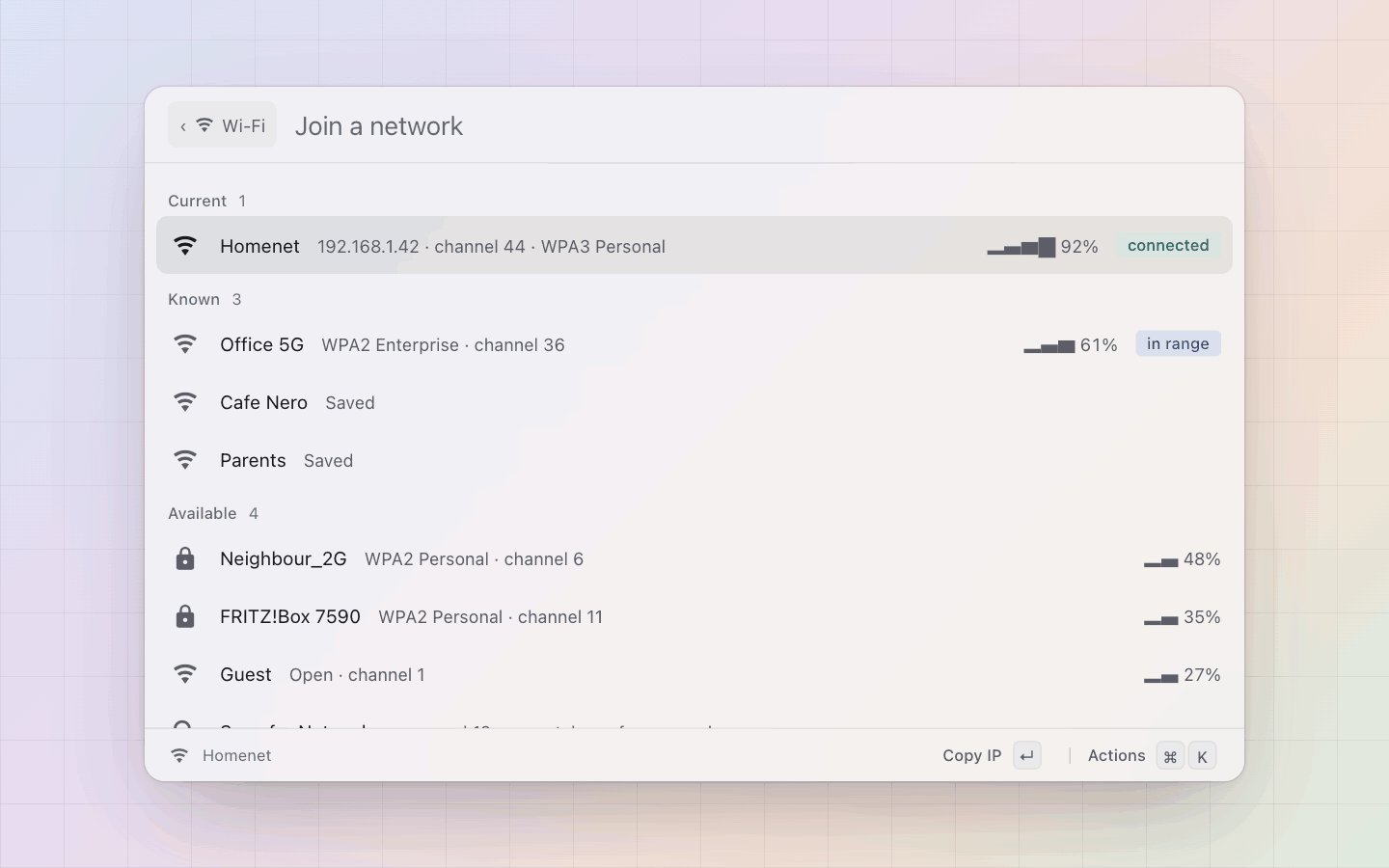
The network the machine is on, the saved ones and what is in range, over the core's wifi capability, in sections Current, Known and Available, plus a Wi-Fi row that turns the radio off or on. The palette is live: read again on every show.
One palette, Wi-Fi (wifi).
Rows
| section | row | subtitle | right side |
|---|---|---|---|
| Current | the network you are on | the IP, channel and security (192.168.1.42 · channel 44 · WPA3 Personal) |
the signal (▂▄▆█ 92%) and a connected tag |
| Known | every saved network, in the OS's preference order | the security and channel when a scan sees it, else Saved |
its signal and an in range tag when a scan sees it |
| Available | what the last scan found that is not saved | the security (Open for none) and the channel |
the signal |
| Available | Scan for Networks (macOS, or when names are hidden) | how old the last scan is, and how many nearby networks have their names hidden | |
| Wi-Fi | Turn Wi-Fi Off / Turn Wi-Fi On | the interface (en0) |
A secured network in range has a lock as its icon, an open one the Wi-Fi glyph. With the radio off only the Wi-Fi row is listed. Without a Wi-Fi interface, or with no backend, the one row says so.
Keyboard
| keys | action | on |
|---|---|---|
enter |
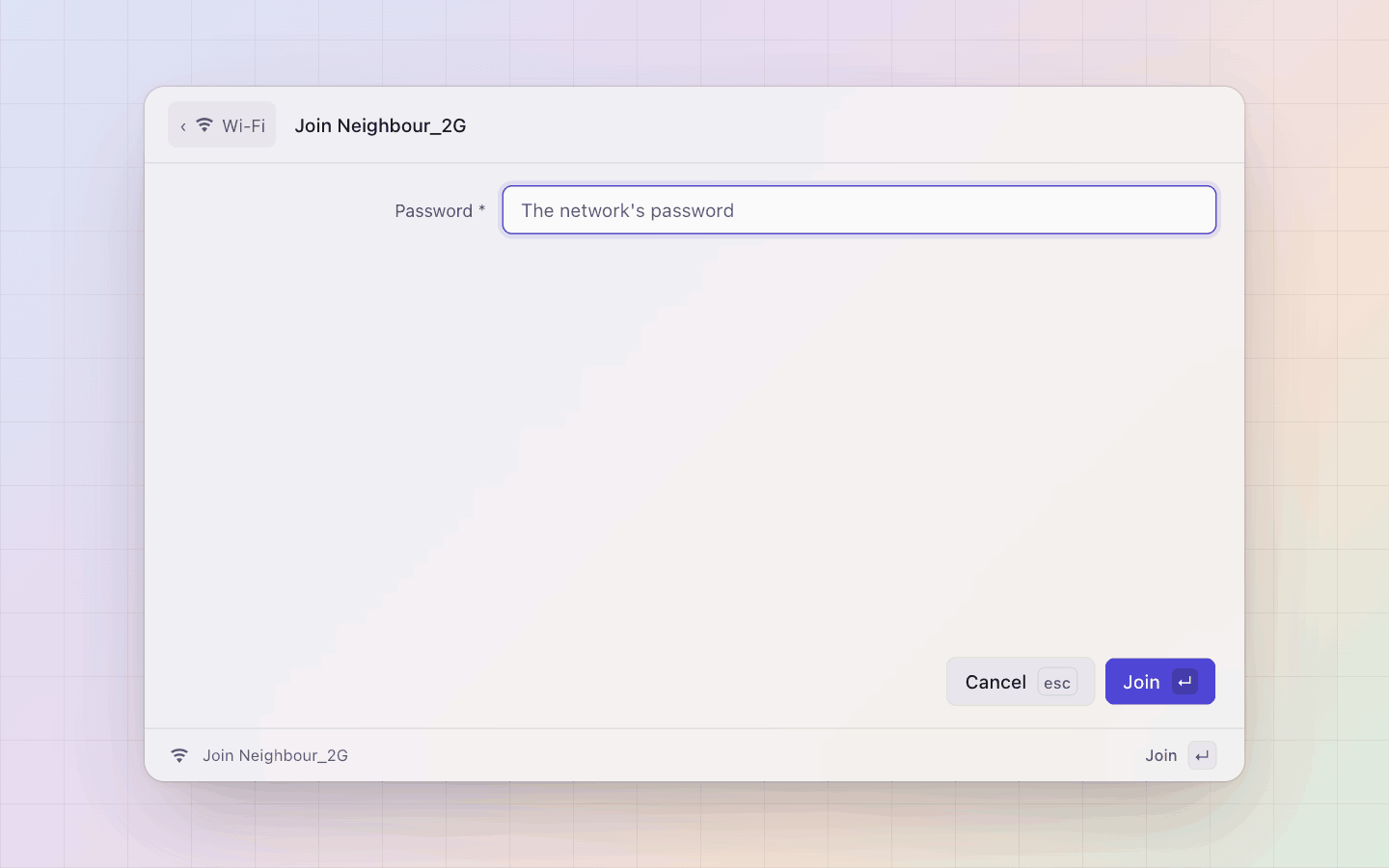
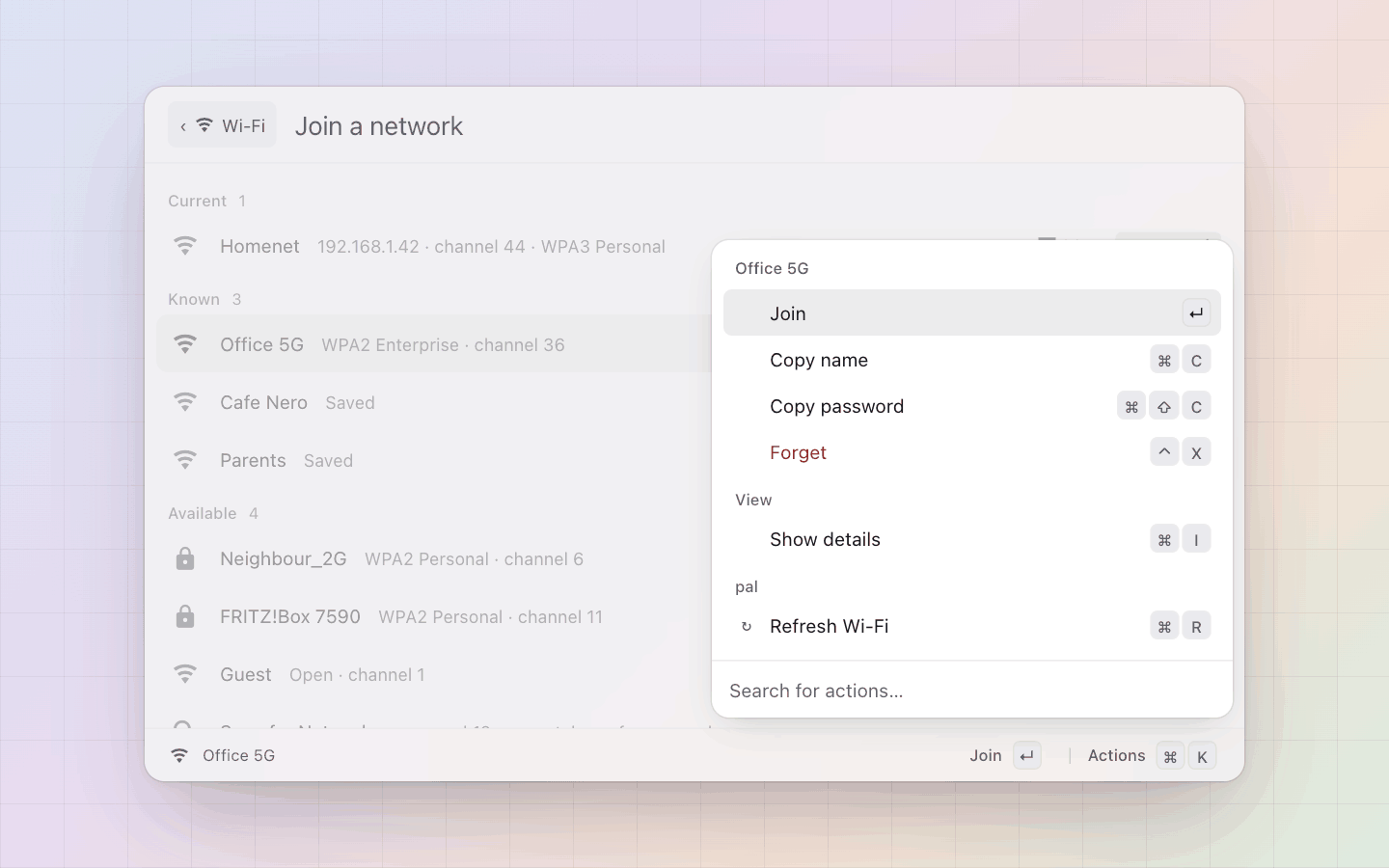
Join: a saved or open network at once; a secured network that is not saved asks for its password in a form, and a refused join shows the form again with the tool's message | a known or available row |
cmd+shift+c |
Copy Password: the saved password onto the clipboard | the current row and known rows |
cmd+c |
Copy IP: the interface's IPv4 address | the current row |
cmd+c |
Copy Name: the network's name | an available row |
ctrl+x |
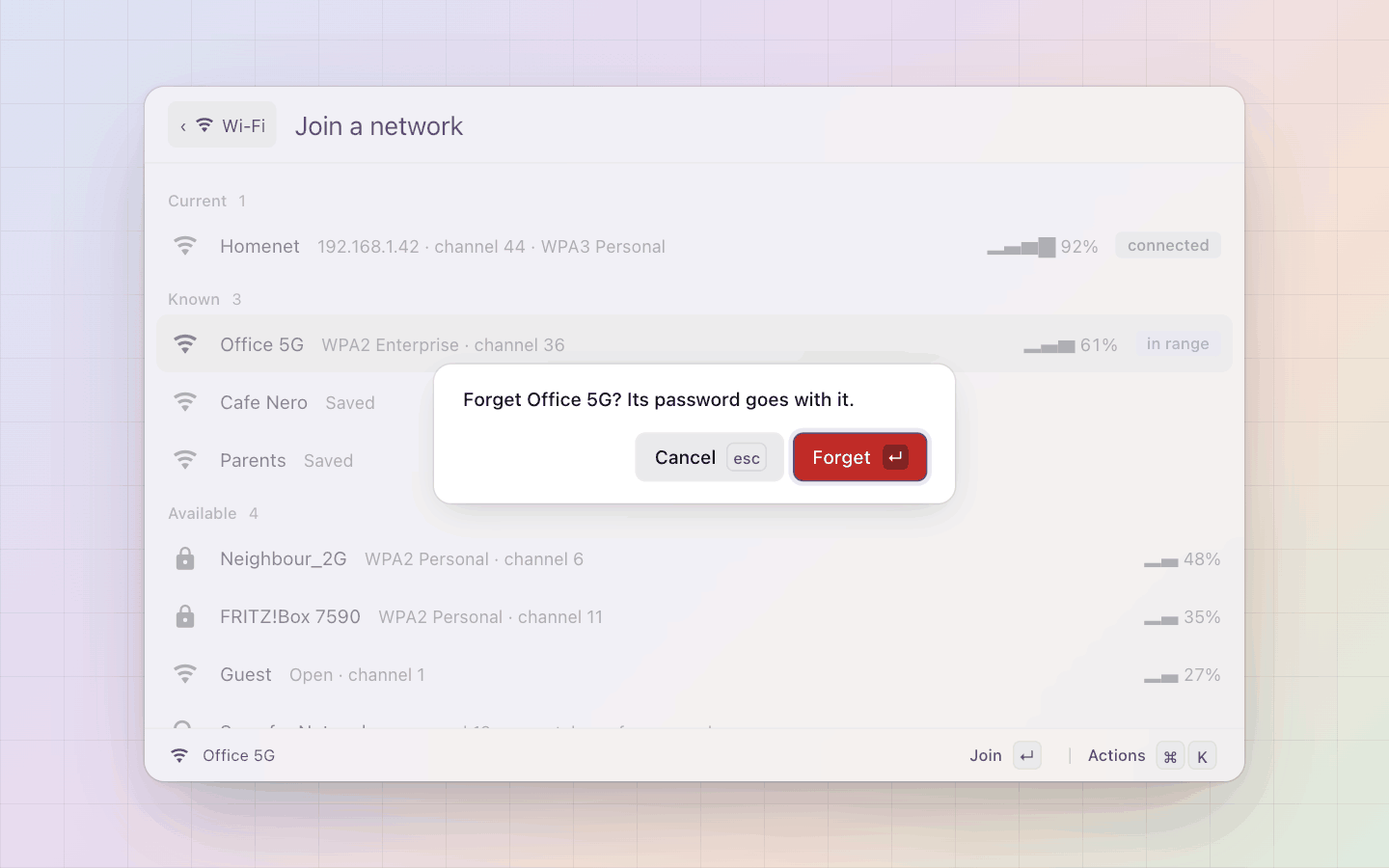
Forget: removes the saved network, after a confirm ("Forget X? Its password goes with it.") | the current row and known rows |
enter |
Scan: a fresh scan, then the list again | the Scan row |
enter |
Turn Off / Turn On: the radio | the Wi-Fi row |
Forget and the power toggle keep the palette open and list again; a join that succeeds hides pal with "Joined X" in the HUD.
Setup
Nothing to configure and nothing to install.
- macOS:
networksetup(the interface, the radio, the preferred list, join, forget),scutilandipconfig getsummaryfor the current link,security find-generic-password -wa <ssid>for a password (the keychain prompts, and that dialog is yours to answer), andsystem_profiler SPAirPortDataType -jsonfor a scan. That scan takes several seconds, so Available shows the last one (kept for a minute) and the Scan for Networks row runs a fresh one. - Linux: NetworkManager over
nmcli -t(device wifi list, which answers from NetworkManager's own scan cache, so Available lists at once;connection showfor the saved ones;device wifi connect;connection delete;radio wifi;-s -g 802-11-wireless-security.pskfor a password).
Location Services on macOS. macOS 15 and later withhold every network
name from a process without Location Services (<redacted> in
ipconfig, scutil and system_profiler alike). The current row then
reads "Connected network" with its IP and channel and says the name is
hidden, and the Scan row counts the nearby networks whose names are
hidden instead of listing them. Grant pal Location access in System
Settings, Privacy & Security, Location Services, and the names appear.
No settings.
What it does not do
- No hidden-SSID join: a network that does not broadcast its name is not in the scan, and the palette has no "other network" form.
- No enterprise credentials: an
802.1Xnetwork that needs a username as well as a password joins only when the OS already has its profile. - No password for a network the OS keeps outside the keychain or NetworkManager's store.
- No signal history or channel graph: the signal is the number at the time of the last scan.
- No
wdutilfallback for the redacted name on macOS: it needs sudo, and the host has no way to ask for a password.
Platforms
macOS and Linux. The Scan row exists on macOS always (a scan is slow there) and on Linux only when the OS reports hidden names, which NetworkManager does not; on Linux Available comes from NetworkManager's cache at once.
Palettes 1
-
Wifi
wifiliveCurrent, known and available networks with their signal.
- ↵Join
- ⌘⇧CCopy the password
- ⌃XForget
Actions
- JoinA saved or open network joins at once; a secured new one asks for its password.↵
- Copy PasswordThe saved password; the macOS keychain prompts.⌘⇧C
- Copy IPOn the current row.⌘C
- Copy NameOn an available row.⌘C
- ForgetRemoves the saved network, after a confirm.⌃X
- ScanOn the Scan for Networks row: a fresh scan, then the list again.↵
- Turn Off / Turn OnOn the Wi-Fi row: the radio.↵
Settings
No settings. It works out of the box.