Audio
Switch the output or input, set the volume, mute, without leaving the keyboard.
 palv0.1.0Systembundled
Ships inside pal. Installing puts an editable copy ahead of the bundled one.
What it does
Audio
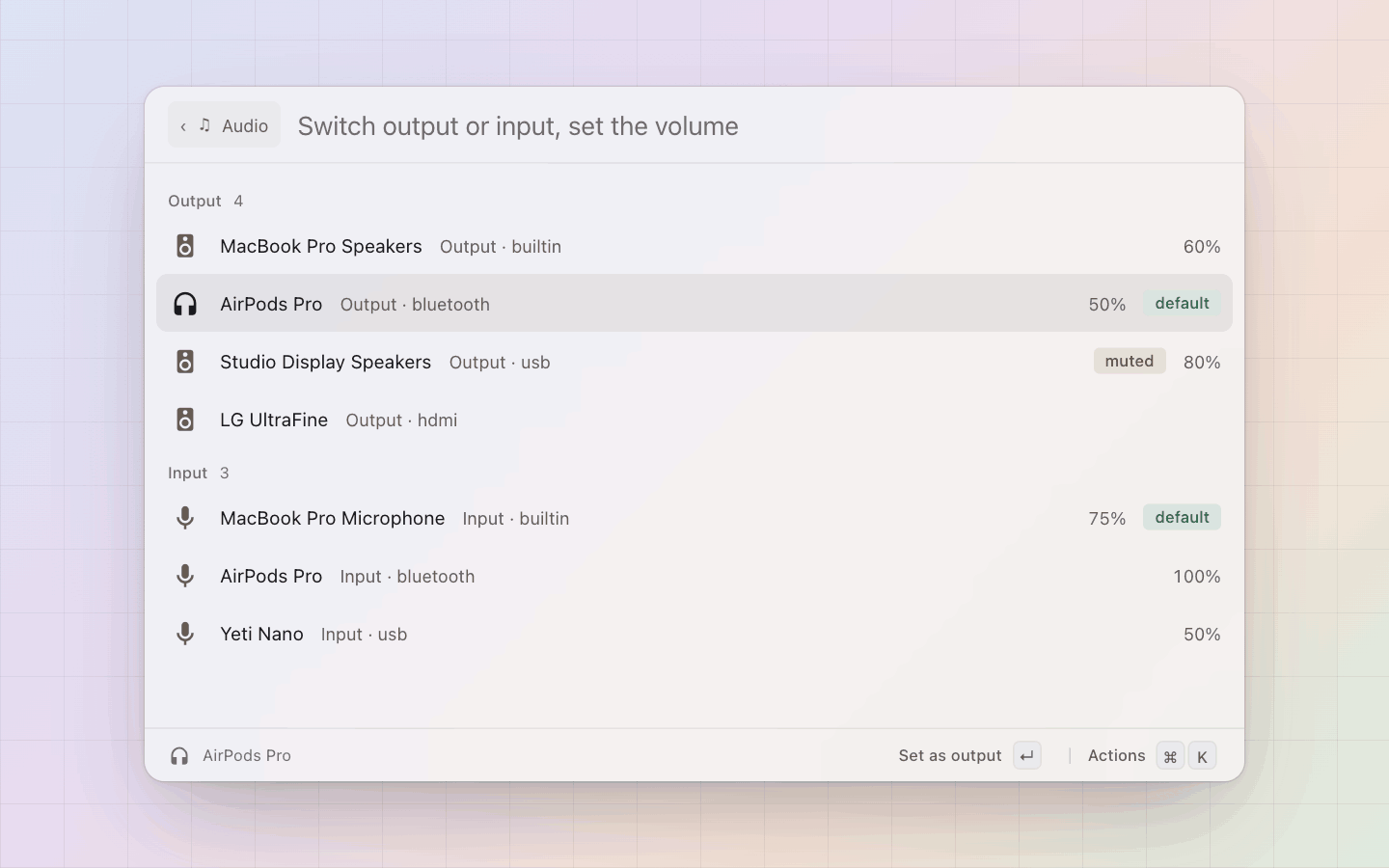
Every audio output and input, in two sections, over the core's audio
capability. The default of each direction carries a default tag, the
volume is the accessory, a muted device is tagged muted; the subtitle
says the direction and, when the OS reports it, the transport
(bluetooth, usb, builtin, hdmi). A headset shows once under Output
and once under Input, since it is one device in both directions. The
palette is live: the defaults and volumes are read again on every show,
so airpods at the root finds the row with its current volume.
One palette, Audio (audio). With no audio backend the one row says
which tool is missing.
Rows
| part | what |
|---|---|
| icon | headphones for a Bluetooth output, a speaker for any other output, a microphone for an input |
| title | the device's name as the OS reports it |
| subtitle | Output · bluetooth, Input · usb; the direction alone when the OS gives no transport |
| accessories | muted (amber) when muted, the volume (45%), default (green) for the default of that direction |
| keywords | the direction and the transport, so bluetooth or input finds the rows |
| section | Output, then Input |
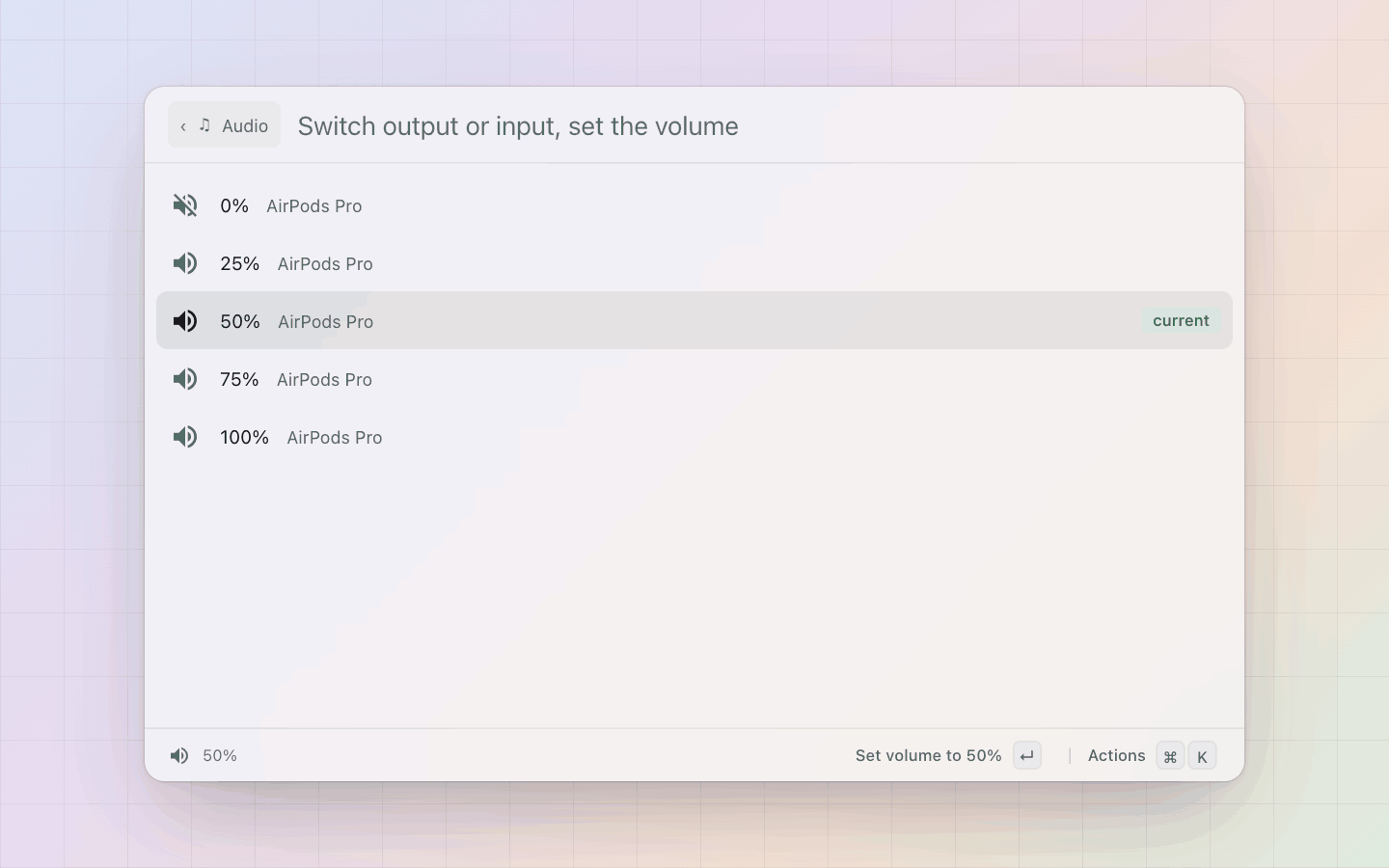
The volume level pushed by Set Volume… has one row per preset with the
device's name as the subtitle and a current tag on the level the device
is at exactly; its icon is the muted speaker for 0 % and the
loud one for the rest.
A hotkey can open the palette straight away, and an item hotkey can make
one device the default without showing pal, keyed on the row's id
(output:<uid> or input:<uid>):
[palettes.audio]
hotkey = "ctrl+alt+a"

[palettes.audio.item_hotkeys]
"output:BuiltInSpeakerDevice" = "ctrl+alt+s"
Keyboard
| keys | action |
|---|---|
enter |
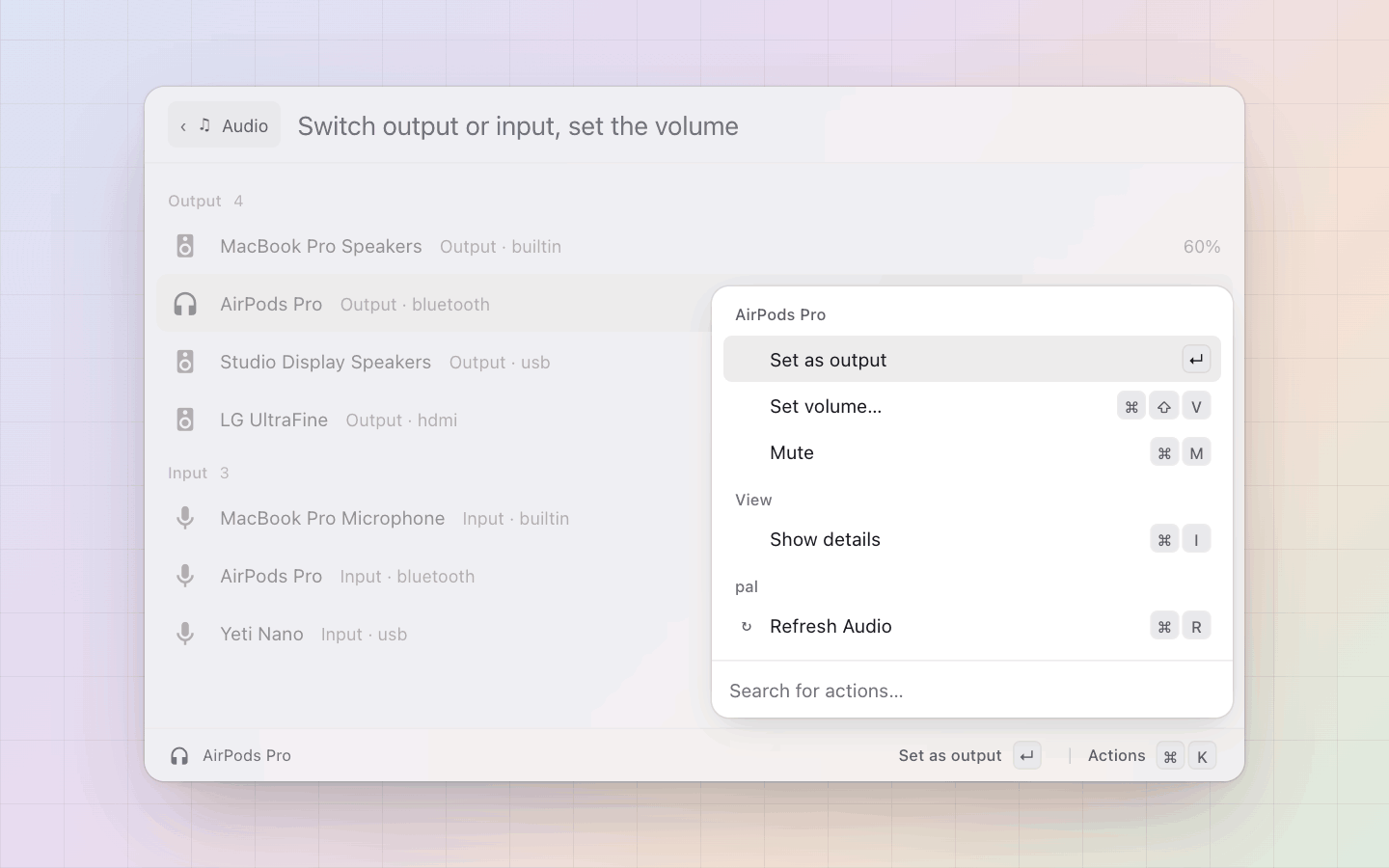
Set as Output / Set as Input: makes the row the default for its direction; the HUD names it |
cmd+shift+v |
Set Volume…: drills into a level of presets, 0 / 25 / 50 / 75 / 100 %, the current one tagged; a pick sets it and the HUD says so |
cmd+m |
Mute / Unmute: toggles mute and stays in the list |
A digital output without a volume control has no volume accessory and no Mute action. A setter that fails keeps the panel open with a toast carrying the backend's message.
Setup
Nothing to configure and nothing to install on macOS.
- macOS: the CoreAudio HAL, in-process. The device's UID is its id (stable across replugs); the volume is the virtual main volume the menu bar slider moves, with the per-channel scalar for a device without one.
- Linux:
wpctl(PipeWire), elsepactl -f json(PulseAudio 16 or later). With neither the palette is one row naming the missing tool.
No settings. Nothing beyond the panel: no permission prompt on either platform.
What it does not do
- No per-app volume, no balance, no sample rate: the capability exposes the default, the main volume and mute of each device, nothing finer.
- No arbitrary level: the presets are the five steps; use the system's volume keys for anything in between.
- No AirPlay or Bluetooth pairing from here: the Bluetooth palette connects a paired device, the OS pairs it.
Platforms
macOS and Linux. The transport in the subtitle comes from CoreAudio, so on Linux the subtitle is the direction alone.
Palettes 1
-
Audio
audioliveEvery output and input, the defaults tagged, with their volume.
- ↵Set as the default output or input
- ⌘⇧VSet the volume
- ⌘MMute or unmute
Actions
- Set as Output / Set as InputMakes the row the default for its direction; the HUD names it.↵
- Set Volume…A level of presets, 0 to 100 %.⌘⇧V
- Mute / UnmuteToggles mute and stays in the list.⌘M
Settings
No settings. It works out of the box.