Unicode characters
The characters one pastes rather than types: arrows, math, currency, dashes, keyboard glyphs, box drawing.
 palv0.1.0Referencebundled
Ships inside pal. Installing puts an editable copy ahead of the bundled one.
What it does
Unicode characters
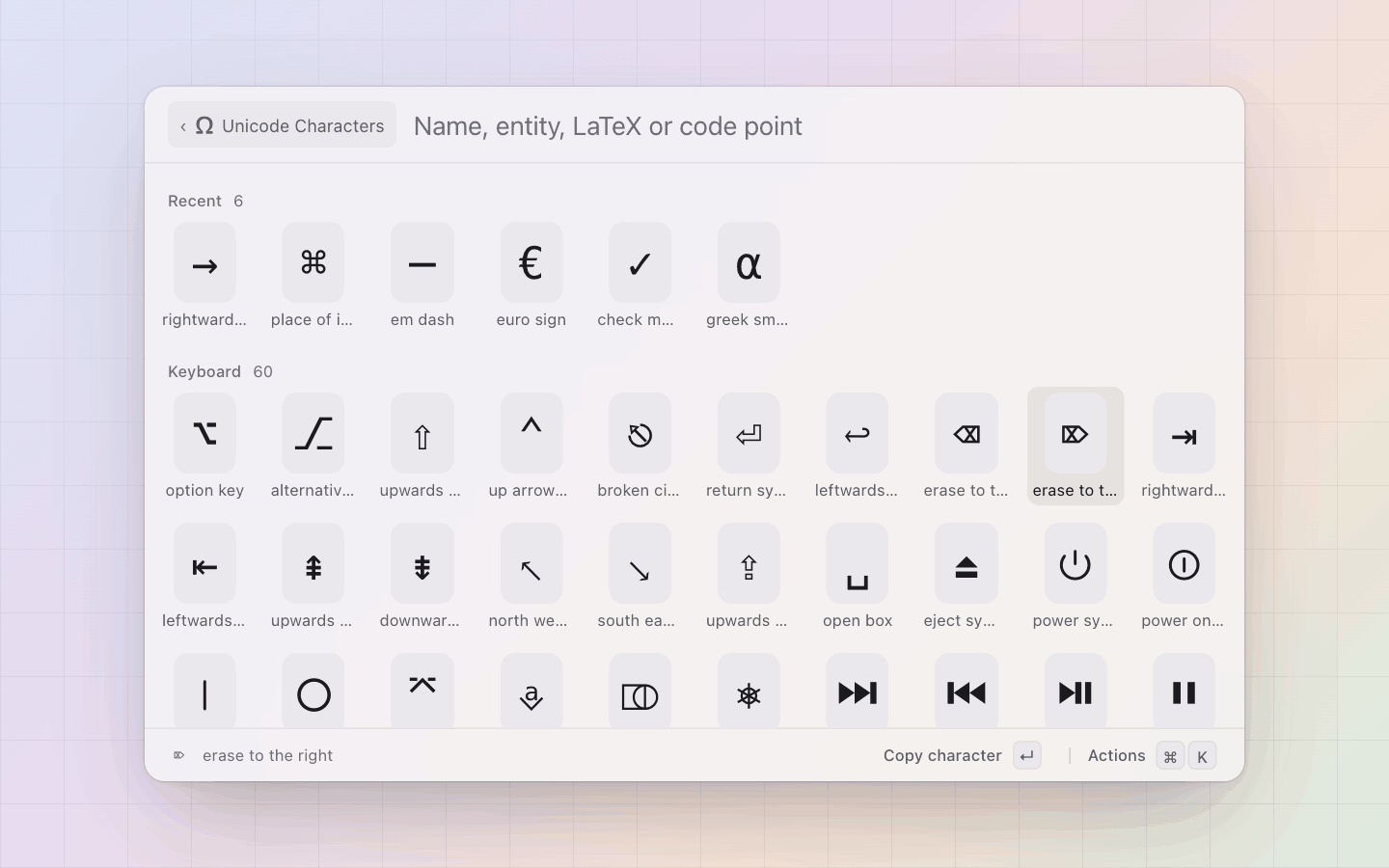
A grid of 1795 characters one pastes rather than types, from
extensions/unicode/data.json: arrows, math, Greek, currency, quotes and
dashes, punctuation, typographic and zero-width spaces, superscripts and
fractions, accented Latin letters (the Turkish, German, French, Nordic
and Spanish sets), letterlike symbols, the Mac keyboard glyphs (⌘ ⌥ ⇧ ⌃ ⎋
⏎ ⌫ ⇥ ⏏ and the control pictures), check marks, box drawing and block
elements, geometric shapes, miscellaneous symbols, dingbats, enclosed
numbers and letters.
The tile is the glyph (a space shows as the open box ␣); the name is
the Unicode name in lower case; the code point is the subtitle; the
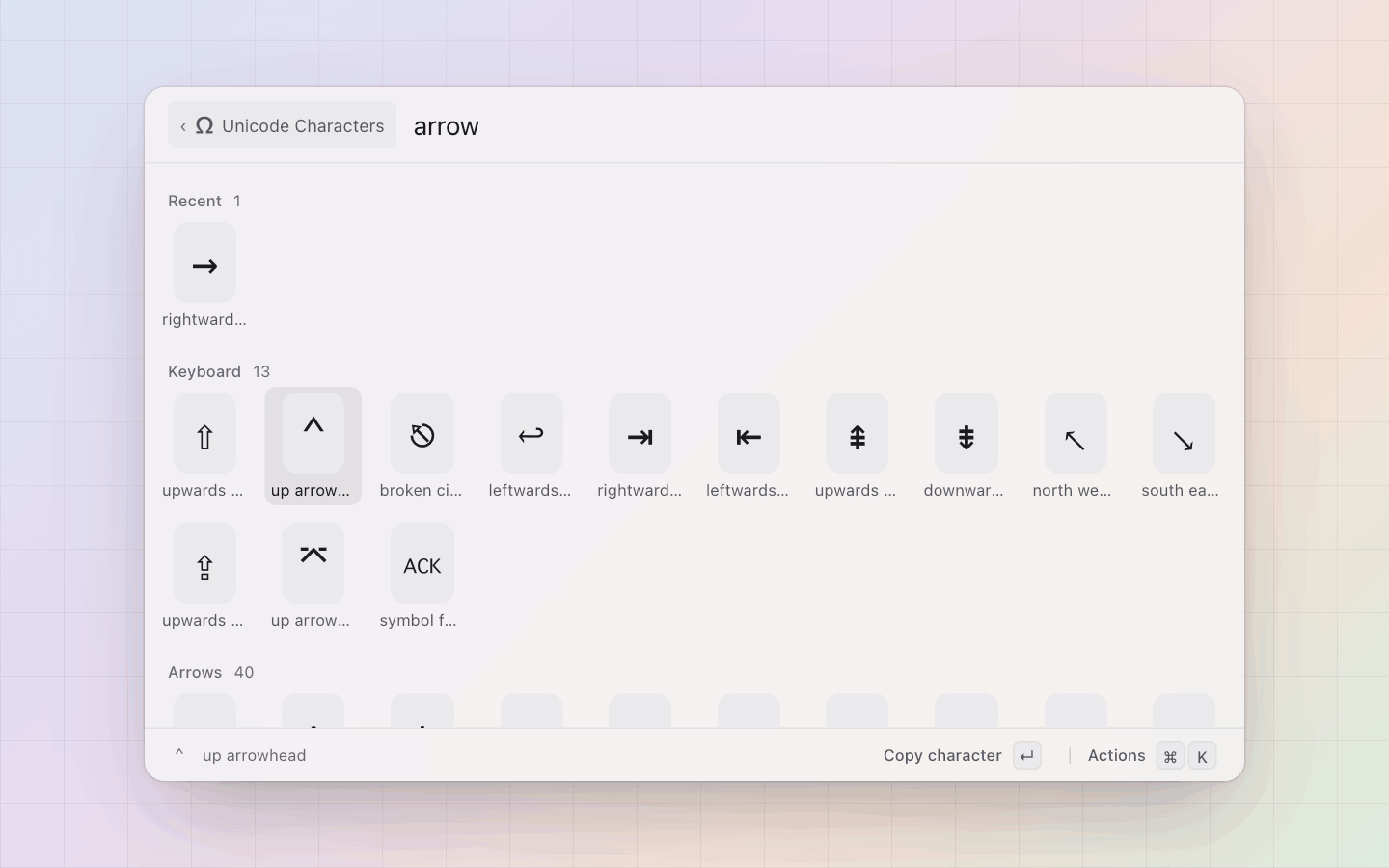
section is the block. The search matches the name, the code point (2192
or u+2192), the HTML entity names (rarr, nbsp), the LaTeX command
where there is an obvious one (\rightarrow, \alpha), the character's
Unicode 1.0 name (command key) and plain words (cmd, turkish,
tick, eur).
The last twelve characters copied lead the grid in a Recent section
(kept in the extension's storage) and leave their block while they are
there. The section is rebuilt when the palette lists again (at start, on
cmd+r); between listings the core's frecency already moves a picked
tile up.
The detail pane (cmd+i) shows the glyph large, the block, the code
point, both HTML forms, the UTF-8 bytes (E2 86 92), the LaTeX command
and the aliases.
Keyboard
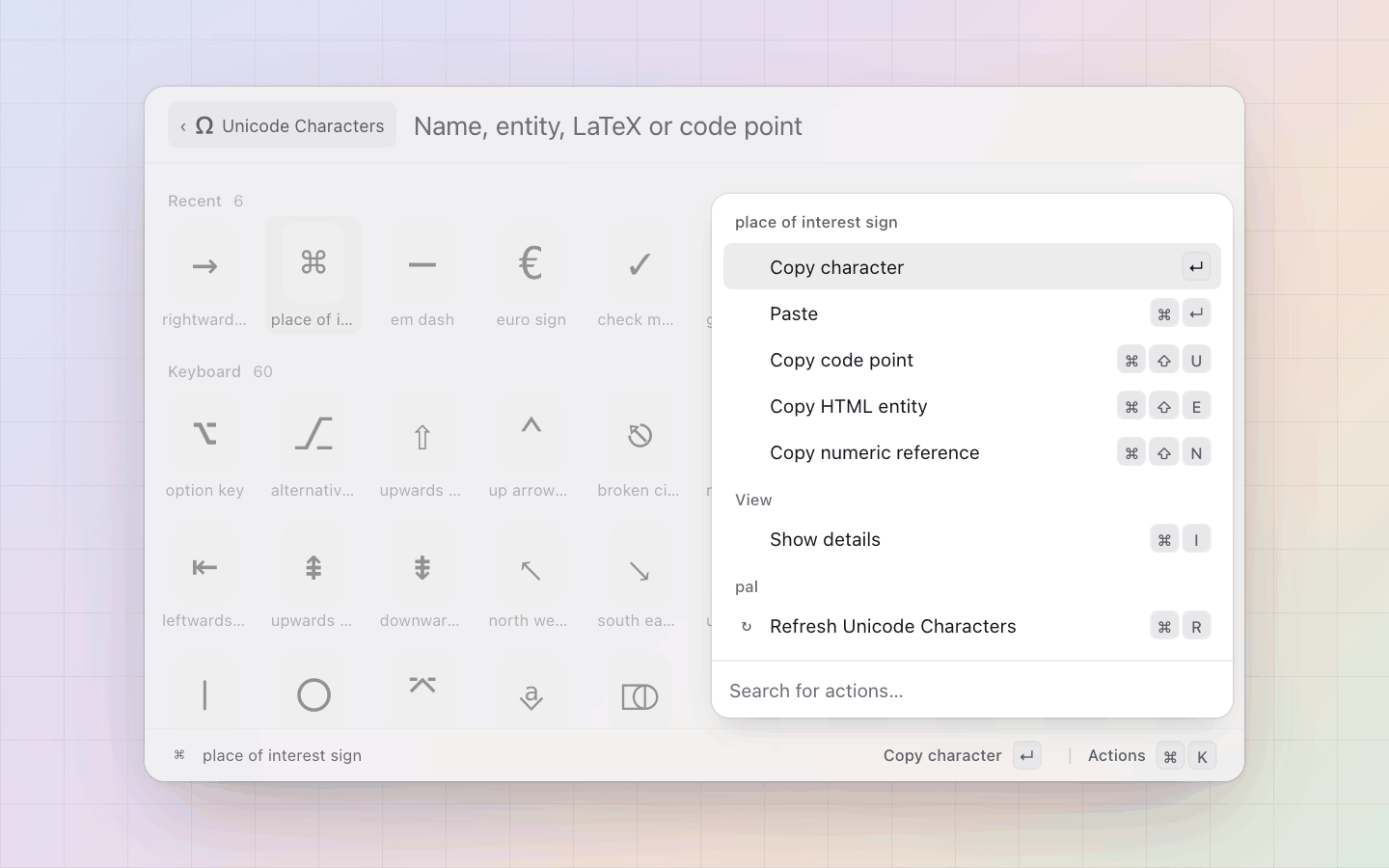
In the grid, arrows move across and down the tiles and Enter runs the
first action of the tile under the cursor.
| keys | action |
|---|---|
enter |
Copy character |
cmd+enter |
Paste it into the app that was in front |
cmd+shift+u |
Copy code point: U+2192 |
cmd+shift+e |
Copy HTML entity: →, or → for a character without a named entity |
cmd+shift+n |
Copy numeric reference: → |
cmd+i |
The detail pane |
cmd+k |
Every action |
Setup
Nothing to install. Pasting is a synthesised Cmd+V, which macOS only
delivers from a process on the Accessibility list: without the permission
pal shows the system prompt once per run and a toast saying what to grant
(System Settings > Privacy & Security > Accessibility). Copying needs
nothing. On Linux the paste is Ctrl+V through wtype, else ydotool
(which needs ydotoold running).
The table is generated: bun run extensions/unicode/build.ts fetches
UnicodeData.txt (names) and the WHATWG entities.json (entity names),
applies the sections, LaTeX and keyword tables in the script, and writes
data.json (160 KB), which is committed. The whole UCD is not shipped;
add a range or a code point to the script's SECTIONS to widen the
table.
No extension settings. Per palette, [palettes.unicode.settings]:
| key | type | default | what |
|---|---|---|---|
columns |
number, 4 to 16 | 10 |
Tiles per row in the grid. Read once when the extension loads: after a change, Settings > Restart extension host. |
What it does not do
- Every Unicode character: 1795 curated ones, by block. A code point
outside the table finds nothing; widen
SECTIONSinbuild.ts. - Emoji: they have their own palette (Emoji), with shortcodes and skin tones.
- Compose characters (a base letter plus a combining mark); the accented letters are the precomposed ones.
- Type a code point to get its character as an input palette would; the
grid is searched, so
2192finds the arrow's tile.
Platforms
macOS and Linux. The glyphs are drawn by the system font, so a character
the font lacks shows as its fallback box; paste needs Accessibility on
macOS and wtype or ydotool on Linux.
Palettes 1
-
Unicode
unicodegridThe bundled character table, by block; recently copied characters first.
- ↵Copy character
- ⌘↵Paste
- ⌘⇧UCopy code point
- ⌘⇧ECopy HTML entity
Actions
- Copy character↵
- PasteInto the app that was in front; needs Accessibility on macOS.⌘↵
- Copy code point`U+2192`⌘⇧U
- Copy HTML entity`→`, or `→` for a character without a named entity.⌘⇧E
- Copy numeric reference`→`⌘⇧N
Settings
Unicode, [palettes.unicode]
columnsTiles per row in the grid.
Defaults shown. Change them in pal's settings window or in the config file.