Emoji
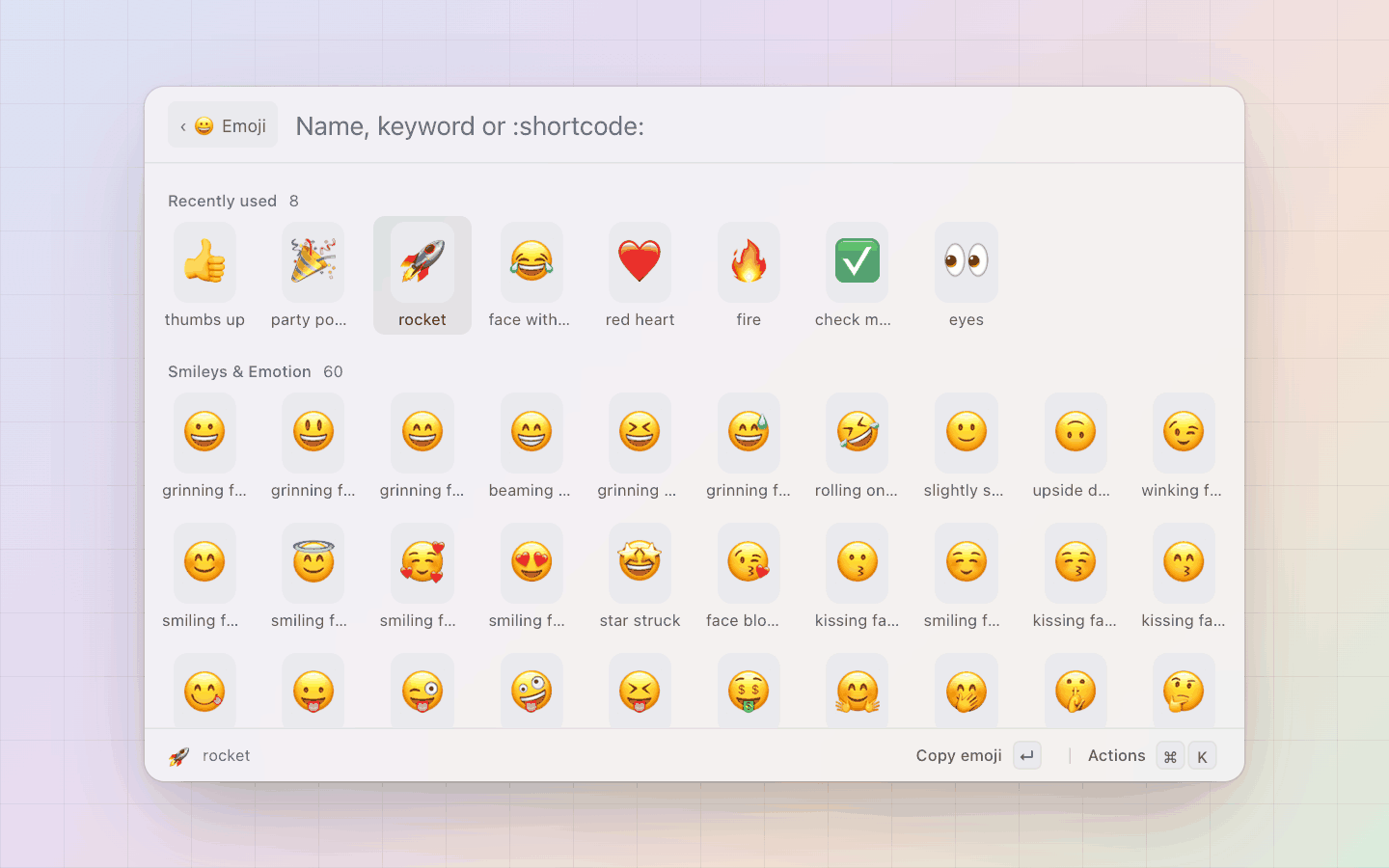
An emoji grid by category, recently used first; copy or paste one, or its :shortcode:.
 palv0.2.0Referencebundled
Ships inside pal. Installing puts an editable copy ahead of the bundled one.
What it does
Emoji
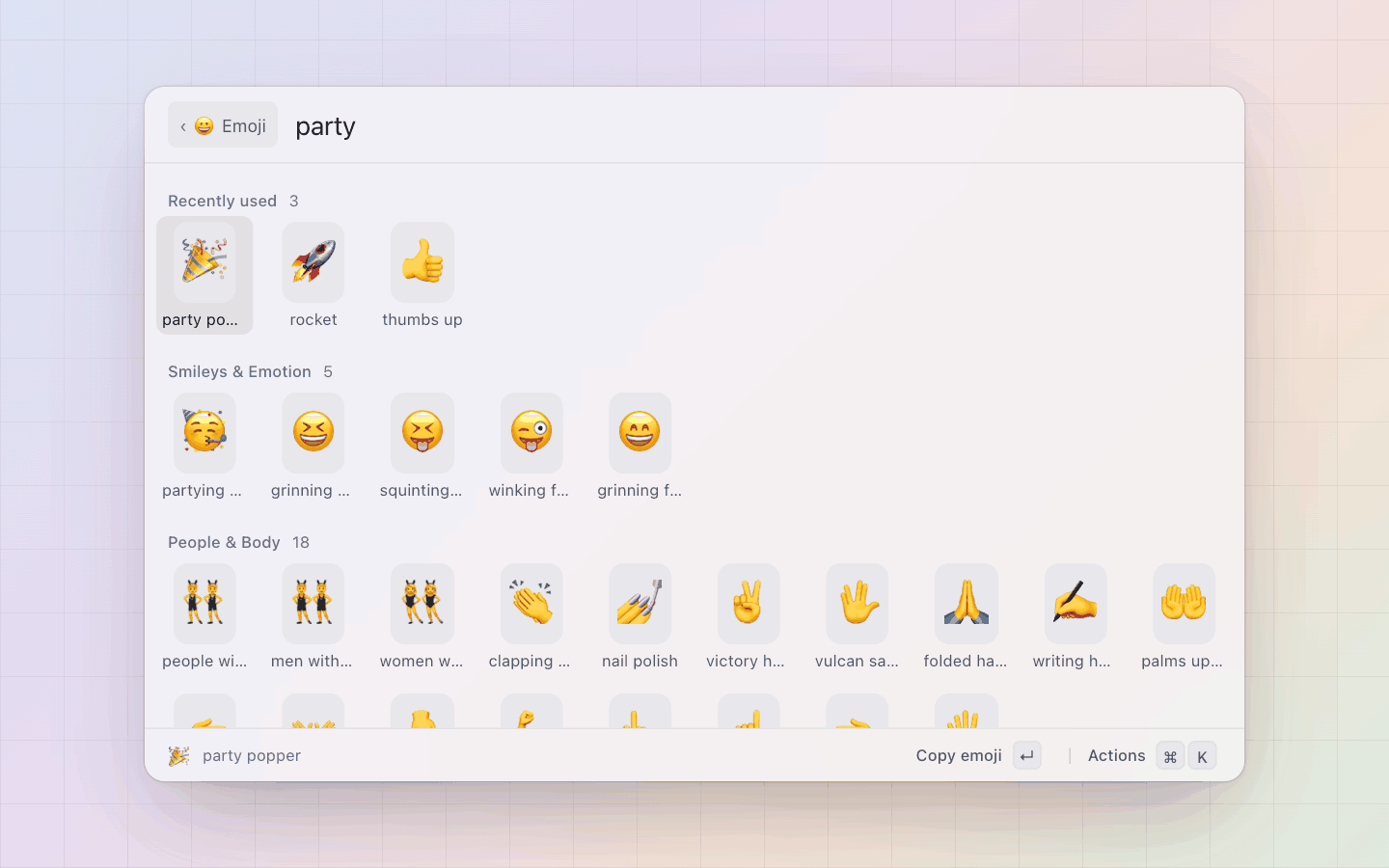
A grid of every emoji in the bundled list, searched by name, keyword and
shortcode. The tile is the glyph; the name is the shortcode with spaces
(thumbs up), and thumbs_up, :thumbs_up: and the keywords
(approve, +1) are what the search also matches.
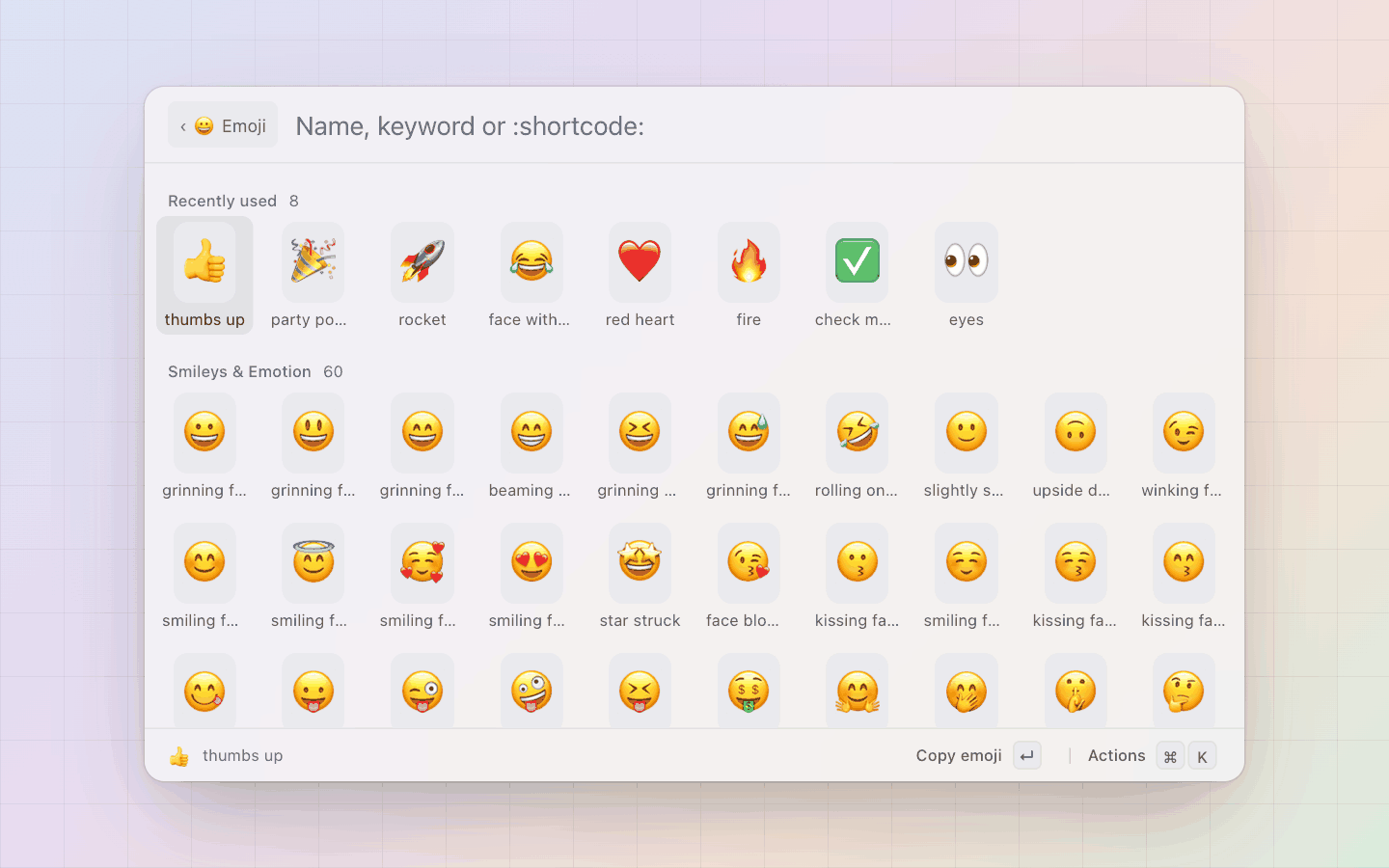
Sections: Recently used first (the last 24 you copied or pasted, kept
in the extension's storage), then Unicode's groups in their order: Smileys
& Emotion, People & Body, Animals & Nature, Food & Drink, Travel & Places,
Activities, Objects, Symbols, Flags. The palette is live with a 30 s
ttl: the order is the sections' own, never frecency's, and a show more
than 30 s after the last listing lists again so the recents follow what
you used.
data.json carries the emoji, its shortcode name, the keywords, the
category and whether a skin tone applies to it (the names and keywords
are emojilib's, the categories and the skin flag unicode-emoji-json's).
Keyboard
In the grid, arrows move across and down the tiles, cmd+1 to cmd+9
jump to a tile, Enter runs the first action of the tile under the
cursor.
| keys | action |
|---|---|
enter |
Copy emoji |
cmd+enter |
Paste emoji into the app that was in front |
cmd+shift+c |
Copy shortcode: :thumbs_up: |
cmd+k |
The three actions |
With paste_by_default on, Enter pastes and cmd+enter copies. A copy
or a paste moves the emoji to the front of Recently used.
Setup
Nothing to install. Pasting is a synthesised Cmd+V, which macOS only
delivers from a process on the Accessibility list: without the permission
pal shows the system prompt once per run and a toast saying what to grant
(System Settings > Privacy & Security > Accessibility). Copying needs
nothing. On Linux the paste is Ctrl+V through wtype, else ydotool
(which needs ydotoold running); with neither, paste fails and the toast
says so.
Settings, [extensions.emoji]:
| key | type | default | what |
|---|---|---|---|
skin_tone |
none, light, medium-light, medium, medium-dark, dark |
"none" |
The Fitzpatrick modifier applied where an emoji takes one (329 of them: hands, people), in the tile, on copy and on paste. |
paste_by_default |
bool | false |
Enter pastes into the app in front, cmd+enter copies. |
The modifier goes after the first code point, which tones a single person and the first person of a family or profession sequence; a two-person sequence gets one tone, on its first person.
Per palette, [palettes.emoji.settings]:
| key | type | default | what |
|---|---|---|---|
columns |
number, 4 to 16 | 10 |
Tiles per row in the grid. Read once when the extension loads: after a change, Settings > Restart extension host. |
What it does not do
- Expand
:shortcode:as you type in other apps: pal copies or pastes on Enter, there is no text expansion. - Tone each person of a two-person sequence differently; one tone, on the first.
- Search by the emoji's Unicode name (
GRINNING FACE); the names are shortcodes. The Unicode characters palette has the named symbols. - Show the emoji large in a detail pane; the tile is the whole picture.
Platforms
macOS and Linux. The glyphs are drawn by the platform's colour emoji font,
so what a tile looks like is the OS's; paste needs Accessibility on macOS
and wtype or ydotool on Linux.
Palettes 1
-
Emoji
emojigridEvery emoji in the bundled list, by category.
- ↵Copy emoji
- ⌘↵Paste emoji
- ⌘⇧CCopy shortcode
Actions
- Copy emoji↵
- Paste emojiInto the app that was in front; needs Accessibility on macOS.⌘↵
- Copy shortcode`:thumbs_up:`⌘⇧C
Settings
Extension, [extensions.emoji]
skin_toneApplied to the emoji that take one (hands, people) when shown, copied and pasted. One of none, light, medium-light, medium, medium-dark, dark.
paste_by_defaultOff, Enter copies and ⌘Enter pastes. Pasting needs Accessibility on macOS.
Emoji, [palettes.emoji]
columnsTiles per row in the grid.
Defaults shown. Change them in pal's settings window or in the config file.