
Ships inside pal. Installing puts an editable copy ahead of the bundled one.
What it does
SSH Hosts
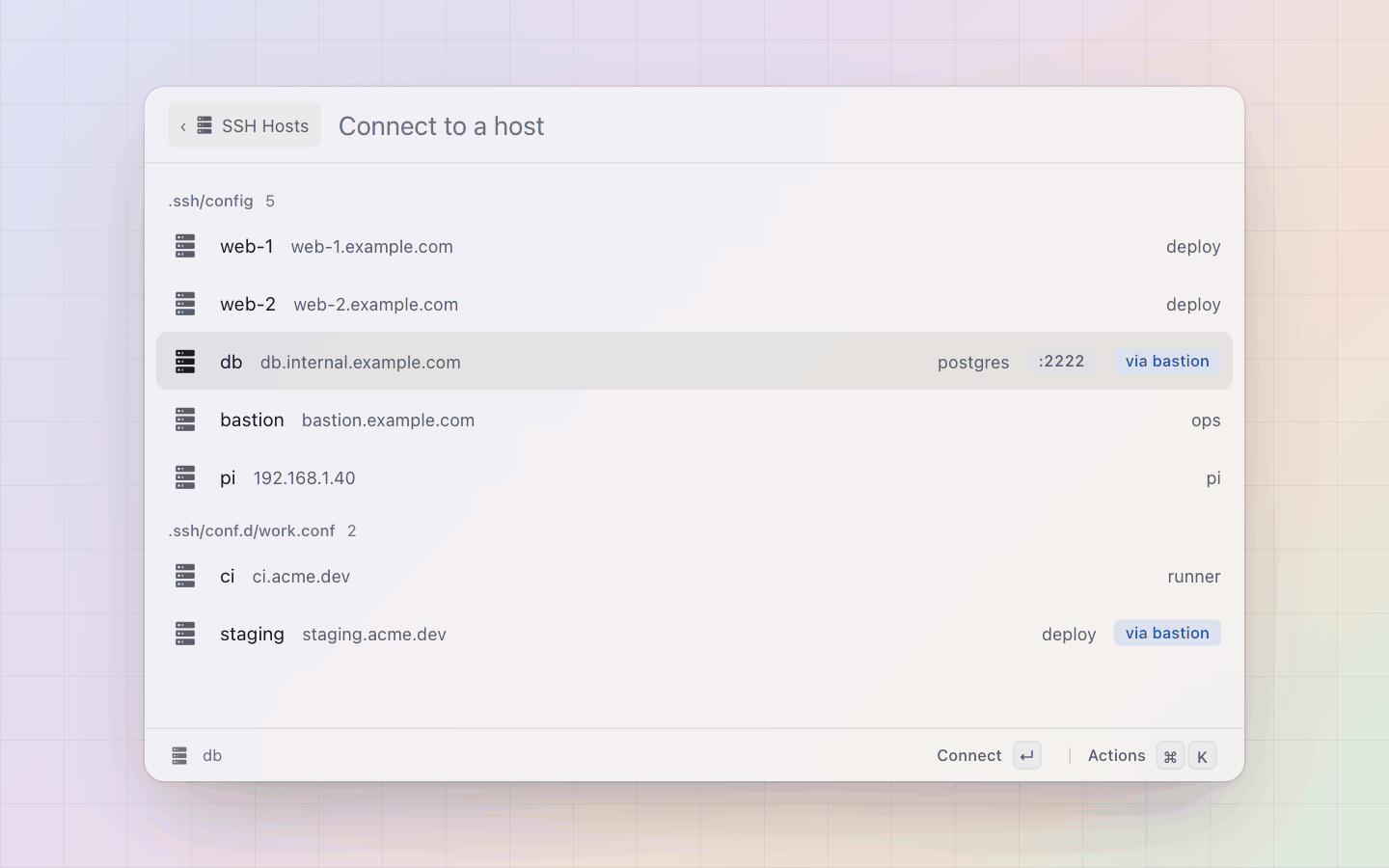
Every Host in ~/.ssh/config that is a name rather than a pattern (*,
? and ! entries are skipped, a Host a b line gives two rows), in file
order. Include lines are followed one level: ~, absolute and globbed
operands work, a relative one is under ~/.ssh. A Match block ends the
current host. The section is the file a host came from, relative to the
config's directory (.ssh/config, .ssh/conf.d/work.conf).
The palette
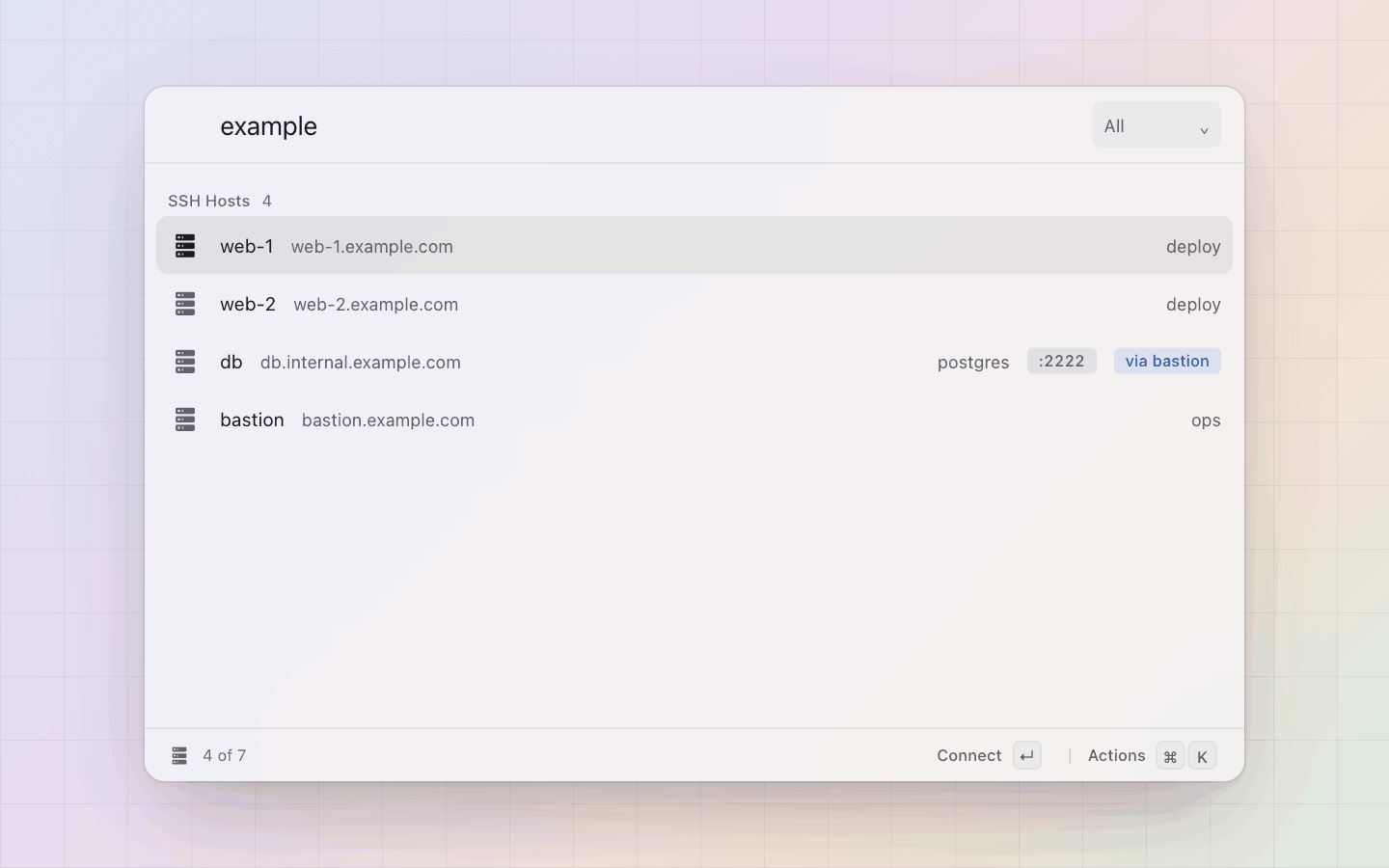
The row is the host's name; HostName is the subtitle and a keyword, so
the real name finds the alias from the root; User is an accessory and a
keyword, Port a :22-style tag. A host with ProxyJump carries a via <jump> tag and the jump as a keyword. The palette is indexed: listed
once, searched from the root, refreshed with cmd+r after the config
changes.
With include_known_hosts on, the names in ~/.ssh/known_hosts (next to
the config) come after, in a last Known hosts section: [host]:port
unwrapped, comma lists split, hashed lines, bare IPs and hosts already in
the config skipped.
Connect opens a terminal window running ssh <host> and hides the panel.
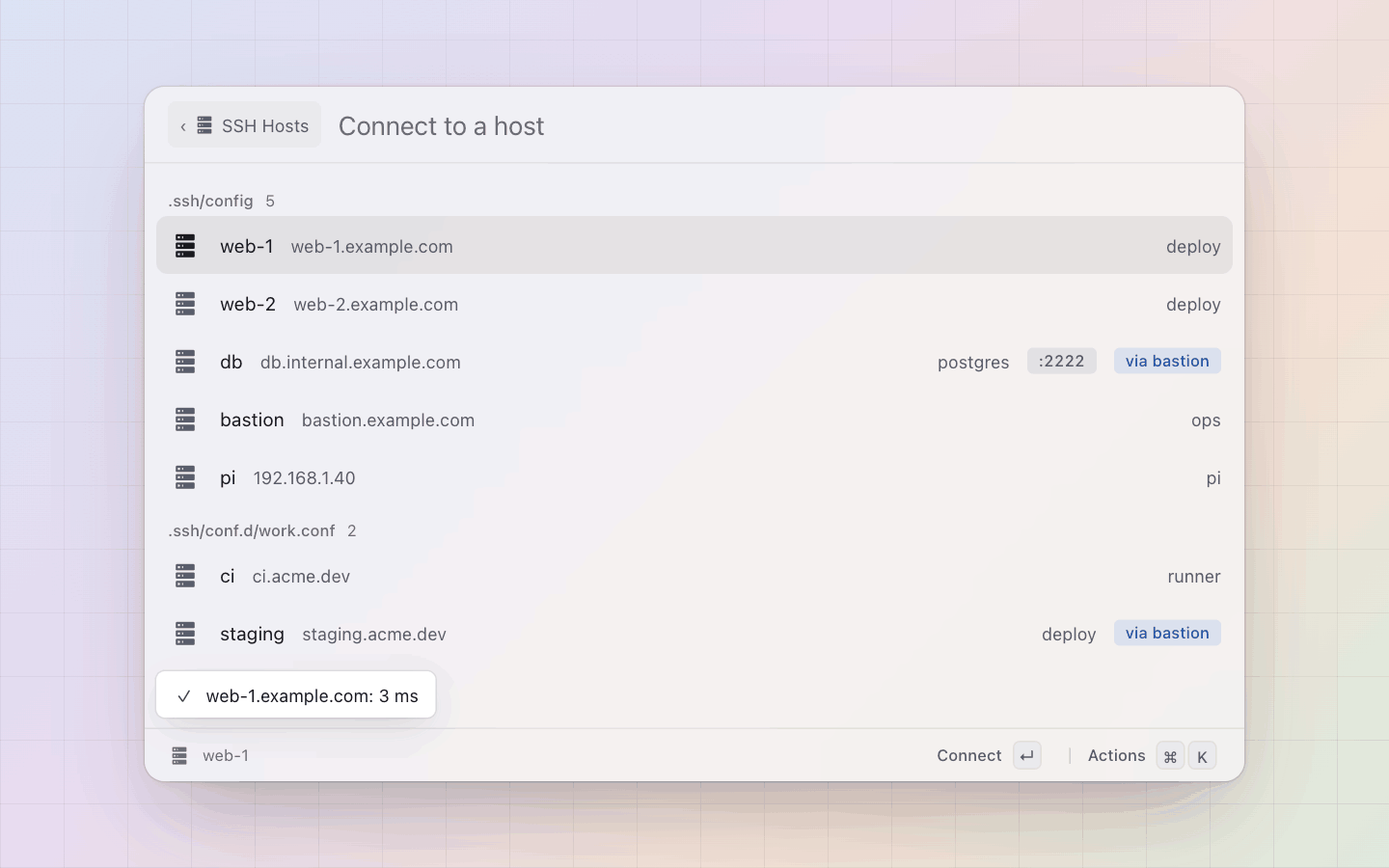
Ping sends one echo to the HostName (else the name) with a 2 s wait and
toasts the round trip (web-1.example.com: 3 ms), or why it did not
answer; the panel stays open.
Keyboard
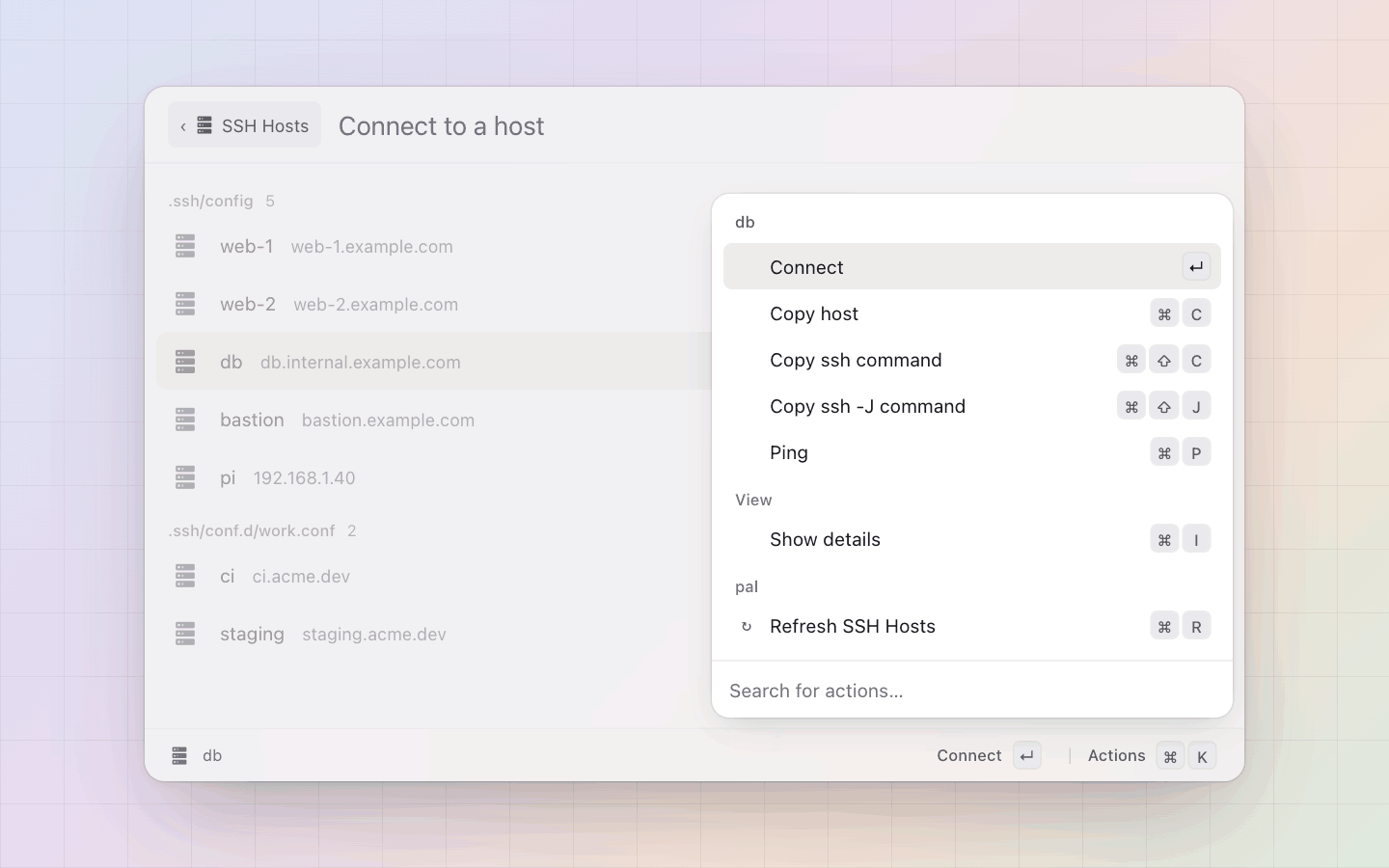
| keys | action |
|---|---|
enter |
Connect: a terminal window running ssh <host> |
cmd+c |
Copy host: the name as written in the config |
cmd+shift+c |
Copy ssh command: ssh <host> |
cmd+shift+j |
Copy ssh -J command: ssh -J <jump> <host> (only on a host with a ProxyJump) |
cmd+p |
Ping: one echo, the round trip as a toast |
cmd+r |
Refresh: read the config again |
The plain command already goes through the config's ProxyJump; the -J
form is for a machine that does not have your config.
Setup
An ~/.ssh/config with Host entries; ssh and ping on PATH. Nothing
else.
Which terminal Connect opens:
- macOS: the
terminalsetting.autotakes the first installed of kitty, Ghostty, Alacritty, iTerm2, Terminal (Terminal is always there, so it is the fallback). kitty getskitty -1 ssh host(a new OS window in the running instance when that was started single-instance), Ghostty and Alacrittyopen -na <app> --args -e ssh host, Terminal and iTerm2 an AppleScript that opens a window running the command, which asks for the Automation permission the first time. A terminal that is picked but not installed keeps the panel open with a toast. - Linux:
$TERMINAL, else the first of kitty, foot, alacritty, xterm on PATH; kitty and foot take the command as arguments, the others after-e.
Settings, [extensions.ssh]:
| key | type | default | what |
|---|---|---|---|
config |
path | ~/.ssh/config |
The config to read. ~ is expanded; known_hosts is looked for next to it. |
include_known_hosts |
bool | false |
List the names in known_hosts too, in a last section. |
terminal |
auto, kitty, Terminal, iTerm2, Ghostty, Alacritty |
auto |
macOS only: which terminal Connect opens. |
What it does not do
- Run ssh inside the panel: Connect hands the command to a terminal window and pal hides.
- Pattern hosts (
Host *.example.com) andMatchblocks: they are not rows, though their settings still apply when ssh runs. - Nested includes: an
Includeinside an included file is not followed. - Passwords, keys or agents: ssh's own business, in the terminal.
Platforms
macOS and Linux. The terminal is chosen per platform as above; ping's
wait flag is -W 2000 on macOS and -W 2 on Linux, the same one echo.
Palettes 1
-
Ssh
sshlistEvery Host in your ssh config, and what it connects to.
- ↵Connect in a terminal
- ⌘CCopy the host name
- ⌘⇧CCopy the ssh command
- ⌘PPing
Actions
- ConnectA terminal window running ssh <host>.↵
- Copy host⌘C
- Copy ssh commandssh <host>.⌘⇧C
- Copy ssh -J commandssh -J <jump> <host>, on a host with a ProxyJump.⌘⇧J
- PingOne echo to the HostName; the round trip as a toast.⌘P
Settings
Extension, [extensions.ssh]
configThe ssh config to read; Include lines in it are followed one level.
include_known_hostsOnly hosts you have connected to by name; hashed and numeric entries are skipped.
terminalWhich terminal Connect opens. Auto picks the first installed of kitty, Ghostty, Alacritty, iTerm2, Terminal. On Linux $TERMINAL, else kitty, foot, alacritty, xterm. One of auto, kitty, Terminal, iTerm2, Ghostty, Alacritty.
Defaults shown. Change them in pal's settings window or in the config file.