Docker
Containers, images and Compose projects from the panel: start, stop, logs, a shell.
 palv0.1.0Developerbundled
Ships inside pal. Installing puts an editable copy ahead of the bundled one.
What it does
Docker
Three live palettes over the docker CLI (docker ps -a, docker images,
docker compose ls -a, each with --format '{{json .}}'), listed again
when the panel shows once their rows are older than ttl. Podman works
through the same commands: set binary to podman, or install its
docker alias. Without the binary, or with the daemon not answering, each
palette is one inert hint row that says which.
Palettes
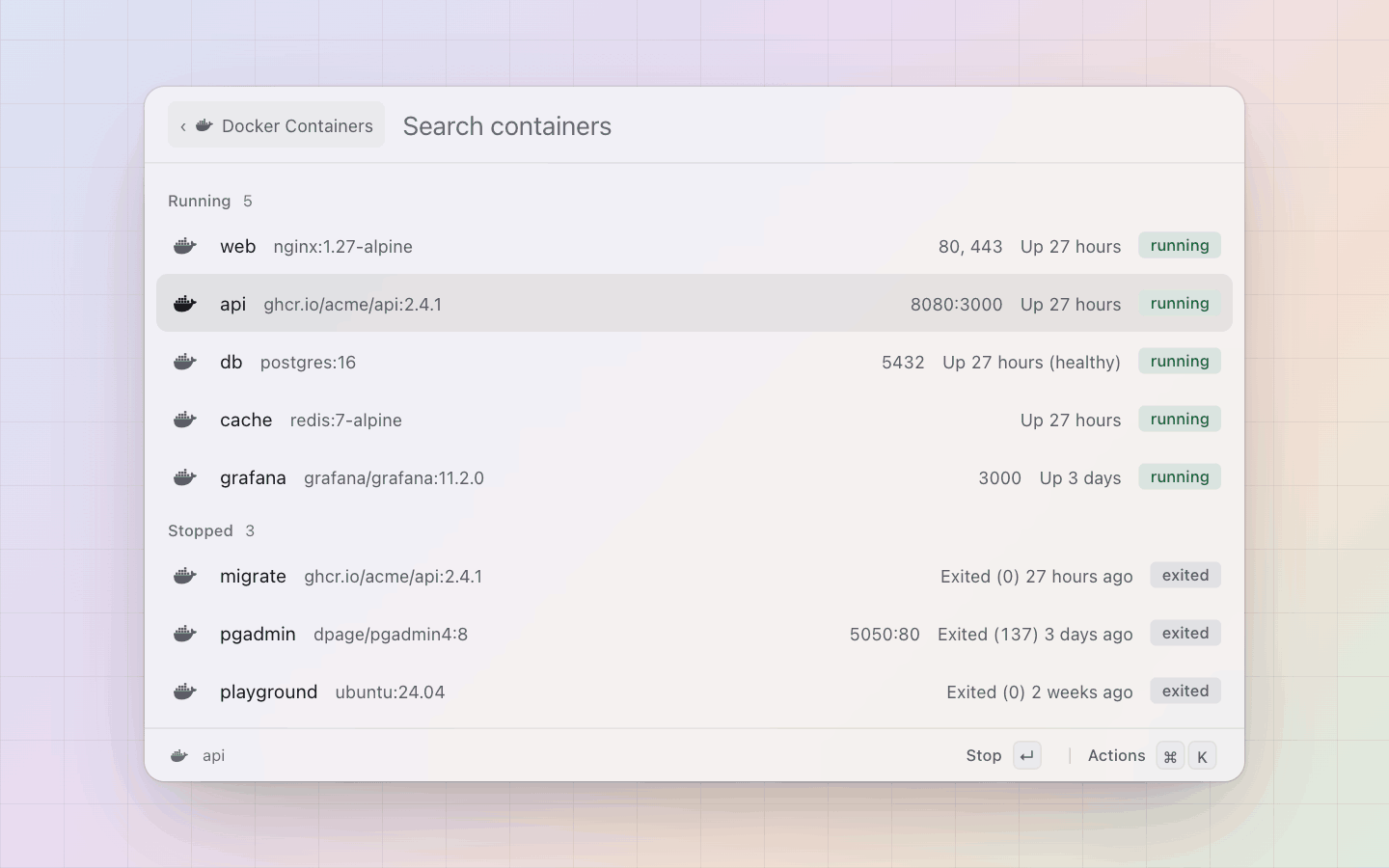
Docker Containers (docker): every container, the running ones first
in a Running section, the rest under Stopped. The row is the container's
name, its image the subtitle; on the right the published ports, compact
(80, 443; 8080:80 when host and container differ), docker's status
(Up 27 hours, Exited (0) 3 days ago) and a state tag (running green,
exited grey, paused and restarting amber, created blue, dead red). The id,
the image and the Compose project are keywords, so nginx or the project
name finds the container from the root. The detail pane lists id, image,
command, status, created, ports, mounts, networks and project.
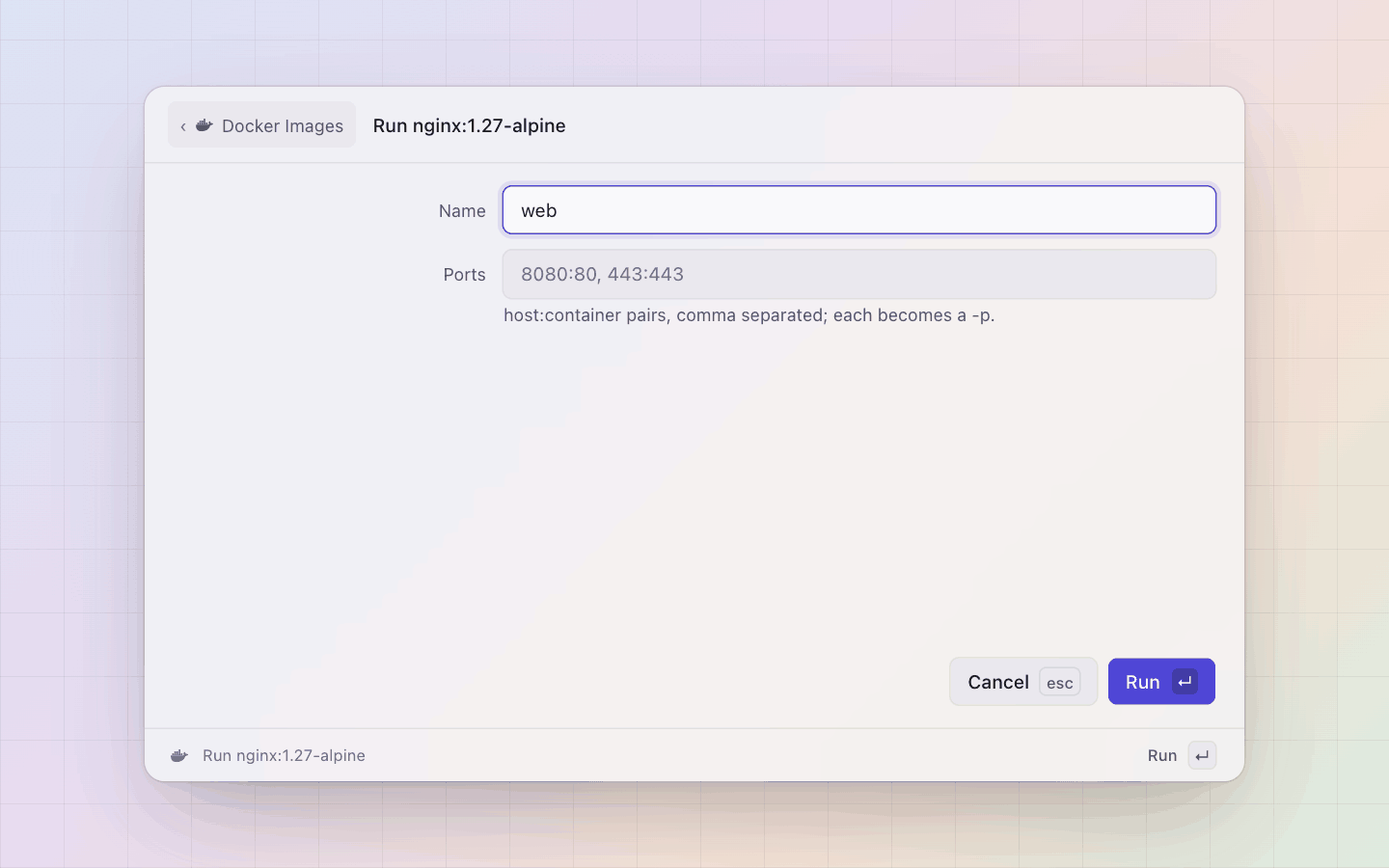
Docker Images (images): repository:tag (the id for an untagged
image), the id as subtitle, size and age on the right. Run asks for a name
and ports in a form (host:container pairs, comma separated; a malformed
one is refused under the field) and runs docker run -d [--name] [-p …] <image>.
Compose Projects (compose): every project docker knows of, its
folder as subtitle, the status text and a tag (running green, a mix amber,
exited grey). Every config file of the project is passed with -f.
A command keeps the panel open and lists again, with a toast naming what
happened. A command still running after 8 s (a stop whose process
ignores SIGTERM, a compose up that pulls) is left to finish on its own
and the toast says so; cmd+r later shows the outcome. A failed command
keeps the panel open with docker's last stderr line.
Keyboard
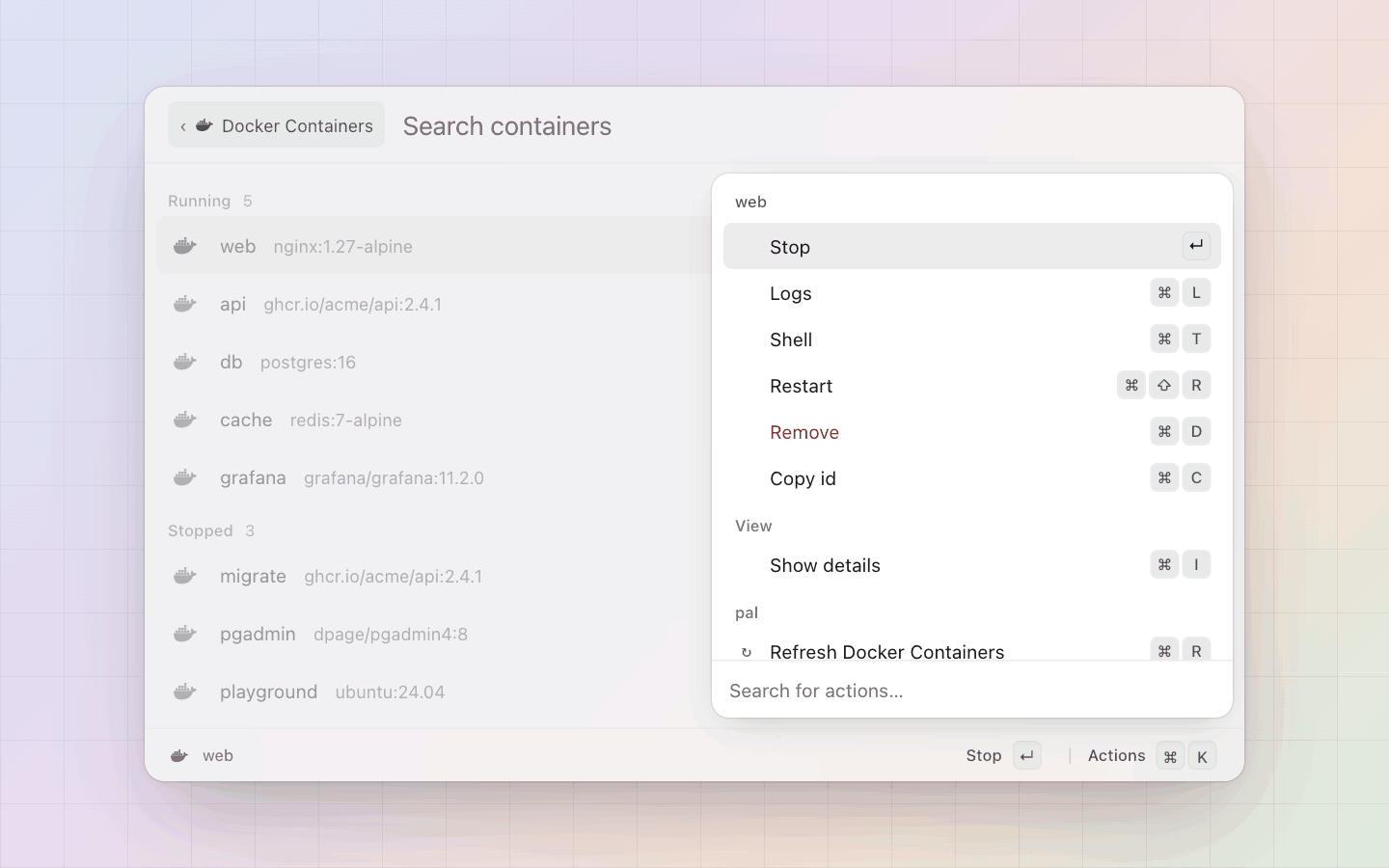
Containers:
| keys | action |
|---|---|
enter |
Stop a running container (asks first), Start a stopped one |
cmd+l |
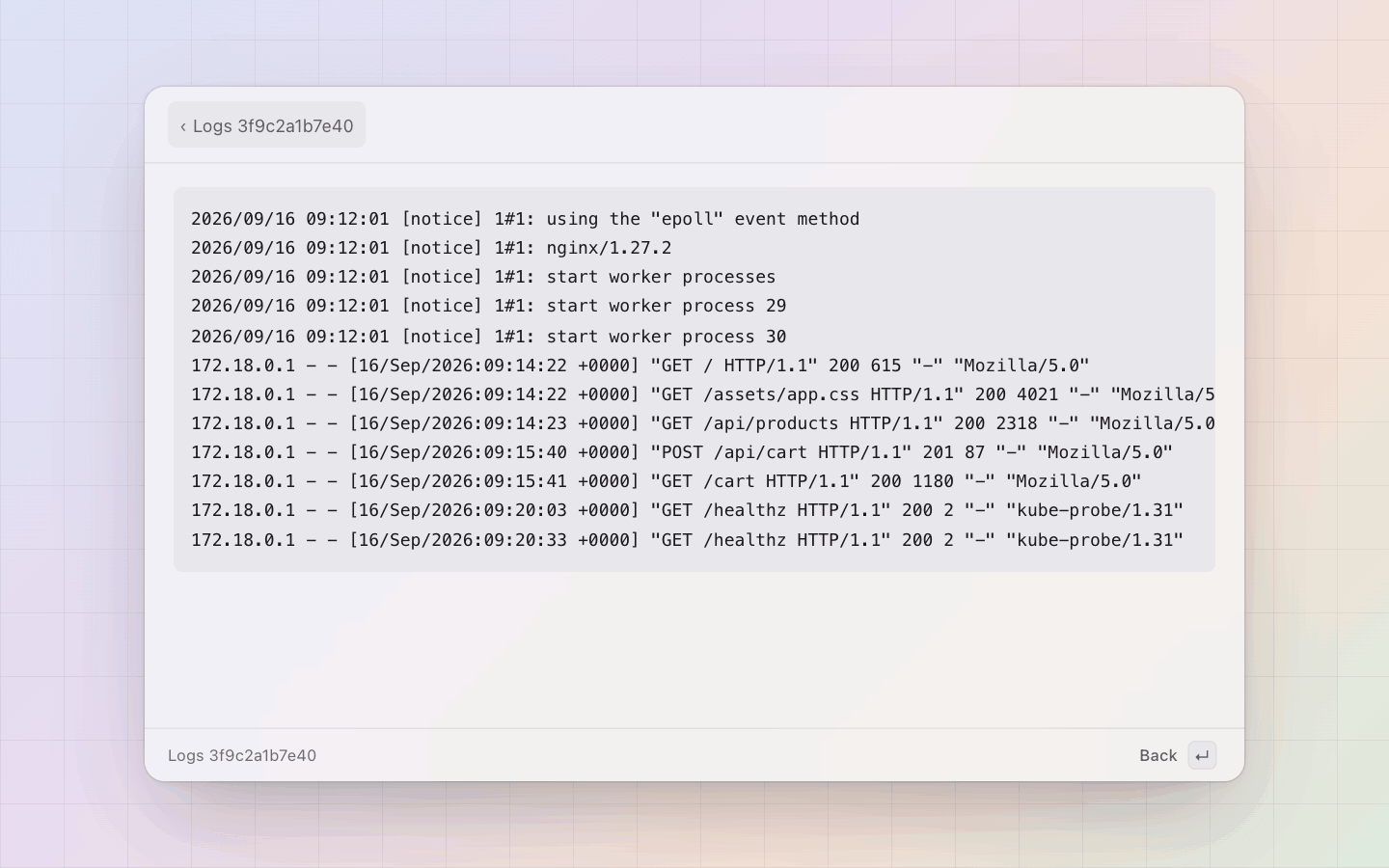
Logs: docker logs --tail 200, stdout and stderr, in the panel |
cmd+t |
Shell: a terminal running docker exec -it <id> (bash when the image has it, sh otherwise); running containers only |
cmd+shift+r |
Restart |
cmd+d |
Remove: docker rm -f, after a confirm |
cmd+c |
Copy the short id |
Images:
| keys | action |
|---|---|
enter |
Run: the form, then docker run -d |
cmd+c |
Copy id |
cmd+d |
Remove: docker rmi, after a confirm |
Compose projects:
| keys | action |
|---|---|
enter |
Up: compose up -d |
cmd+l |
Logs: compose logs --tail 200 |
cmd+shift+r |
Restart |
cmd+d |
Down, after a confirm |
cmd+o |
Open the project folder |
Setup
Docker (or Podman) installed and its daemon running; the CLI is looked up on PATH. Nothing else.
Which terminal Shell opens: on macOS the terminal setting (auto takes
the first installed of kitty, Ghostty, Alacritty, iTerm2, Terminal);
Terminal and iTerm2 are driven through AppleScript, so the first Shell
into one of them asks for the Automation permission once. On Linux
$TERMINAL, else the first of kitty, foot, alacritty, xterm on PATH.
Settings, [extensions.docker]:
| key | type | default | what |
|---|---|---|---|
binary |
text | docker |
The CLI to run; podman works. |
ttl |
number (s) | 10 |
How long a listing stays good for before a show lists again. Read when the extension loads. |
terminal |
auto, kitty, Terminal, iTerm2, Ghostty, Alacritty |
auto |
macOS only: which terminal Shell opens. |
What it does not do
- Pull, build or push: only what is already on the machine is listed.
- Remote hosts and contexts beyond what the CLI's own default context points at.
- Stream logs: Logs is a snapshot of the last 200 lines, read again on the
next
cmd+l. - Wait for a slow command: after 8 s it goes on alone and the toast says so.
Platforms
macOS and Linux. The terminal for Shell is chosen per platform as above; everything else is the same CLI on both.
Palettes 3
-
Docker
dockerliveEvery container, running first: start, stop, restart, logs, a shell, remove.
- ↵Stop a running container, start a stopped one
- ⌘LLogs
- ⌘TShell in a terminal
- ⌘DRemove
-
Images
imagesliveLocal images: run one (name and ports asked), remove, copy the id.
- ↵Run, after a form for the name and ports
- ⌘CCopy id
- ⌘DRemove
-
Compose
composeliveCompose projects docker knows of: up, down, restart, logs.
- ↵Up
- ⌘LLogs
- ⌘DDown
- ⌘OOpen project folder
Actions
- StopA running container; asks first.↵
- StartA stopped container.↵
- LogsThe last 200 lines, stdout and stderr, in the panel.⌘L
- ShellA terminal running docker exec (bash when the image has it, sh otherwise).⌘T
- Restart⌘⇧R
- Removedocker rm -f, docker rmi or compose down; asks first.⌘D
- Copy id⌘C
- Run…An image: a form for the name and ports, then docker run -d.↵
- UpA Compose project: compose up -d.↵
- DownStops and removes the project's containers and networks; asks first.⌘D
- Open project folder⌘O
Settings
Extension, [extensions.docker]
binaryThe CLI to run: docker, or podman (its docker-compatible commands are what is used).
ttlSeconds a listing stays good for: the palettes list again on show only once the rows are older than this. Read when the extension loads.
terminalWhich terminal Shell opens. Auto picks the first installed of kitty, Ghostty, Alacritty, iTerm2, Terminal. On Linux $TERMINAL, else kitty, foot, alacritty, xterm. One of auto, kitty, Terminal, iTerm2, Ghostty, Alacritty.
Defaults shown. Change them in pal's settings window or in the config file.