Services
The OS's service manager in the panel: systemd units on Linux, launchd jobs on macOS.
 palv0.1.0Systembundled
Ships inside pal. Installing puts an editable copy ahead of the bundled one.
What it does
Services
The OS's service manager, one live palette: systemd units on Linux,
launchd jobs on macOS. What it lists depends on the platform; on both the
rows are listed again when the panel shows once they are older than
ttl, and cmd+r lists now. The backend is picked from the platform
(PAL_SERVICES_BACKEND=systemd|launchd forces one; the tests run both on
one machine against fake binaries).
Linux: systemd
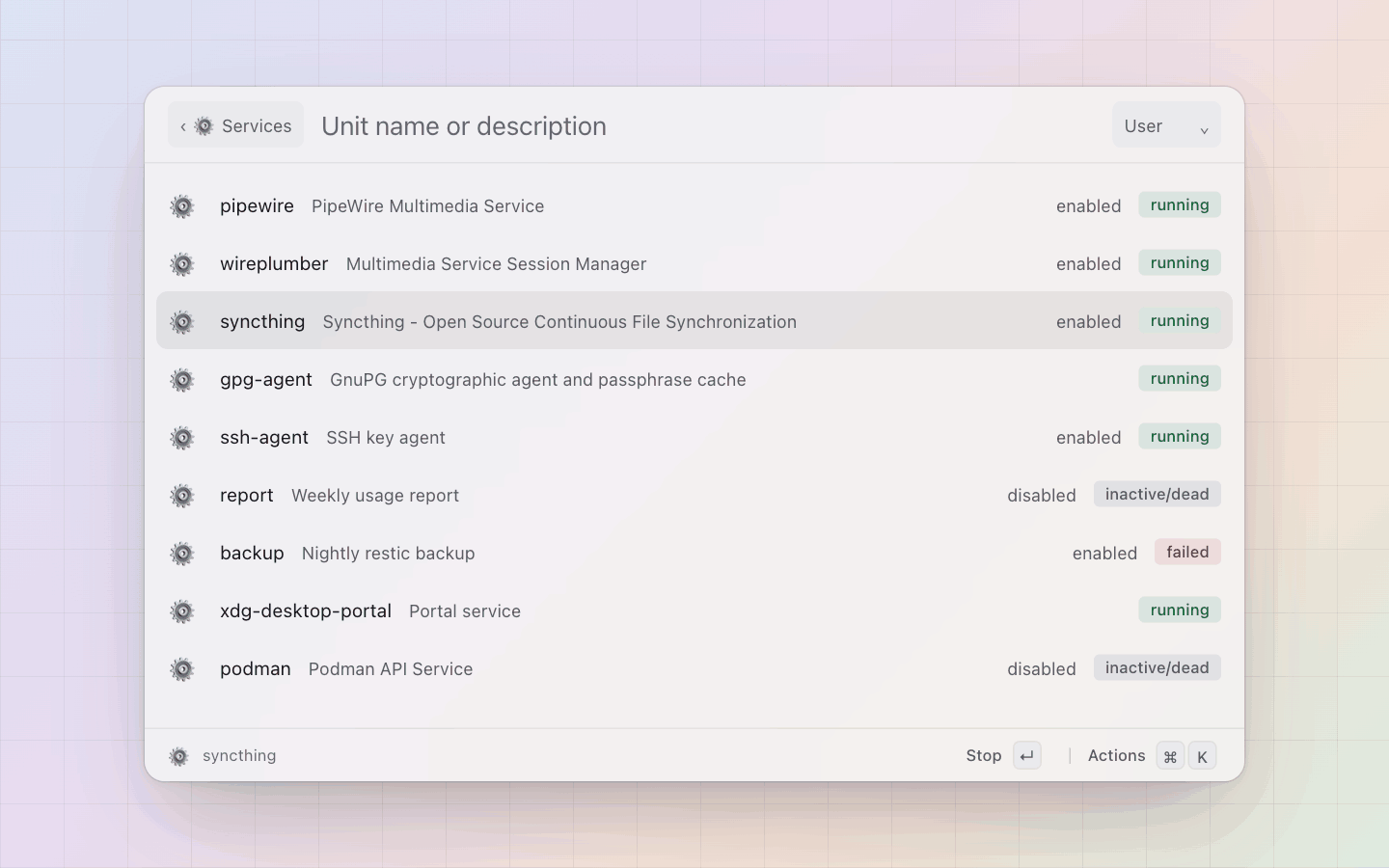
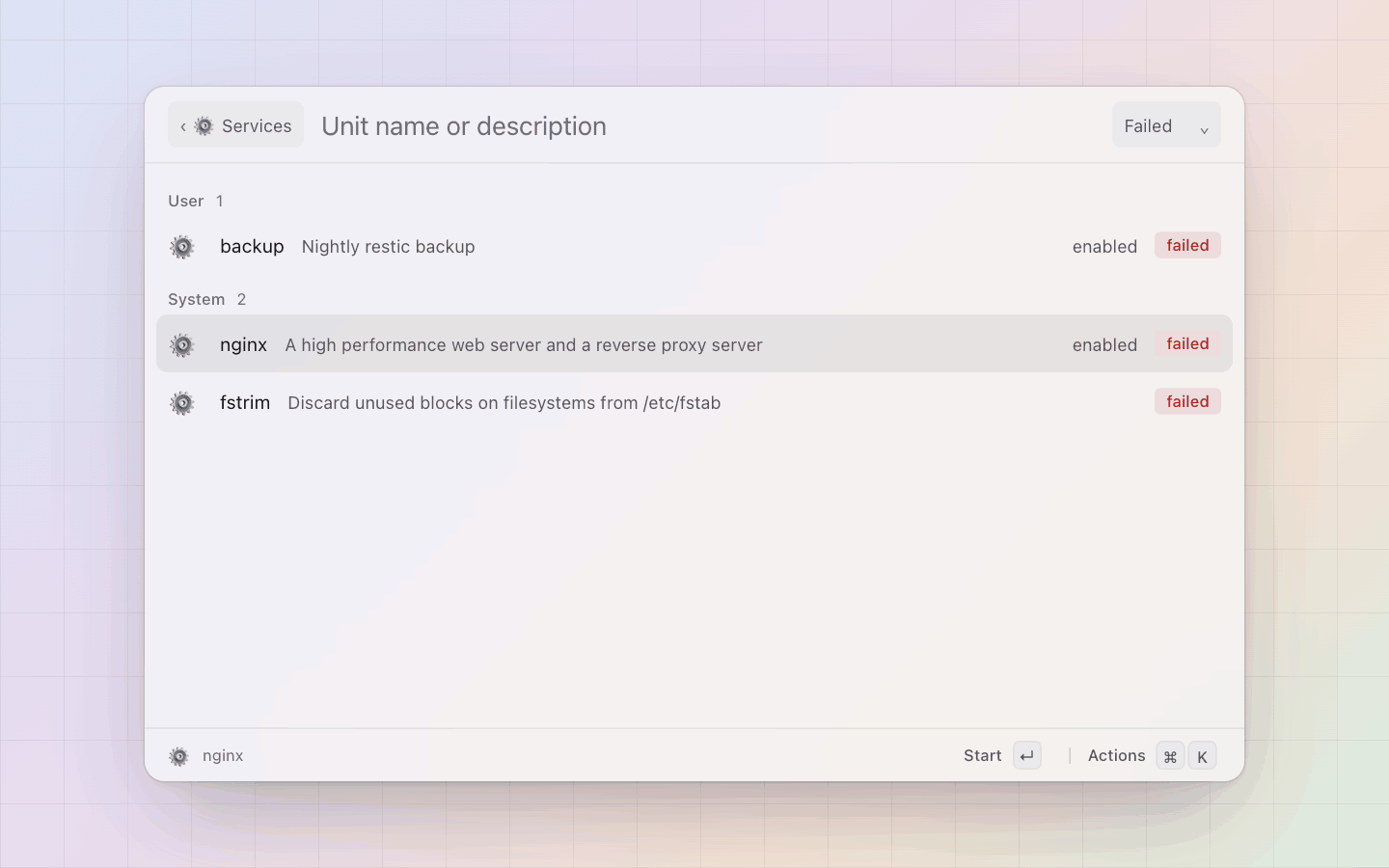
Filters: User (systemctl --user), System, Failed and Running (the last
two span both managers, in a User and a System section). The row is the
unit without .service, its description the subtitle; on the right the
unit file's state (enabled, disabled; nothing for static, generated
and transient units) and a tag with the active state: the sub state alone
when active (running, exited, green), active/sub otherwise
(inactive/dead grey, failed/failed red, activating amber). Units are
what list-units --all has loaded, then the unit files it has not (a
disabled service that never ran), inactive and without a description;
templates, masked and alias files are skipped. An instance
(app-foo@autostart.service) shows its template's enabled state. The
detail pane lists the unit, its scope, the load and active states and the
unit file's state.
A system unit's Stop, Restart and Disable ask first (a user unit's too
with confirm_user). A system verb runs as systemctl --no-ask-password <verb>; when that is refused for want of authentication it is tried
through sudo -n (a credential window opened by sudo -v in a terminal),
then pkexec (a polkit agent's prompt, when one is running). When none is
allowed the panel stays open with a toast quoting all three refusals. A
verb still running after 8 s (a stop waiting on TimeoutStopSec, a polkit
prompt) goes on without the panel; cmd+r shows the outcome. A
journalctl for a system unit shows what your user may read.
macOS: launchd
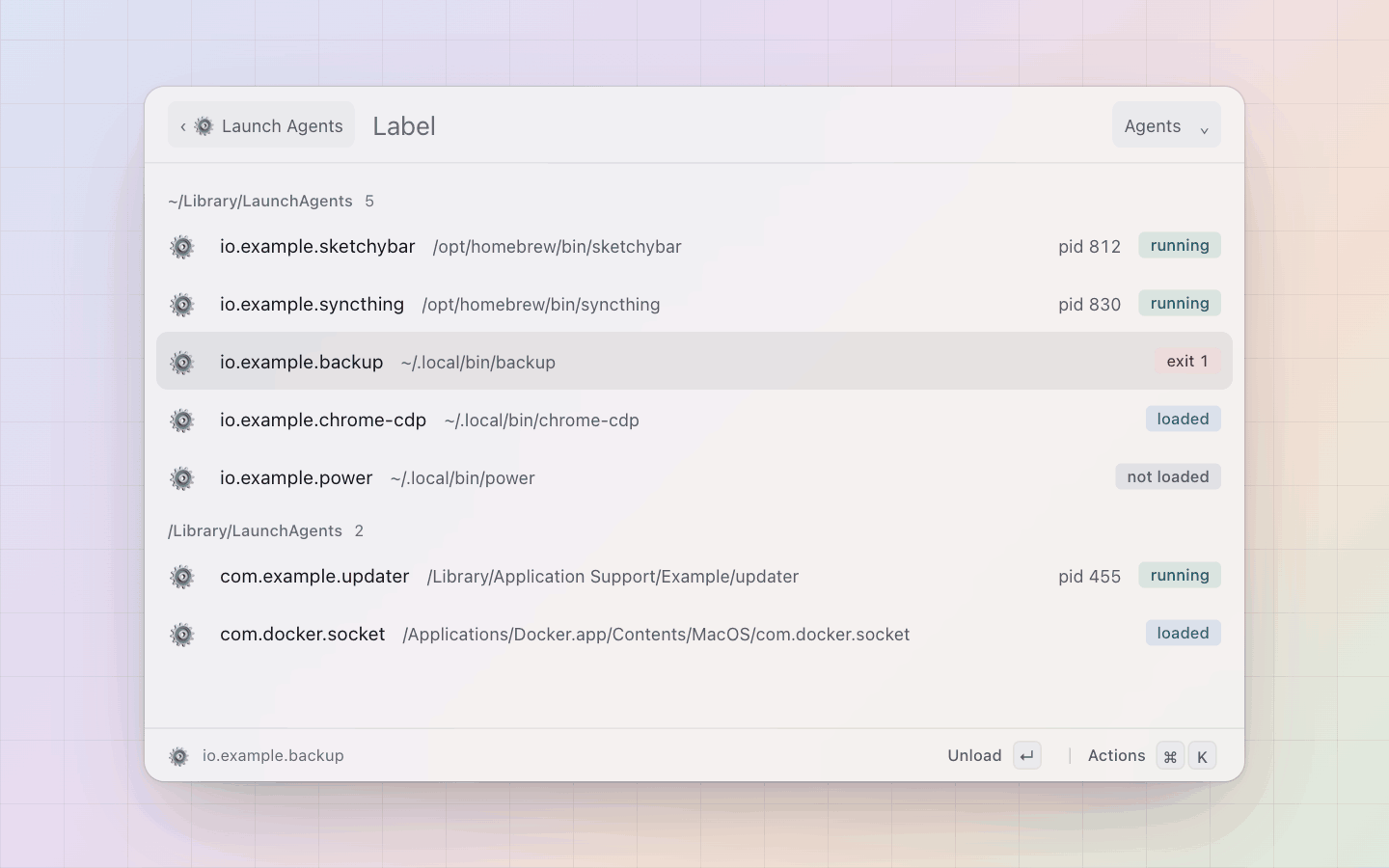
Filters: Agents (the plists in the agent_dirs folders, one section per
folder), Loaded (everything launchctl list knows, sorted; the
application.* jobs of running apps skipped) and Running (those with a
pid). The row is the label, the program from the plist (its Program, or
the first ProgramArguments entry) the subtitle, and on the right the pid
and a tag: running (green), loaded (blue, no process right now), exit N (red, the last exit was not 0), not loaded (grey, a plist launchd has
not been given). A binary plist is read through plutil.
Keyboard
Linux:
| keys | action |
|---|---|
enter |
Stop an active unit (systemctl stop), Start an inactive one |
cmd+l |
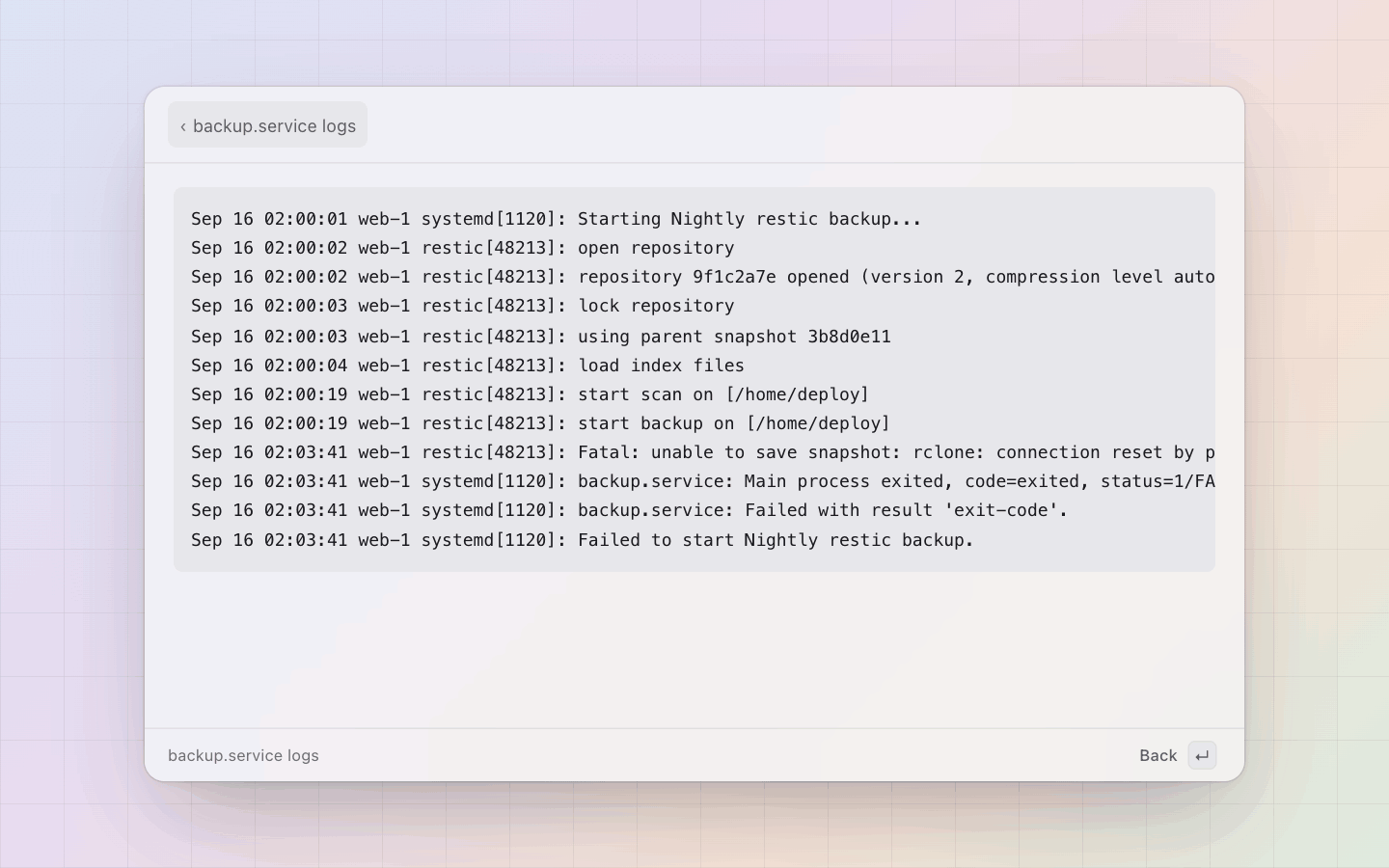
Logs: journalctl -u <unit> -n 200 --no-pager (--user for a user unit) in the panel |
cmd+shift+r |
Restart |
cmd+e |
Enable or Disable, on the unit file's state; absent for a static, generated or transient unit |
cmd+c |
Copy unit name: name.service |
tab |
The next filter: User, System, Failed, Running |
macOS:
| keys | action |
|---|---|
enter |
Unload a loaded job (launchctl bootout gui/$UID/<label>, after a confirm), Load one that is not (launchctl bootstrap gui/$UID <plist>) |
cmd+shift+r |
Restart: launchctl kickstart -k gui/$UID/<label> |
cmd+l |
Show plist: the plist as XML in the panel |
cmd+o |
Open the plist file |
cmd+c |
Copy label |
tab |
The next filter: Agents, Loaded, Running |
Setup
Nothing to install: systemctl and journalctl on Linux, launchctl and
plutil on macOS are the OS's own. For system units on Linux, either an
open sudo window (sudo -v in a terminal) or a running polkit agent lets
a verb through; without both, the toast says what was refused.
Settings, [extensions.services]:
| key | type | default | what |
|---|---|---|---|
ttl |
number (s) | 10 |
How long a listing stays good for before a show lists again. Read when the extension loads. |
confirm_user |
bool | false |
Ask before stopping, restarting or disabling a user unit too. |
agent_dirs |
list | ~/Library/LaunchAgents, /Library/LaunchAgents |
macOS only: where agent plists are read from. |
What it does not do
- Ask for a password itself: the host has no way to; a system verb goes
through
sudo -norpkexecand needs one of them to be allowed. - Edit a unit or a plist: Open plist file hands it to the default app.
- Timers, sockets, mounts: on Linux only
.serviceunits are listed; on macOS launch daemons (/Library/LaunchDaemons, root's) are not. - Follow logs: Logs is a snapshot of the last 200 lines.
Platforms
Both, with a different backend each: systemd on Linux, launchd on macOS. The filters, the tags and the verbs are the backend's own, as above.
Palettes 1
-
Services
servicesliveEvery service unit (Linux) or launchd job (macOS), with its state.
- ↵Stop or start (unload or load on macOS)
- ⌘LLogs (the plist on macOS)
- ⌘⇧RRestart
- ⇥Next filter: User, System, Failed, Running
Actions
- Stopsystemctl stop on an active unit; a system unit asks first.↵
- Startsystemctl start on an inactive unit.↵
- Logsjournalctl -u <unit> -n 200 in the panel.⌘L
- Restartsystemctl restart, or launchctl kickstart -k on macOS.⌘⇧R
- Enablesystemctl enable on a disabled unit file.⌘E
- Disablesystemctl disable; a system unit asks first.⌘E
- Copy unit namename.service.⌘C
- UnloadmacOS: launchctl bootout; asks first.↵
- LoadmacOS: launchctl bootstrap from the plist.↵
- Show plistmacOS: the plist as XML in the panel.⌘L
- Open plist file⌘O
- Copy label⌘C
Settings
Extension, [extensions.services]
ttlSeconds a listing stays good for: the palette lists again on show only once the rows are older than this. Read when the extension loads.
confirm_useragent_dirsWhere the launchd agent plists are read from; the first is yours, the second every user's.
Defaults shown. Change them in pal's settings window or in the config file.