Network
Every address this machine has right now, one Enter from the clipboard.
 palv0.1.0Systembundled
Ships inside pal. Installing puts an editable copy ahead of the bundled one.
What it does
Network
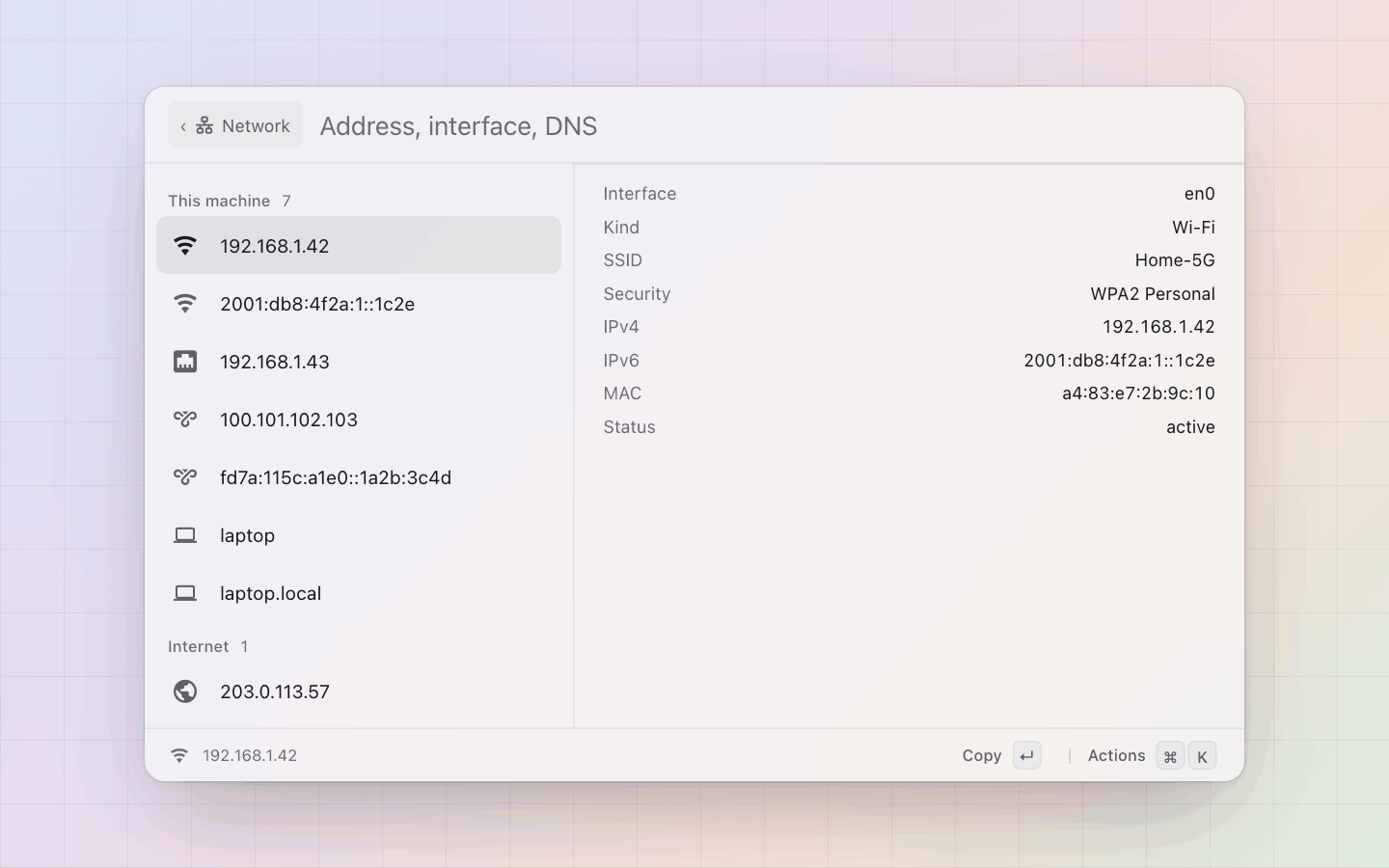
This machine's addresses, one row per value: the value is the row's name
so it reads at a glance, the label is the subtitle, enter copies. Live,
listed again when the panel shows and the last listing is over a minute
old; cmd+r lists now. The palette opens with the detail pane showing.
The rows
| section | rows | from |
|---|---|---|
| This machine | every interface's IPv4 and global IPv6 addresses (loopback and link-local left out), the Wi-Fi one labelled with its SSID; the Tailscale IPv4 and IPv6; the hostname; the Bonjour .local name on macOS |
macOS: ifconfig, networksetup -listallhardwareports (the kind), ipconfig getsummary <dev> (SSID, security); Linux: ip -j addr, iw dev; tailscale ip where the CLI is on PATH (or the Tailscale.app binary on macOS); os.hostname(), scutil --get LocalHostName |
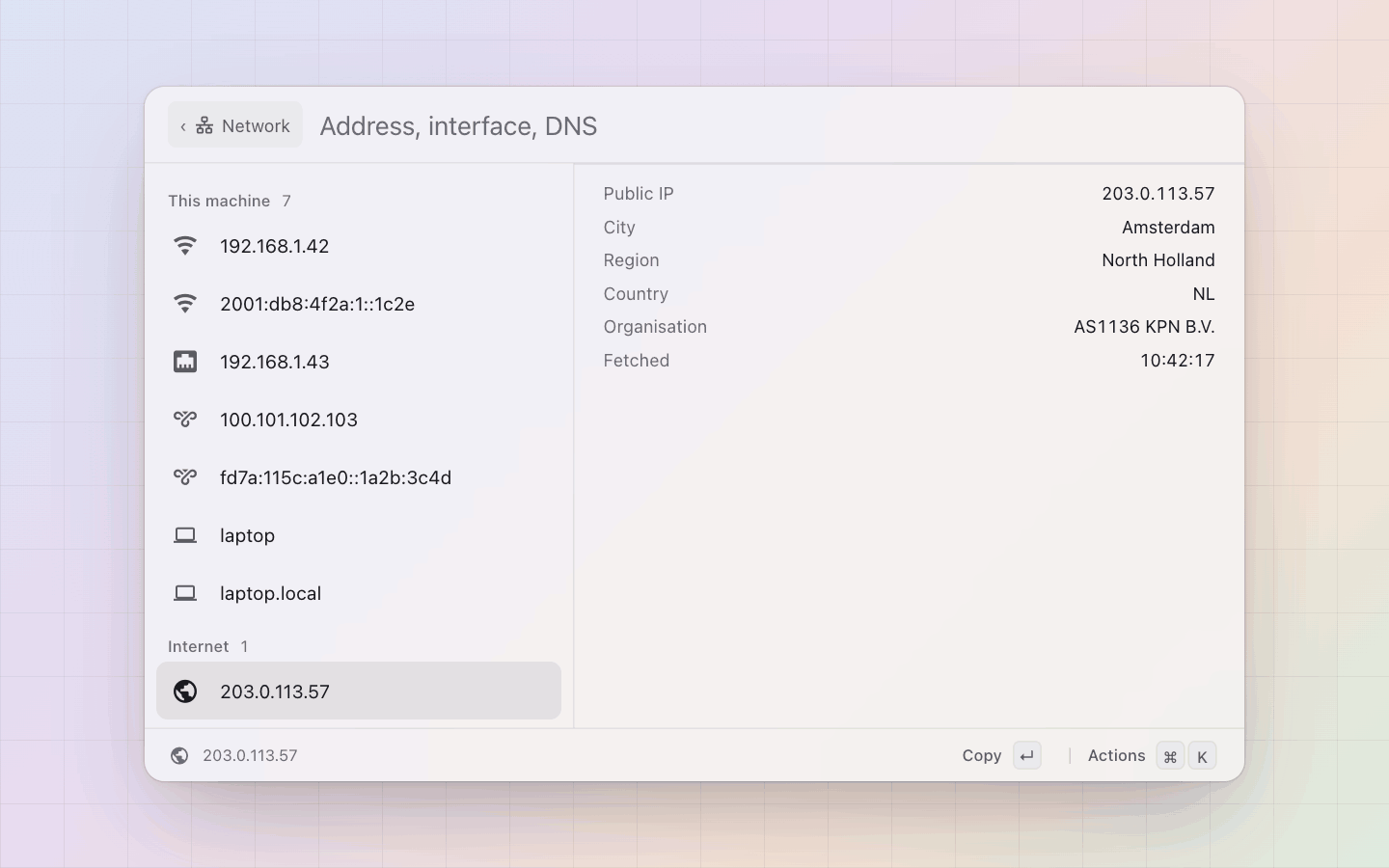
| Internet | the public IP, with the city, country and organisation when the endpoint gives them | one GET of public_ip_url with a 3 s timeout, kept 10 minutes (cmd+r fetches again; a failure is not kept); JSON with ip (ipinfo), query (ip-api) or connection.isp (ipwho.is) shapes, or a bare address |
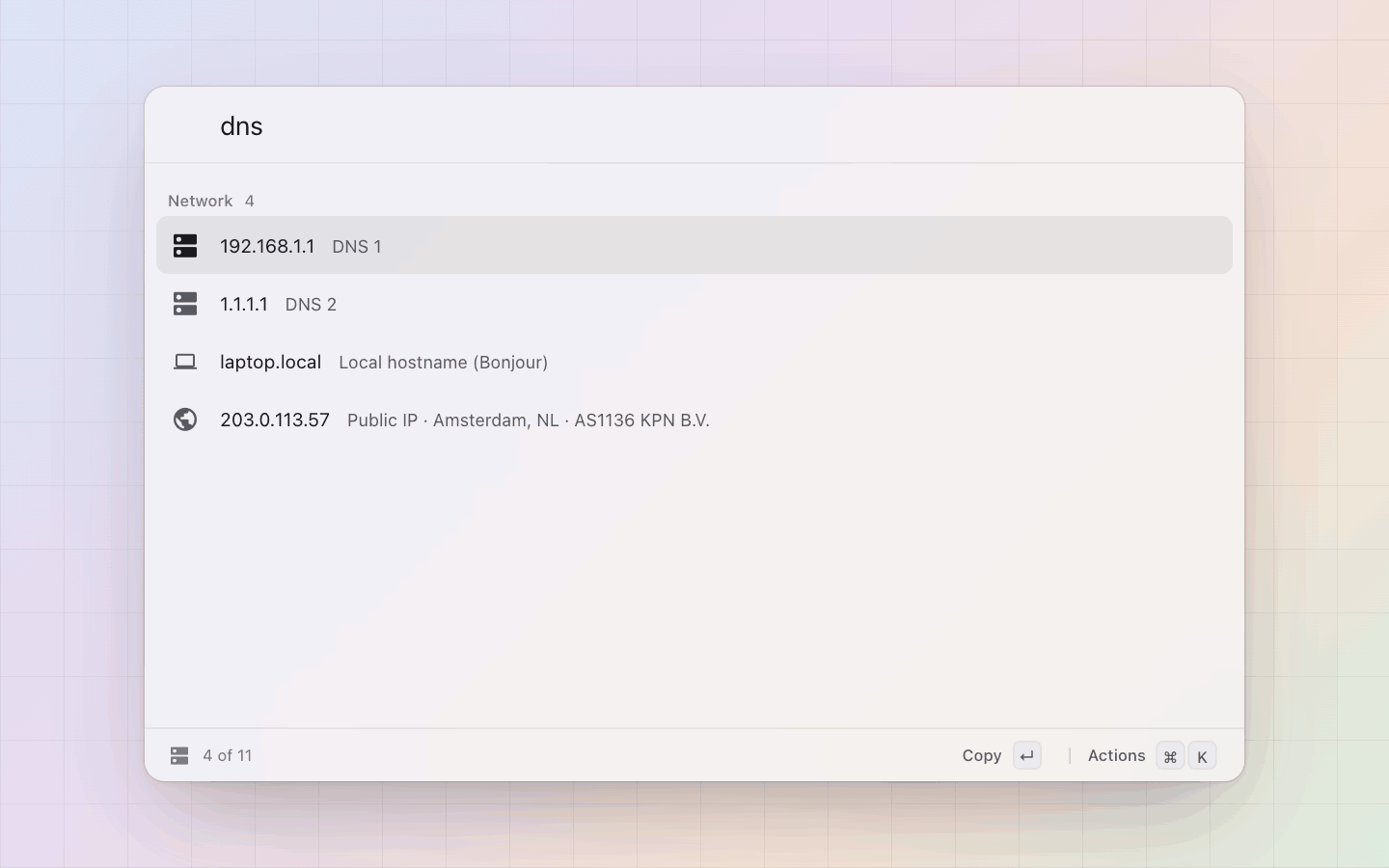
| Network | the default gateway with its interface; the DNS servers in resolver order | macOS: route -n get default, scutil --dns; Linux: ip -j route show default, /etc/resolv.conf (behind systemd-resolved's stub, resolvectl dns) |
Every tool runs with a 3 s timeout and a missing one just leaves its rows
out. The tunnel interface carrying the Tailscale addresses (utun4,
tailscale0) is folded into the Tailscale rows. When nothing has an
address, or there is no route, an inert row says so; the public IP row
says why when the fetch fails.
Keywords make the rows findable from the root: wifi, lan, ip for an
interface address, public, wan, external for the public IP,
gateway, router for the route, dns, nameserver for a resolver,
tailscale, vpn for those.
The detail pane lists every field of the row: interface, kind, SSID, security, IPv4, IPv6, MAC and status for an address; city, region, country, organisation and when it was fetched for the public IP; the resolver order for a DNS server.
Keyboard
| keys | action |
|---|---|
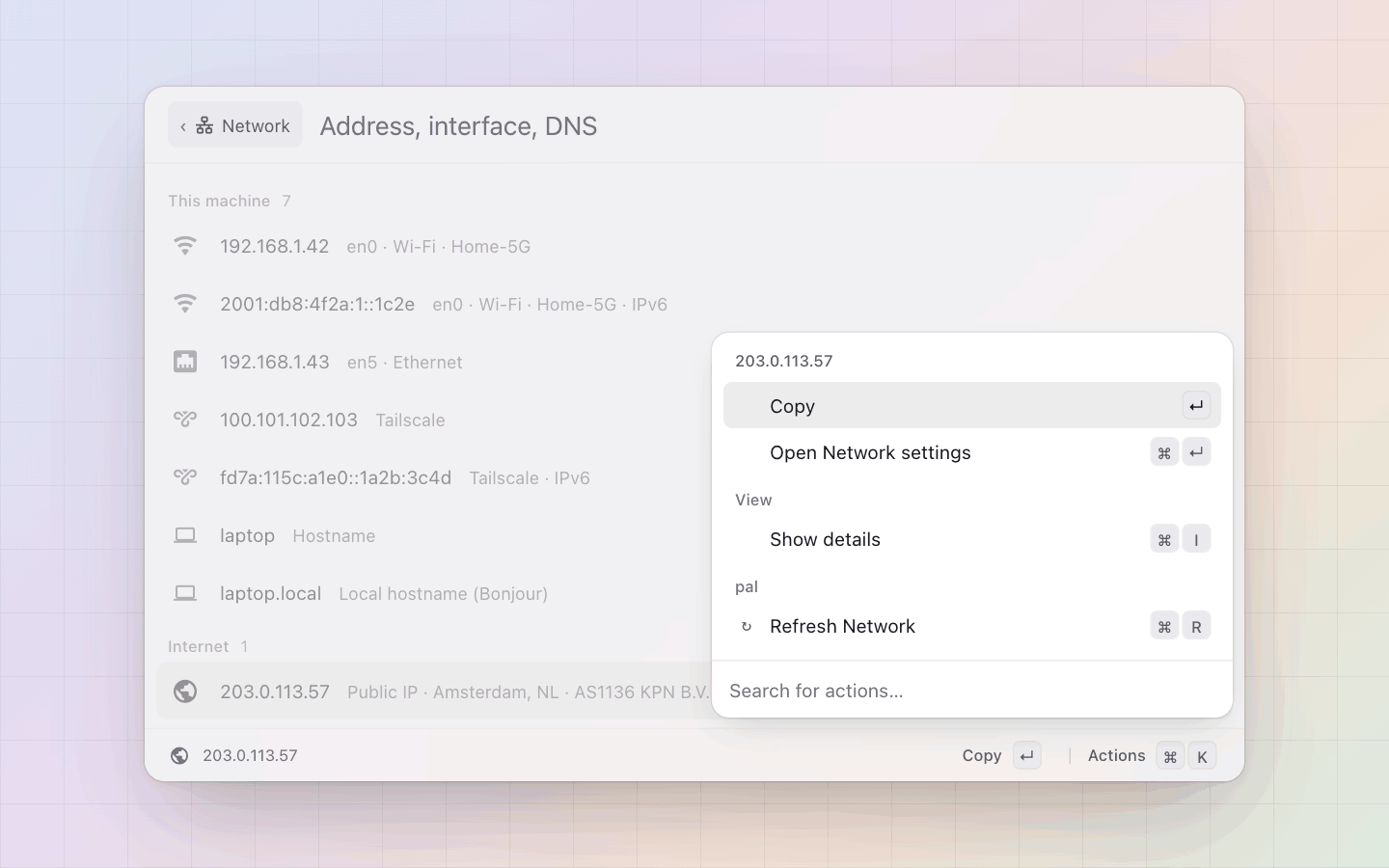
enter |
Copy the value |
cmd+enter |
Open Network settings: the Network pane of System Settings on macOS; on Linux the first of gnome-control-center network, systemsettings kcm_networkmanagement, nm-connection-editor installed |
cmd+i |
Hide or show the detail pane (open by default here) |
cmd+r |
List again, and fetch the public IP again |
Setup
Nothing to install: the rows come from the OS's own tools. tailscale on
PATH (or Tailscale.app) adds the Tailscale rows.
The SSID on macOS: since Sonoma the system redacts the network name
for a process without Location Services access (ipconfig getsummary
prints <redacted>, networksetup -getairportnetwork says not
associated), so without that grant the Wi-Fi row is labelled by kind
(en0 · Wi-Fi) and the detail pane says the SSID is hidden. Grant pal
Location access in System Settings and the name appears; everything else
works without it.
The public IP is one request to public_ip_url (ipinfo.io by default);
set it empty for no Internet section and no request at all.
Settings, [extensions.network]:
| key | type | default | what |
|---|---|---|---|
public_ip_url |
text | https://ipinfo.io/json |
The endpoint the public IP row asks. Empty: no Internet section. https://api.ipify.org (a bare address) and http://ip-api.com/json work too. |
What it does not do
- Flush DNS: on macOS it is
dscacheutil -flushcache; killall -HUP mDNSResponder, which needs sudo, and the host has no way to ask for a password; run it from a terminal. - Change anything: no joining, no interface toggles; Open Network settings hands that to the OS. Wi-Fi networks are the Wi-Fi extension's.
- Speed tests, ping, port scans: only what the machine already knows about itself, plus the one public IP request.
- Watch for changes: the rows are as of the last listing, a minute old at most when the panel shows.
Platforms
macOS and Linux, with the platform's own tools as in the table above. The
Bonjour .local name and the SSID redaction are macOS only; the
resolvectl path is for a Linux behind systemd-resolved.
Palettes 1
-
Network
networkliveLive rows, listed again when the panel shows and the last listing is over a minute old; ⌘R lists now and fetches the public IP again.
- ↵Copy the value
- ⌘↵Open Network settings
- ⌘RList again, public IP included
Actions
- CopyThe row's value.↵
- Open Network settingsSystem Settings on macOS; gnome-control-center, systemsettings or nm-connection-editor on Linux.⌘↵
Settings
Extension, [extensions.network]
public_ip_urlFetched with a 3 s timeout and kept 10 minutes; JSON with `ip` (and `city`, `country`, `org` when it has them) or a bare address. Empty: no public IP row.
Defaults shown. Change them in pal's settings window or in the config file.