GitHub
Your pull requests, issues, repositories and notifications as rows, and GitHub's search typed into the panel.
 palv0.1.0DeveloperbundledMenu bar: Notifications
Ships inside pal. Installing puts an editable copy ahead of the bundled one.
Menu bar 1



What it does
GitHub
One extension, five palettes, one sign-in: your pull requests, issues, repositories and notifications as rows, and GitHub's own search typed into the panel. Enter opens the thing on GitHub; the other actions copy, check out, merge, close or mark read without leaving the keyboard.
| palette | id | kind | what Enter does |
|---|---|---|---|
| Pull Requests | github-prs |
indexed, 5 min | opens the pull request |
| Issues | github-issues |
indexed, 5 min | opens the issue |
| Repositories | github-repos |
indexed, 5 min | opens the repository on GitHub |
| Notifications | github-notifications |
live, 1 min | marks the thread read and opens it |
| Search GitHub | github-search |
input | opens what was found |
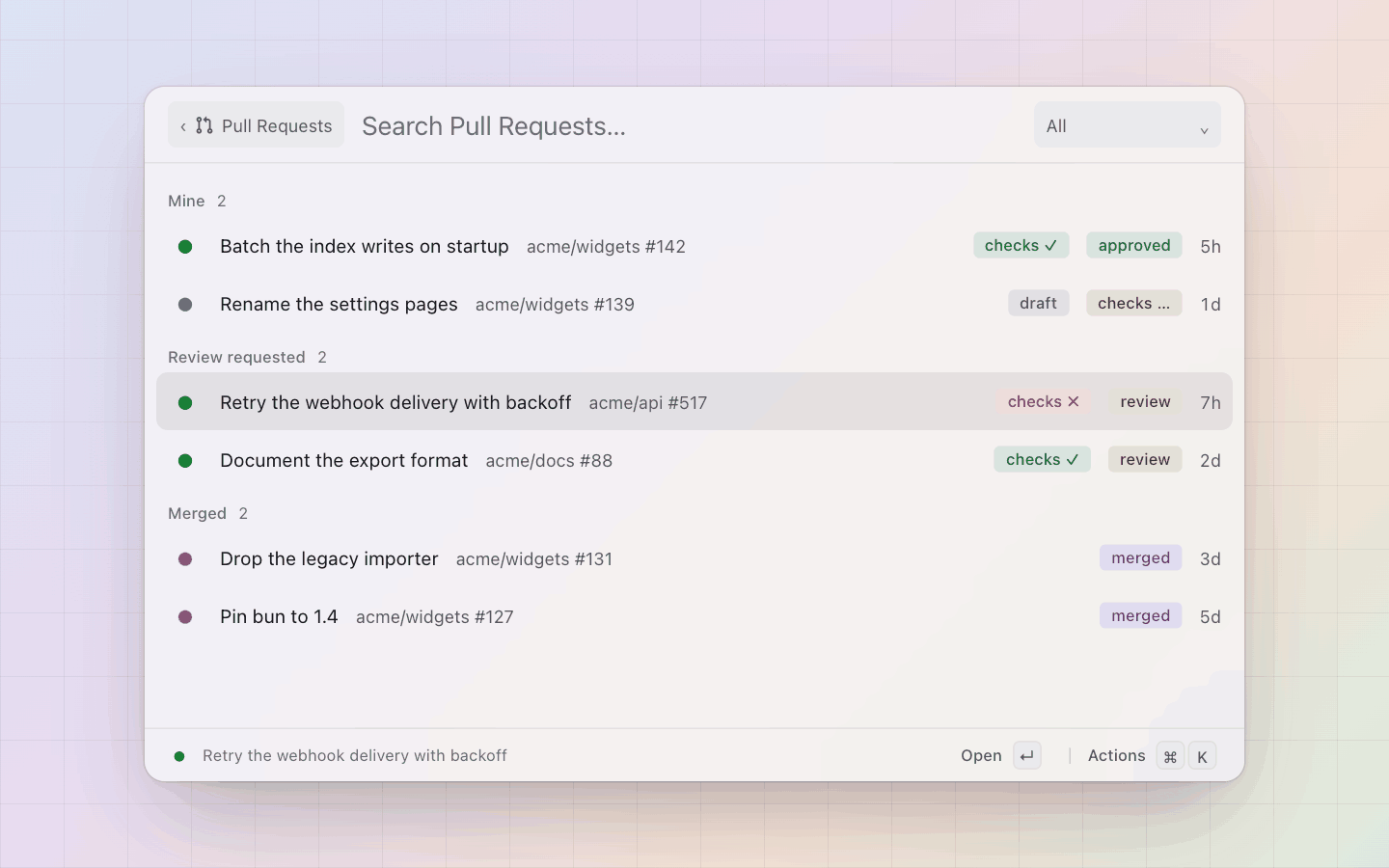
Pull Requests lists yours (is:open author:@me), the ones waiting on
your review (review-requested:@me), and yours merged within
merged_days, sectioned Mine, Review requested, Merged; the filter
dropdown has the same three plus All. The row is the title with
owner/repo #n under it, a state dot (green open, grey draft, violet
merged, red closed) and tags for the checks (checks ✓ / ✗ / …),
the review decision (approved, changes requested, review), draft and
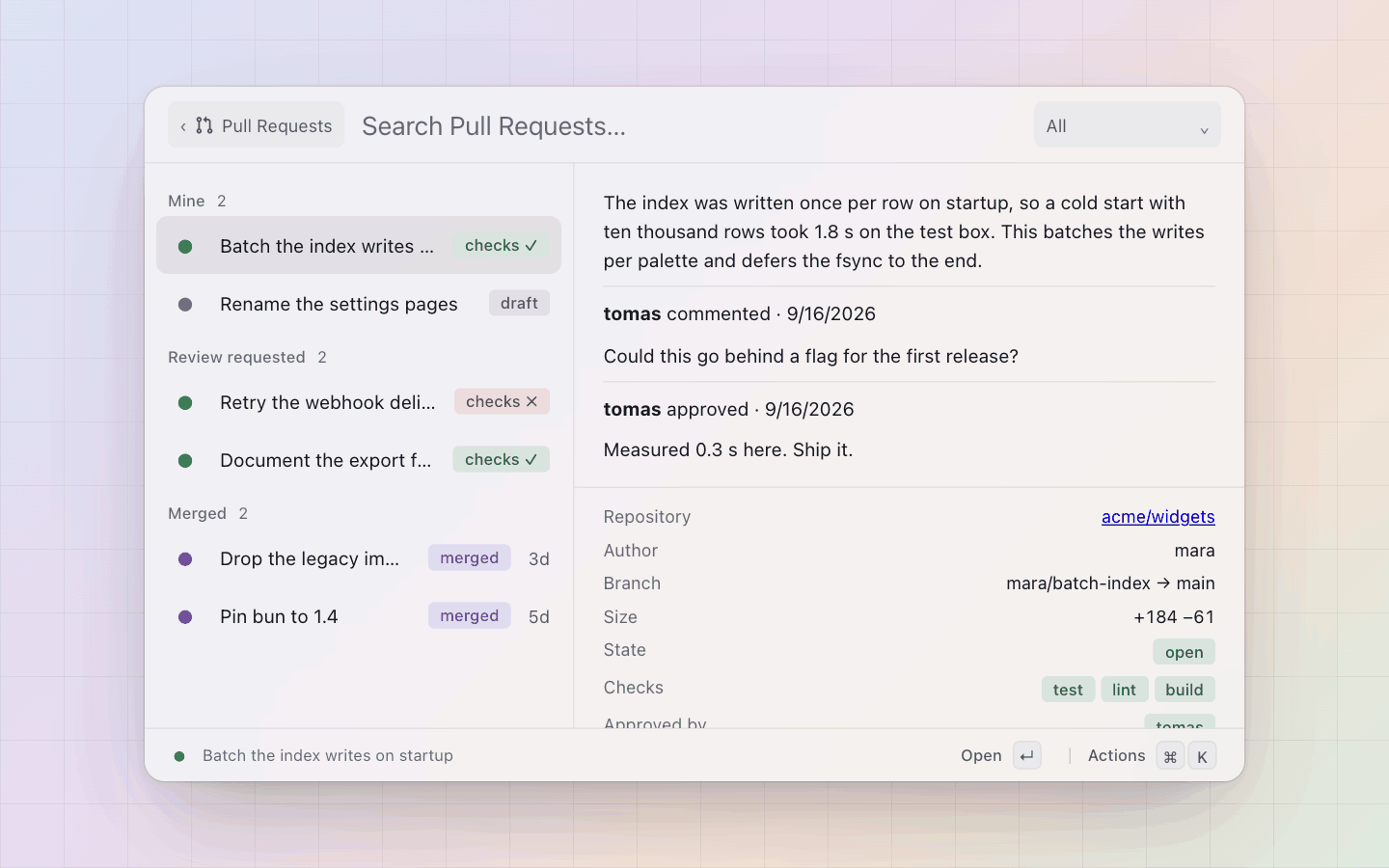
conflicts, then the updated date. The palette opens with the detail pane:
the body, the latest comments and reviews, and under them the repository,
author, branch, size, every check by name, who approved, who asked for
changes, reviewers, labels and dates (fetched when the cursor rests).
Issues is what is assigned to you, mentions you, or you opened, in that order, an issue in two lists listed once. Rows carry the first two labels, the comment count and the updated date; the pane the body, the latest comments and the milestone. Create Issue at the top is a form (repository, title, body) whose submit opens the new issue.
Repositories is yours (owner or collaborator, by push date), your
default_org's recently pushed, and your starred ones, sectioned so. Rows
show the description, tags for private, archived and the language, the
stars and the push date; the pane adds forks, open issues, the default
branch, the clone url and the local clone when one sits under
repos_root. Create Repository is a form (owner, name, description,
private).
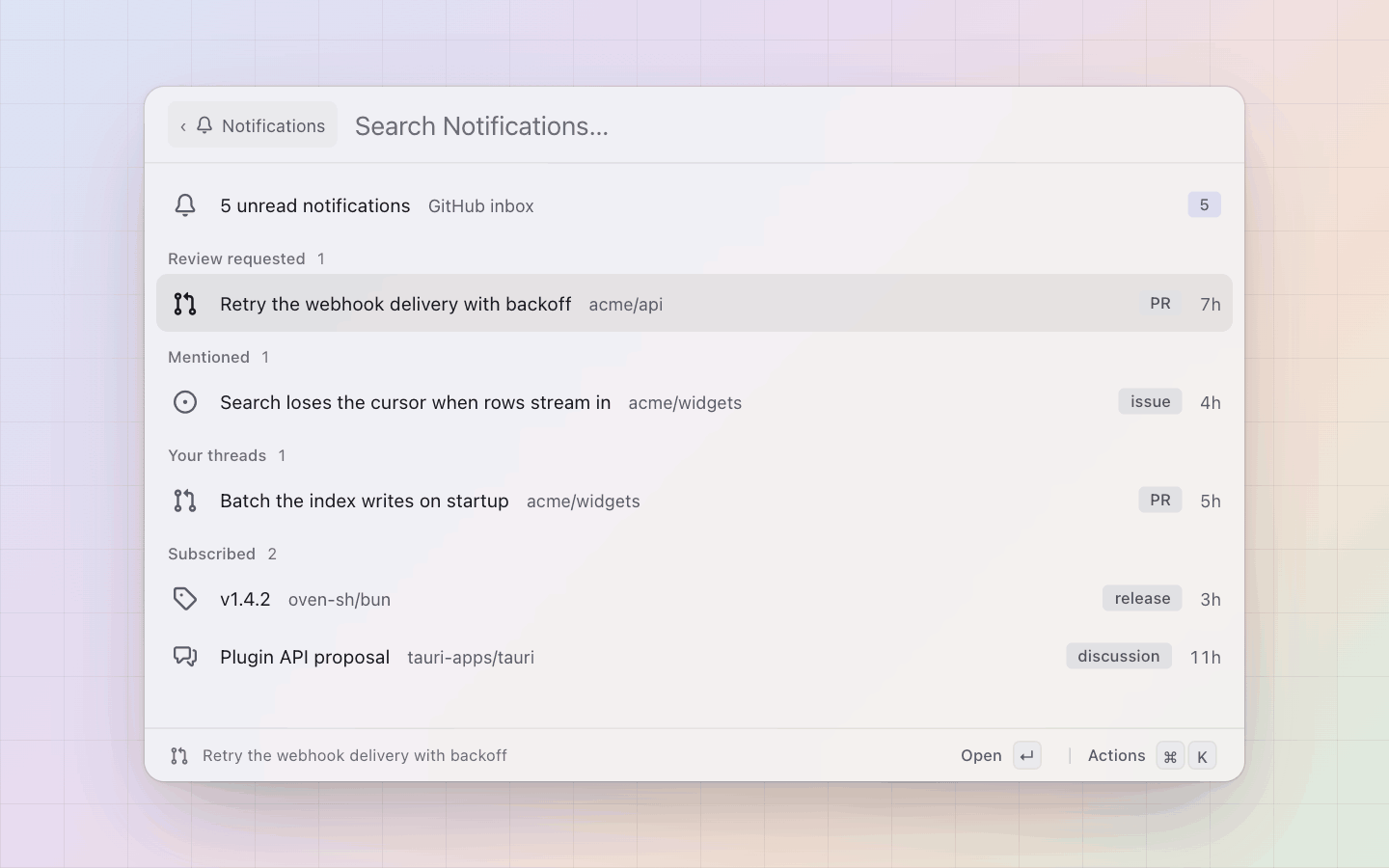
Notifications is every unread thread, sectioned by reason (Review requested, Mentioned, Assigned, Your threads, Comments, State changed, CI, Security, Subscribed), newest first inside one; the first row is the unread count. Enter marks the thread read and opens it, so the count is honest when you come back.
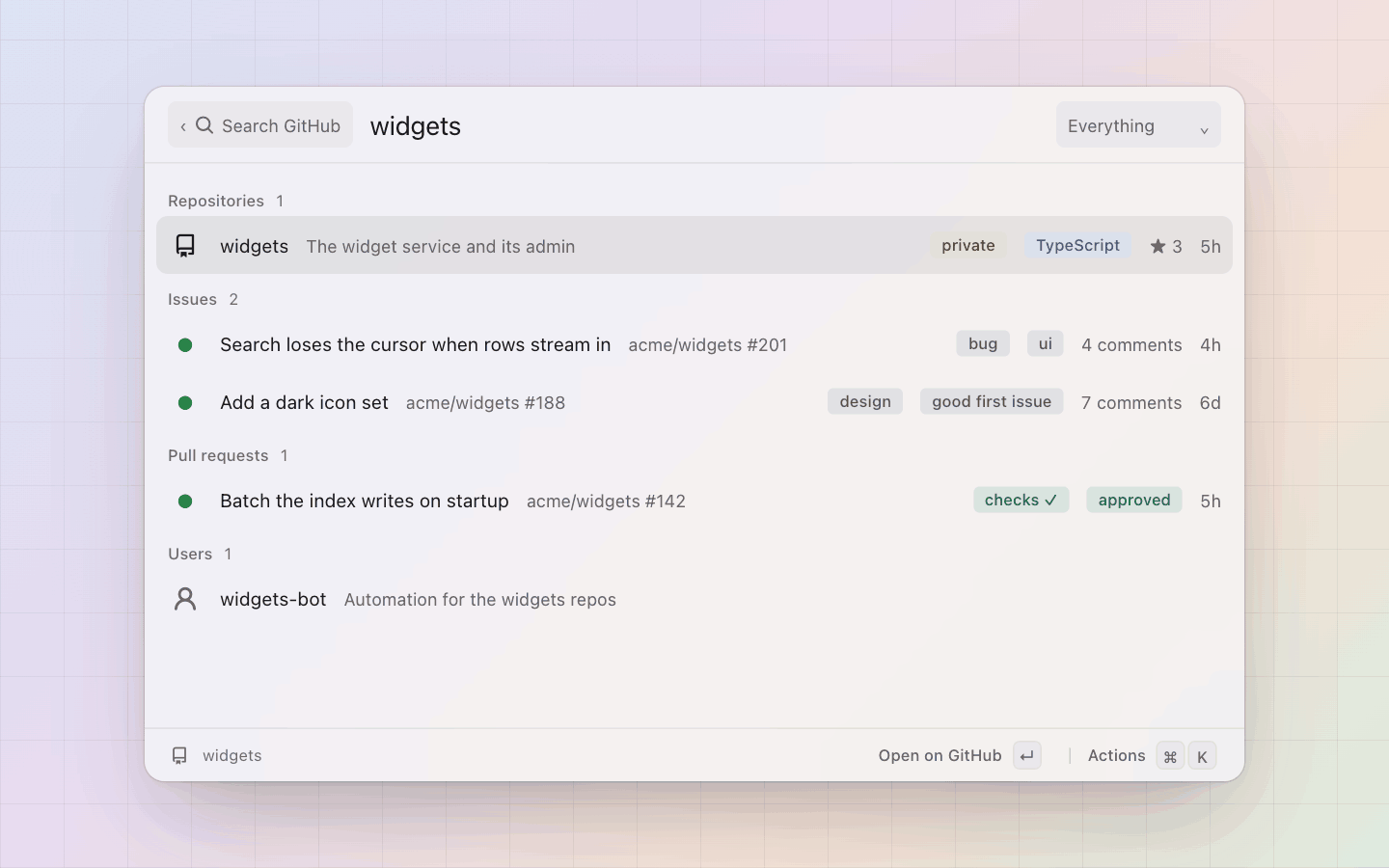
Search GitHub takes GitHub's syntax as you type: free text,
repo:owner/name, is:pr, author:login, label:bug. Filters
Everything, Issues and PRs, Repositories, Users; results come sectioned by
kind with the same rows and actions as the palettes above, users with
their avatar. A keystroke waits 300 ms for the next before asking.
Keyboard
| keys | action | where |
|---|---|---|
enter |
Open (Open on GitHub, Open profile) | everywhere; a notification is marked read first |
cmd+c |
Copy URL (Copy login on a user) | everywhere |
cmd+shift+o |
Checkout branch: gh pr checkout in the clone |
an open pull request with a clone under repos_root and gh on PATH |
cmd+shift+b |
Copy branch name | pull requests |
cmd+shift+k |
Open checks | pull requests |
cmd+shift+f |
Open files changed | pull requests |
cmd+shift+r |
Mark ready for review | a draft pull request |
cmd+shift+m |
Merge, with merge_method; asks first |
an open, mergeable pull request |
cmd+shift+x |
Close issue; asks first | an open issue |
cmd+e |
Open in editor (code, else the folder) |
a repository with a local clone |
cmd+o |
Open folder | a repository with a local clone |
cmd+shift+c |
Copy clone URL (clone_protocol) |
repositories |
cmd+shift+r |
Mark as read, without opening | notifications |
cmd+shift+a |
Mark all as read; asks first | notifications |
cmd+k |
Copy reference (owner/repo#n), Copy owner/name, Open issues, Open pull requests, Open repositories |
the rest, without a shortcut |
cmd+i |
The detail pane (open by default in Pull Requests and Issues) |
Setup
Sign in one of two ways: install the gh CLI and
run gh auth login (the extension asks gh auth token at most every five
minutes), or set the token setting to a personal access token with
repo, notifications and read:org (the config file holds a
keychain: reference, never the value). With neither, each palette is one
hint row saying how to sign in; Enter on it opens the token settings. A
token GitHub rejects is the same row with GitHub's message.
Every request has a 10 s timeout. Pull Requests, Issues and Search are one GraphQL request each; Repositories and Notifications are REST with ETags, so a re-list that changed nothing costs no rate limit. The rows are kept in the extension's storage, so a restart still has them and an outage shows the last ones; while the rate limit is exhausted a hint row at the top says when it resets.
Settings, [extensions.github]:
| key | type | default | what |
|---|---|---|---|
token |
secret | (none) | A personal access token; empty means the gh CLI's login. |
default_org |
text | (none) | The organisation whose recently pushed repositories are listed, and an owner the Create Repository form offers. |
repos_root |
path | (none) | Where your clones live (<root>/<name> or <root>/<owner>/<name>); enables Checkout branch and Open in editor. ~ is expanded. |
clone_protocol |
ssh / https |
ssh |
What Copy clone URL copies. |
merged_days |
number (days) | 7 |
How far back the Merged list reaches. |
merge_method |
merge / squash / rebase |
merge |
How the Merge action merges. |
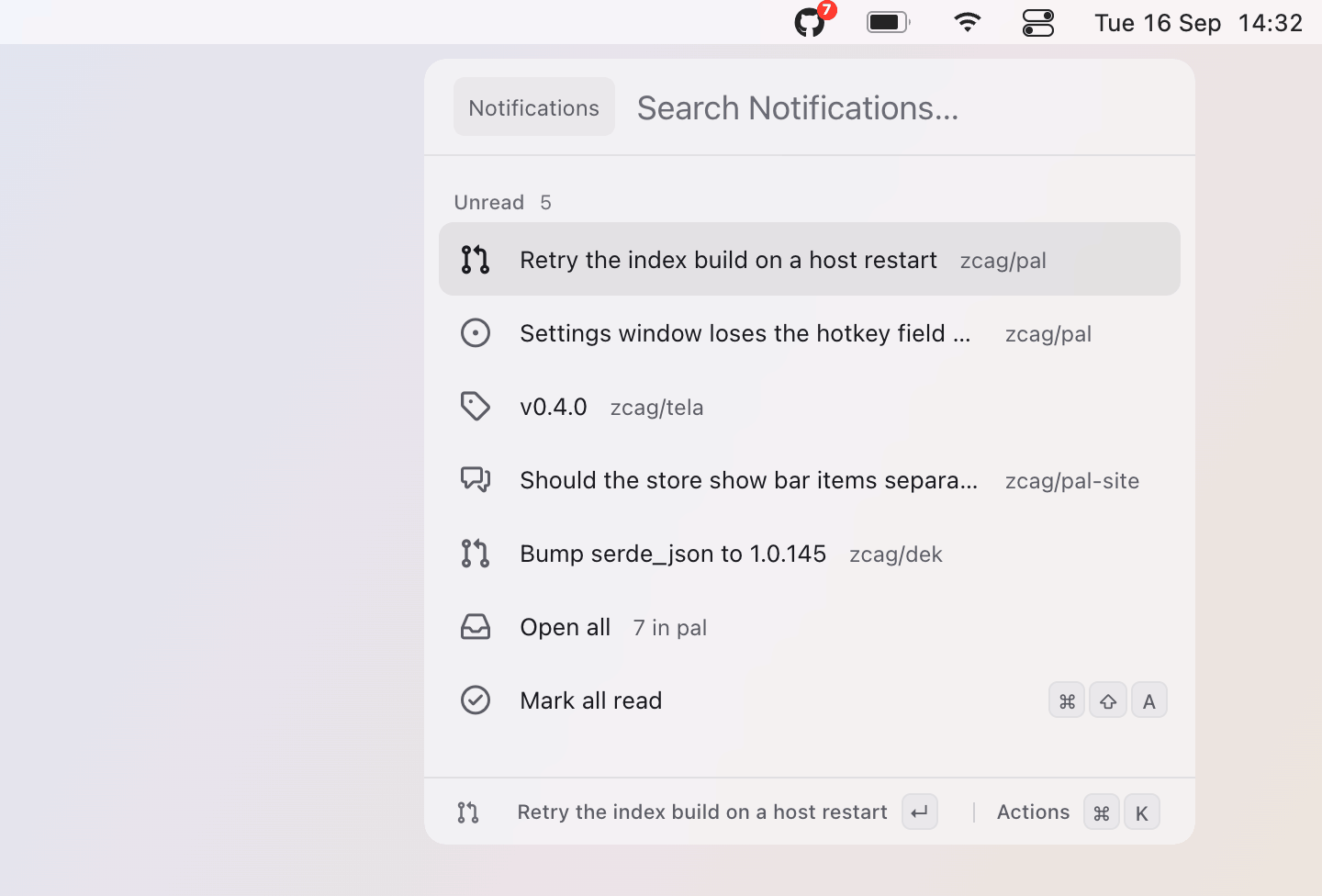
The bar item Notifications shows the unread count as a badge (hidden at zero) with the newest five and Mark all read in its popover, refreshed every five minutes and on show, wake and a network change.
What it does not do
- Review from the panel: approving, commenting and requesting changes happen on GitHub; the pane only shows them.
- Repositories beyond yours, your organisation's recent ones and your stars: anything else is found through Search.
- Notifications older than what GitHub returns as unread; read ones are not listed.
- Checkout without a clone: Checkout branch needs the repository already
cloned under
repos_rootandghon PATH.
Platforms
macOS and Linux, the same on both. Open in editor uses code when it is
on PATH, else the system opener on the folder.
Palettes 5
-
Pull Requests
prslistrefreshes every 5 minYours, the ones waiting on your review, and what merged lately.
- ↵Open the pull request
- ⌘CCopy its URL
- ⌘⇧OCheckout the branch
- ⌘⇧MMerge
-
Issues
issueslistrefreshes every 5 minAssigned to you, mentioning you, opened by you; Create Issue.
- ↵Open the issue
- ⌘CCopy its URL
- ⌘⇧XClose it
-
Repositories
reposlistrefreshes every 5 minYours, starred, and your organisation's recently pushed.
- ↵Open on GitHub
- ⌘EOpen the clone in the editor
- ⌘⇧CCopy the clone URL
-
Notifications
notificationsliverefreshes every 1 minUnread, by reason; opening one marks it read.
- ↵Mark read and open
- ⌘⇧RMark as read
- ⌘⇧AMark all as read
-
Search GitHub
searchinputGitHub's search syntax over issues, pull requests, repositories and users.
- ↵Open what was found
- ⌘CCopy its URL
- ⇥Everything, Issues and PRs, Repositories, Users
Actions
- OpenThe pull request, issue, repository, notification or profile on GitHub; a notification is marked read first.↵
- Copy URL⌘C
- Checkout branchgh pr checkout in the clone under repos_root.⌘⇧O
- Copy branch name⌘⇧B
- Open checks⌘⇧K
- Open files changed⌘⇧F
- Copy referenceowner/repo#n.
- Mark ready for reviewOn a draft.⌘⇧R
- MergeWith merge_method; asks first.⌘⇧M
- Close issueAsks first.⌘⇧X
- Create IssueA form: repository, title, body.
- Open in editorThe local clone, in code or the system opener.⌘E
- Open folder⌘O
- Copy clone URLssh or https, per clone_protocol.⌘⇧C
- Copy owner/name
- Open issues
- Open pull requests
- Create RepositoryA form: owner, name, description, private.
- Mark as readWithout opening.⌘⇧R
- Mark all as readAsks first.⌘⇧A
- Open profileA user found by Search.↵
- Copy login⌘C
- Open repositories
Settings
Extension, [extensions.github]
tokenA personal access token (repo, notifications, read:org). Leave empty to use the gh CLI's login.
default_orgAn organisation whose recently pushed repositories are listed, and an owner the Create Repository form offers.
repos_rootWhere your clones live (<root>/<name> or <root>/<owner>/<name>): enables Checkout on a pull request and Open in editor on a repository.
clone_protocolWhat Copy clone URL copies. One of ssh, https.
merged_daysHow far back the Merged list of Pull Requests reaches.
merge_methodHow the Merge action merges. One of merge, squash, rebase.
Defaults shown. Change them in pal's settings window or in the config file.