Quicklinks
Your own links, with a {query} placeholder for search URLs, kept and edited in the panel.
 palv0.1.0Productivitybundled
Ships inside pal. Installing puts an editable copy ahead of the bundled one.
What it does
Quicklinks
Your own links, kept in the extension's storage and edited in the panel.
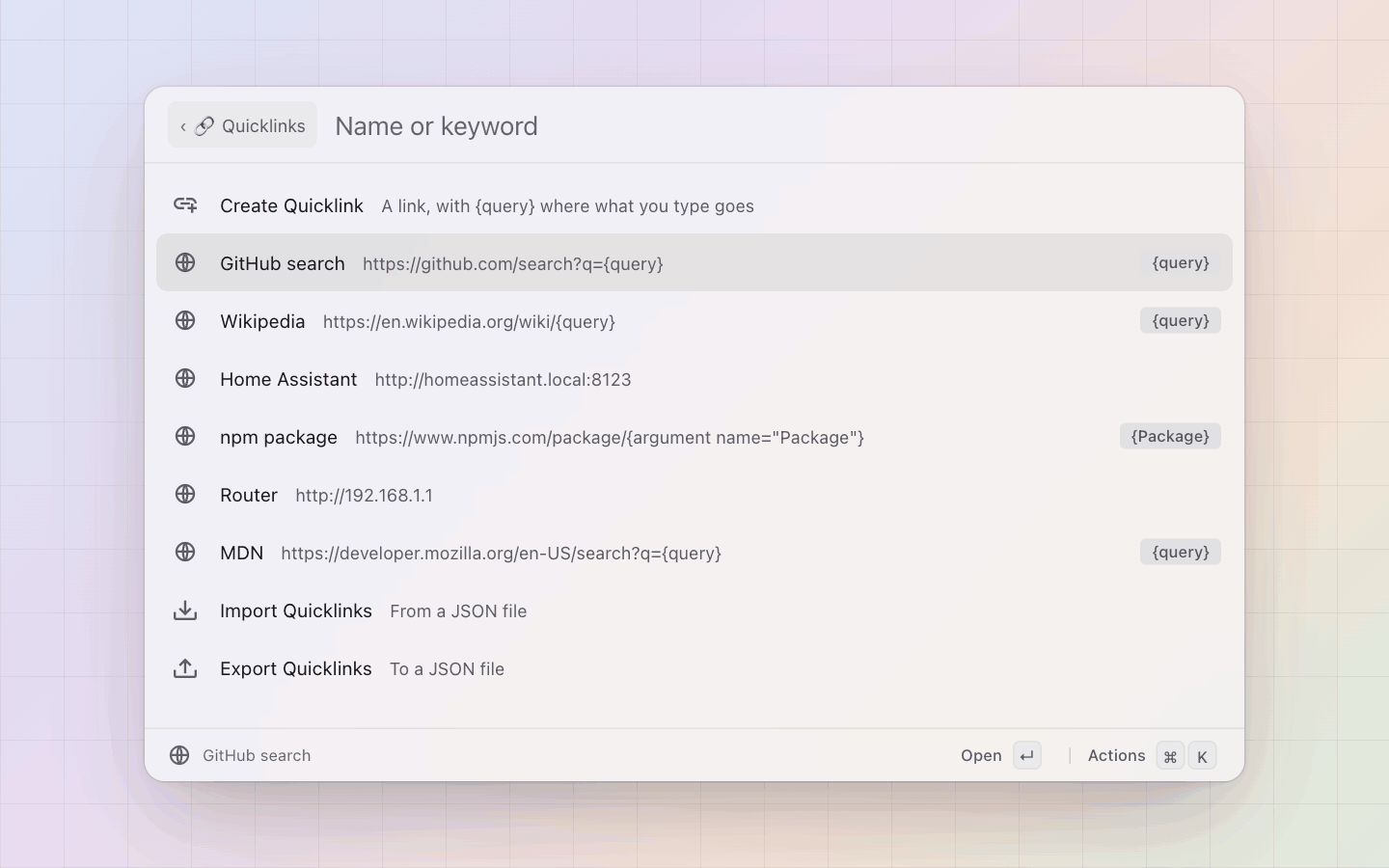
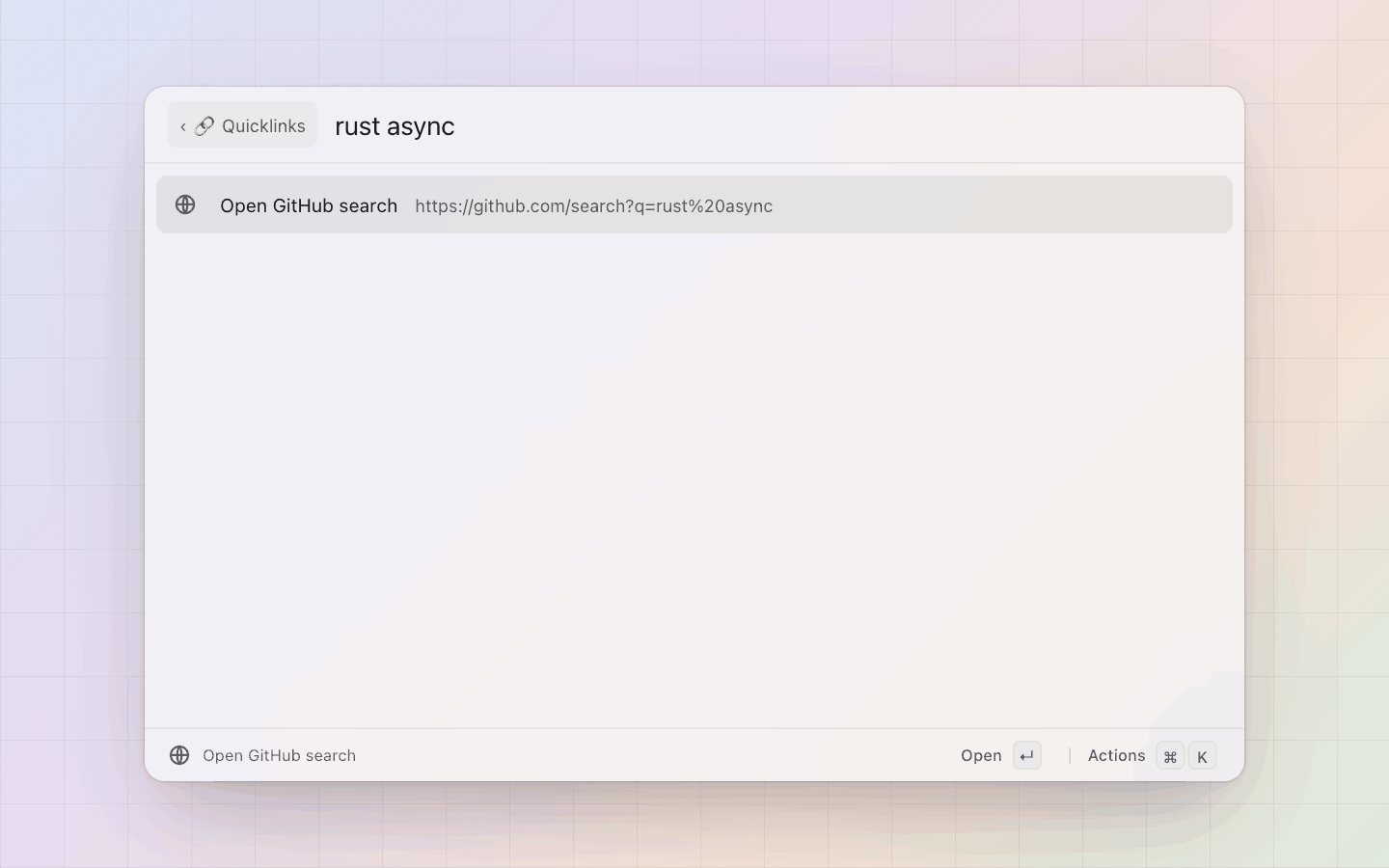
Enter on a link opens it. A link whose url has a {query} placeholder
(https://github.com/search?q={query}; Raycast's {argument} and
{argument name="Repo"} are read the same way) drills in instead: the
input fills the placeholder as you type, percent-encoded, and Enter opens
the filled url (cmd+c copies it). The row shows the placeholder as a tag
and the url as its subtitle; the icon is the site's favicon; keywords are
extra words the search matches.
The palette is indexed, so a quicklink's name and keywords find it from the root, and the rows after the list are its tools:
| row | what |
|---|---|
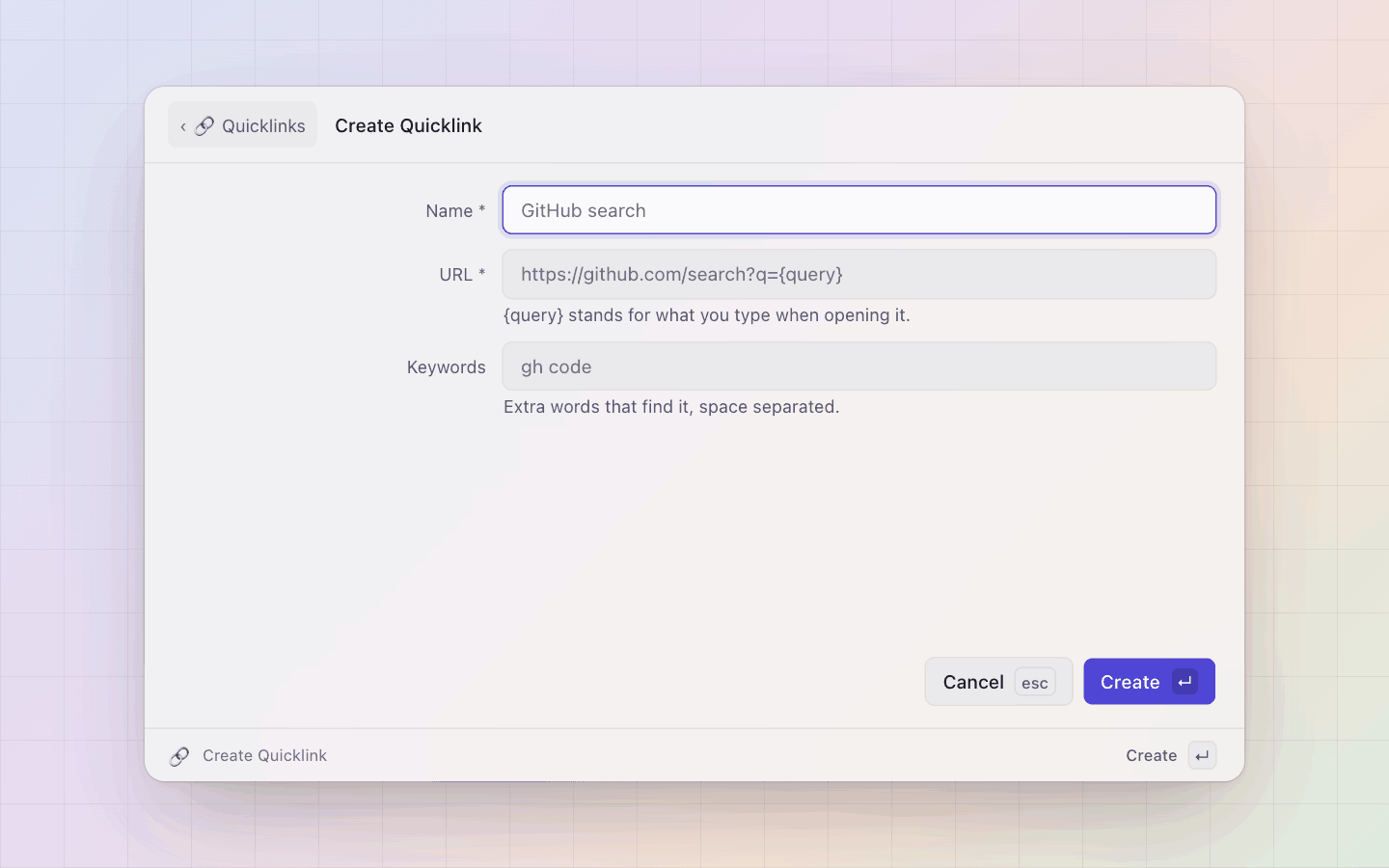
| Create Quicklink | a form: name, url, keywords (space or comma separated) |
| Import Quicklinks | a form with one path field; reads a JSON array of {name, url, keywords?} (Raycast's {name, link} export too), skips the urls you already have, says how many came in |
| Export Quicklinks | writes your own links as a JSON array (no ids) to the path, ~/Downloads/pal-quicklinks.json by default, replacing the file |
A url the opener could not take (no scheme, not a path) is refused with
the message under the field; a path that cannot be read or written, the
same. The detail pane (cmd+i) shows the url in a code block, what the
link asks for, its keywords and where it came from.
Keyboard
| keys | action |
|---|---|
enter |
Open the url, or drill in to fill its {query} first |
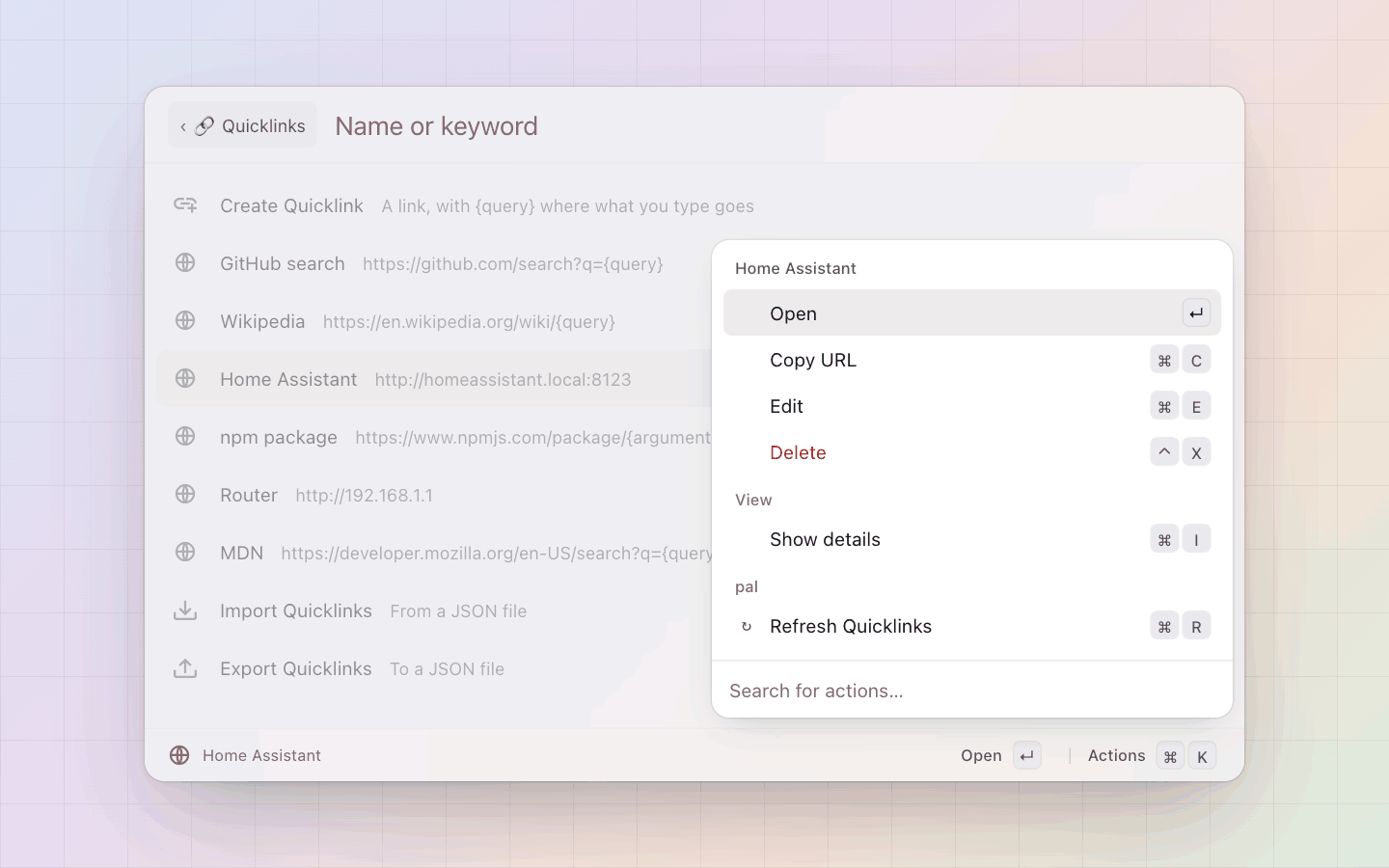
cmd+c |
Copy URL, as stored (placeholder included); inside the drill-in, the filled url |
cmd+e |
Edit: the form, filled in |
ctrl+x |
Delete, after a confirm |
cmd+i |
The detail pane |
An imported link (from the import file) has Open and Copy URL only.
Setup
Nothing to install and no permission: the links live in
<data dir>/pal/storage/quicklinks.json (Storage in the Extensions guide),
shared by every config profile.
Settings, [extensions.quicklinks]:
| key | type | default | what |
|---|---|---|---|
import |
path | (none) | A JSON array of {name, url, keywords?} listed alongside your own links, read-only, read on every listing. ~ is expanded. A file that cannot be read lists nothing and says so in the log. |
A quicklink file for import looks like this:
[
  { "name": "GitHub search", "url": "https://github.com/search?q={query}", "keywords": ["gh", "code"] },
  { "name": "Wikipedia", "url": "https://en.wikipedia.org/wiki/{query}" }
]
What it does not do
- No
{query}at the root: a search link needs its drill-in, sogh rustat the root does not open a GitHub search. Open the link's row first, then type. - No browser choice: the url goes to the system opener. The Bookmarks palette has "Open in Chrome/Safari" for a browser's own bookmarks.
- Two different placeholders in one url: every one is filled with the same text, since the drill-in has one input.
- Import does not merge edits: a link whose url you already have is skipped, whatever its name or keywords in the file.
Platforms
macOS and Linux, the same on both.
Palettes 1
-
Quicklinks
quicklinkslistEvery quicklink by name and keyword, plus Create Quicklink.
- ↵Open, or fill in the {query}
- ⌘CCopy the url
- ⌘EEdit
- ⌃XDelete
Actions
- OpenOpens the url, or drills in to fill its {query} first.↵
- Copy URLThe url as stored, placeholder included.⌘C
- EditThe form, filled in.⌘E
- DeleteAsks first.⌃X
- Create QuicklinkThe form, on the Create row.↵
- Import…A JSON file's links, the ones you already have skipped.↵
- Export…Your links to a JSON file.↵
Settings
Extension, [extensions.quicklinks]
importA JSON array of {name, url, keywords?} listed alongside your own links, read-only; empty for none.
Defaults shown. Change them in pal's settings window or in the config file.