Files
Files by name through the OS's own index, the recently used ones before you type.
 palv0.1.0Productivitybundled
Ships inside pal. Installing puts an editable copy ahead of the bundled one.
What it does
Files
Two palettes over the operating system's own file index, never a walk pal indexes itself.
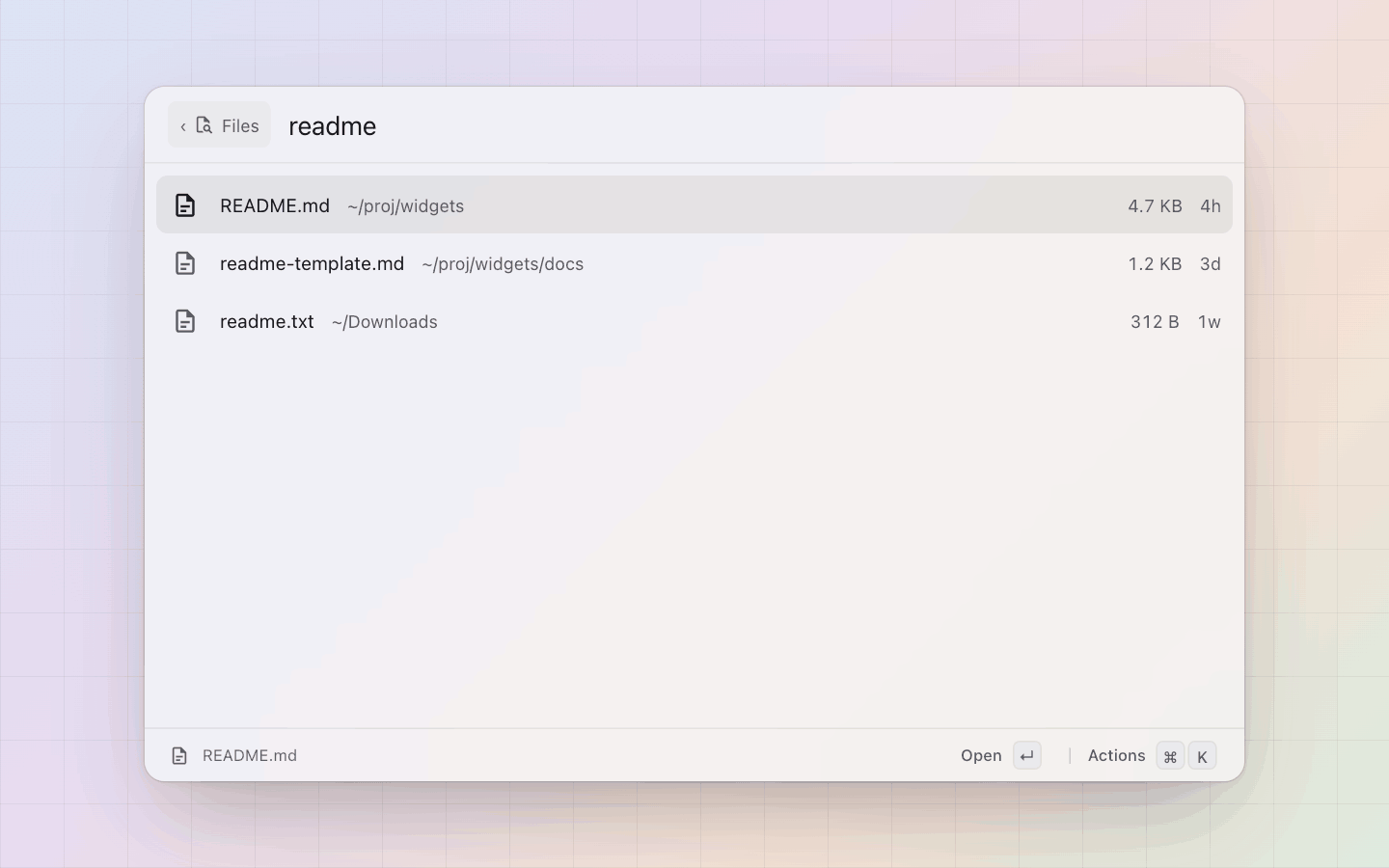
Files is an input palette: what you type is a name search on every
keystroke. The row is the file name; the parent folder is the subtitle
(home shortened to ~); the size and the modification date are
accessories. .app bundles get their own icon, everything else a glyph by
kind (folder, image, document, code, archive). Exact and prefix name
matches come first, the rest in the backend's order, at most limit rows.
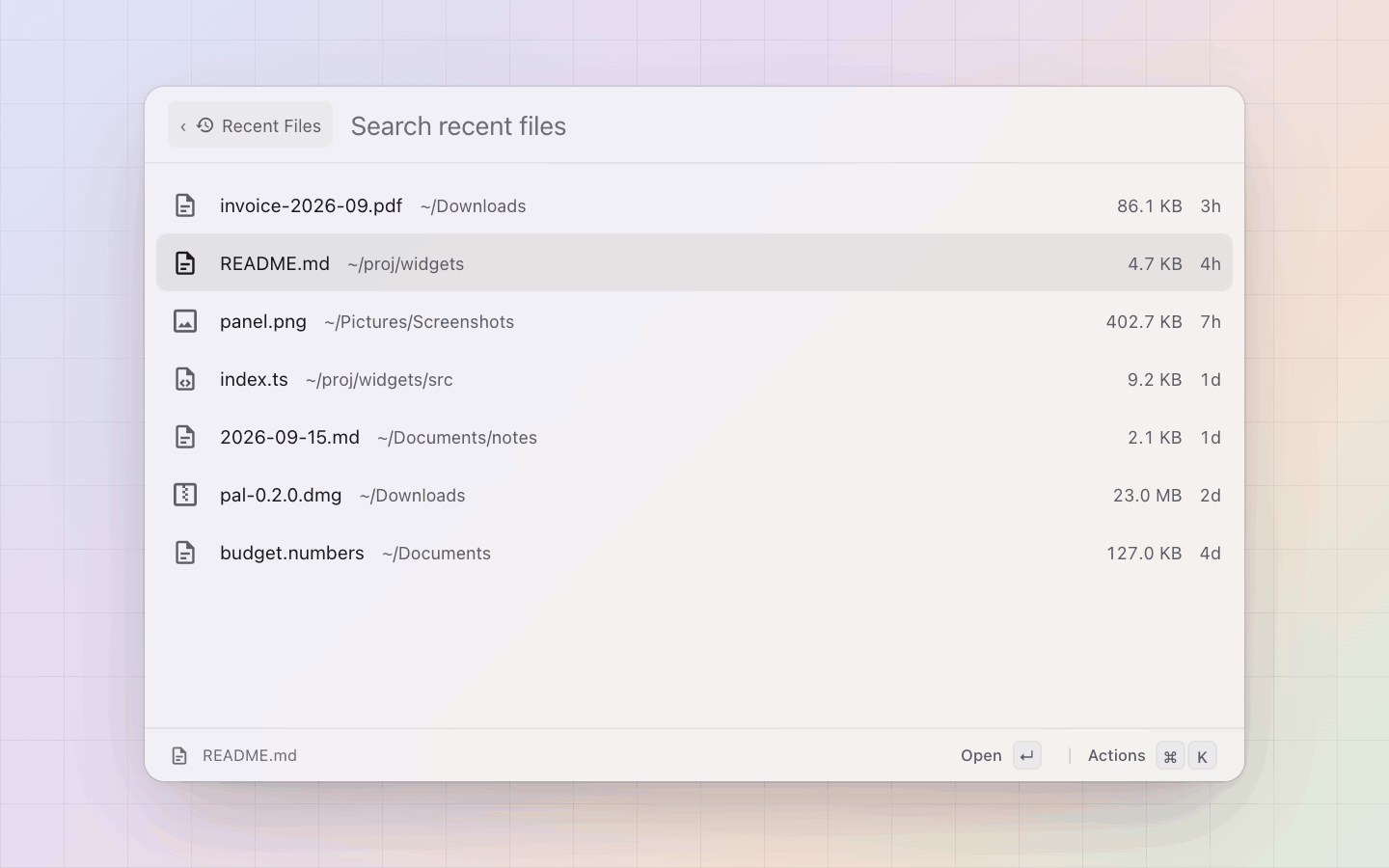
Before you type, the palette lists the recently used files (a
Recently used section) instead of hints.
Recent Files lists those same rows as a palette of its own: the files
used in the last seven days within the configured folders, newest first
(on macOS Spotlight's kMDItemLastUsedDate, on Linux GTK's
~/.local/share/recently-used.xbel), listed again on a show once the
listing is a minute old, with the same actions and detail pane. Folders,
hidden and excluded paths and files that are gone are left out.
Backends
Picked once when the extension loads and logged ([files] backend: fd):
| platform | backend | how |
|---|---|---|
| macOS | Spotlight | mdfind -name <query> -onlyin <folder>...; case-insensitive substring of the display name, so kitty finds kitty.app |
| Linux | fd |
fd --absolute-path --fixed-strings --max-results <limit> --max-depth 8 --exclude <x>... <query> <folders>; respects .gitignore like fd does everywhere |
| Linux, no fd | locate |
locate -i <query>, filtered to the folders (updatedb decides how fresh it is) |
| Linux, neither | find |
find <folders> -iname '*<query>*'; walks the folders on every keystroke, and a second hint row says so |
Every search is one process: killed after 3 s, killed as soon as limit
paths have been read, and killed when the next keystroke starts a new one.
The exclude folders are pruned from the walk (fd, find) or dropped from
the answer (Spotlight, locate).
Keyboard
| keys | action |
|---|---|
enter |
Open with the system opener |
cmd+enter |
Reveal in Finder (open -R), Show in file manager on Linux (xdg-open on the parent folder) |
cmd+y |
Quick Look (qlmanage -p), macOS only |
cmd+o |
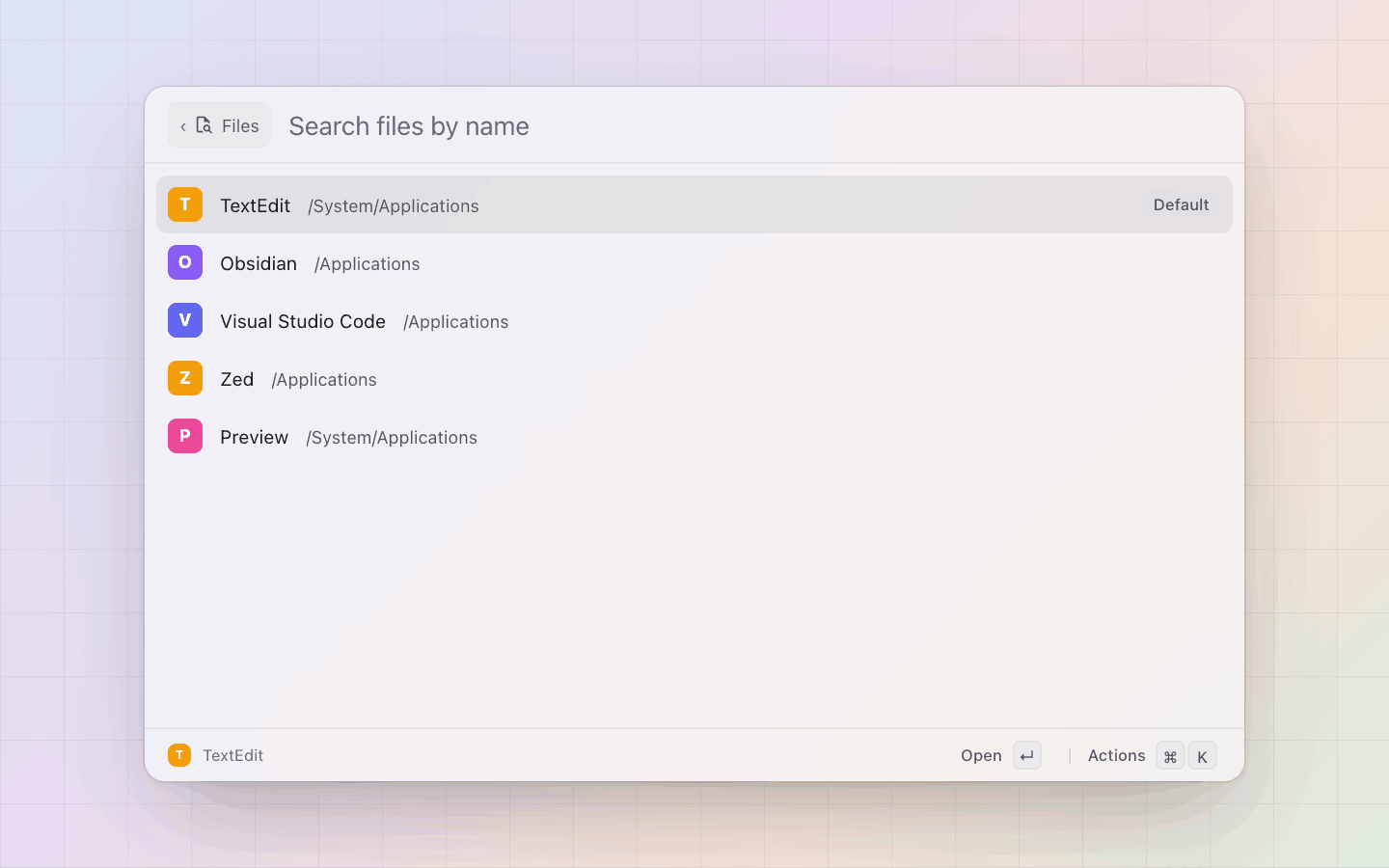
Open with…: a level listing the apps registered for the file, the default first with a Default tag; typing narrows them, Enter opens the file with that app |
cmd+c |
Copy path |
cmd+shift+c |
Copy file: the file itself onto the clipboard; a paste in Finder or a file manager copies it, a paste in a text field gets its path |
cmd+d |
Move to Trash: asks first; Finder's delete on macOS, gio trash on Linux; the palette stays open with a toast |
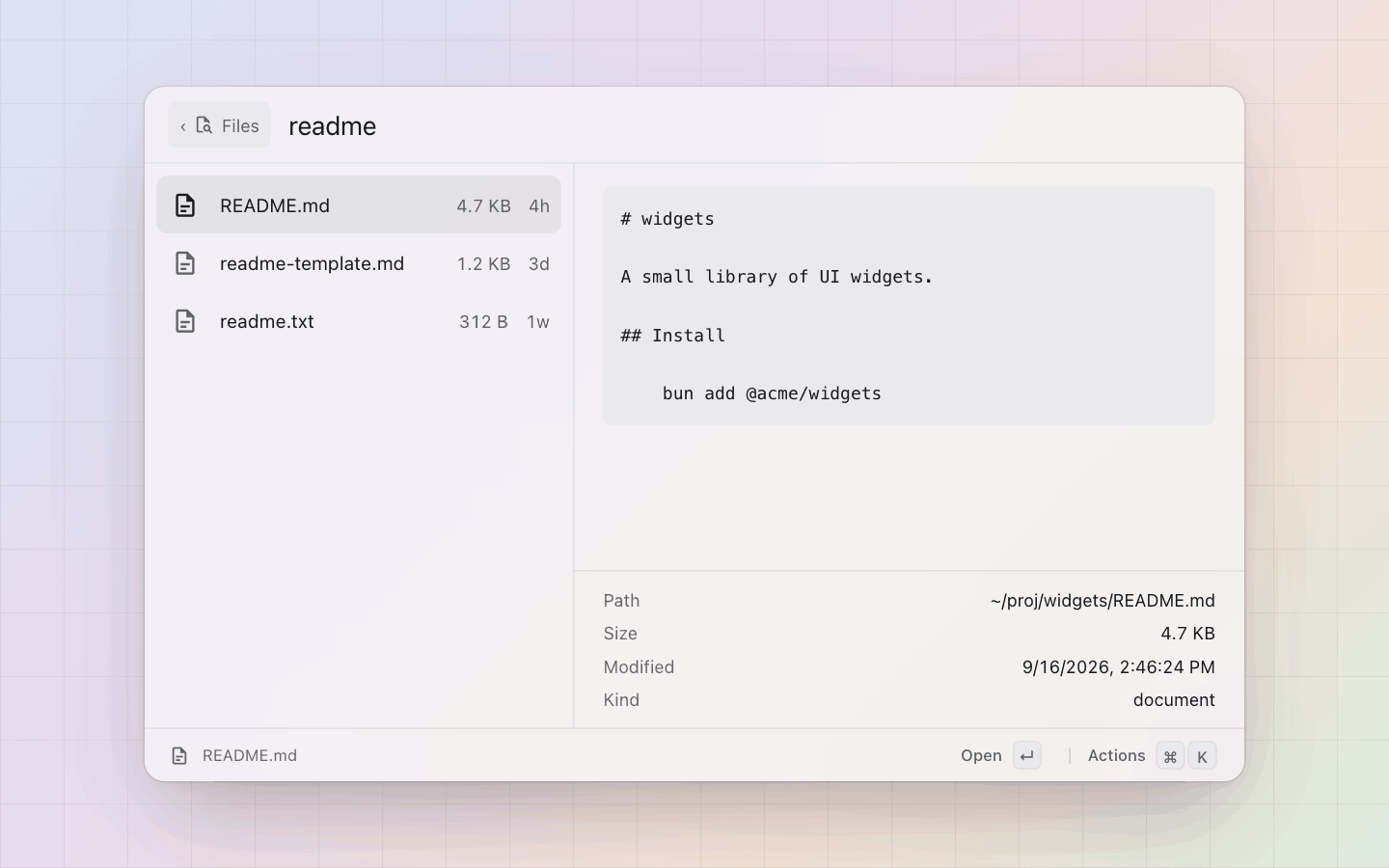
cmd+i |
The detail pane: path, size, modified time and kind; for a text file under 64 KB the first 40 lines in a code block |
Open with… lists Launch Services' apps on macOS (NSWorkspace, every
role); on Linux the file's MIME type is looked up in the mimeapps.list
files and every data dir's mimeinfo.cache, the default from
xdg-mime query default.
Setup
macOS needs nothing: Spotlight is always there. On Linux install fd
(else locate; with neither, find works but is slow). Move to Trash on
macOS goes through Finder, so the first one shows the Automation prompt.
Settings, [extensions.files]:
| key | type | default | what |
|---|---|---|---|
folders |
list of paths | ["~"] |
Where to search. ~ is expanded. |
limit |
number, 1 to 500 | 50 |
At most this many rows per query. |
show_hidden |
bool | false |
List files and folders whose name starts with a dot (below the configured folder; ~/.config as a folder is fine either way). |
exclude |
list of names | ["node_modules", ".cache", "Library/Caches", "target"] |
Folders skipped below the search folders, by name or a short path. |
What it does not do
- Search file contents: it is a name search. Spotlight's content index is not asked.
- Preview images: the app's
icon://scheme serves app icons, favicons and clipboard images only, so the pane shows text files and metadata. - Rename, move or copy files: Reveal and open the file manager.
- Index anything itself: no fd, locate or Spotlight means no results (one hint row says which tool is missing), and fd stops eight levels down.
Platforms
macOS (Spotlight, Quick Look, Finder) and Linux (fd, locate or find; GTK's
recently-used list; gio trash and xdg-open).
Palettes 2
-
Files
filesinputType part of a file name; rows are the matches under the configured folders. Before you type: the recently used files.
- ↵Open the file
- ⌘↵Reveal in Finder
- ⌘OOpen with another app
- ⌘IThe path, size and first lines
-
Recent
recentliveFiles used in the last seven days under the configured folders, newest first.
- ↵Open the file
- ⌘↵Reveal in Finder
Actions
- OpenThe system opener.↵
- Reveal in FinderShow in file manager on Linux.⌘↵
- Quick LookmacOS only.⌘Y
- Open with…A level of the apps registered for the file.⌘O
- Copy path⌘C
- Copy fileThe file itself onto the clipboard: a paste in Finder copies it.⌘⇧C
- Move to TrashAsks first.⌘D
Settings
Extension, [extensions.files]
foldersWhere to search. `~` is expanded.
limitAt most this many rows per query.
show_hiddenexcludeFolders skipped below the search folders, by name (`node_modules`) or a short path (`Library/Caches`).
Defaults shown. Change them in pal's settings window or in the config file.